Google confirmed a broad core algorithm update in early March 2026. It rolled out over roughly two weeks, and the SEO community is still assessing the damage. Semrush Sensor spiked to 9.5 out of 10. Webmasters across industries reported organic traffic drops of 20 to 35 percent within days.
If your site lost rankings or traffic after this update, you are not alone. Over 55 percent of monitored websites saw ranking shifts within the first two weeks of rollout.
This guide breaks down exactly what changed, which industries got hit hardest, and the specific steps you need to take right now to recover. I have personally audited and recovered 300+ websites after algorithm updates, and this is what I am seeing with this one.
What changes in the March 2026 Core Update?
Google announced the March 2026 core update through the Google Search Central blog. The rollout started in early March and was completed in approximately two weeks. You can verify the exact dates on the Google Search Status Dashboard.
This was Google’s fourth core update since March 2025. It came immediately after the February 2026 Discover core update, which was the first time Google ever released a Discover-only algorithm change. That Discover update took 21 days to roll out and finished on February 27.
Back-to-back algorithm changes within a single month are unusual. The overlap created extreme volatility across both organic search and Discover traffic channels.
Here is what the March 2026 core update targeted
Information Gain scoring: Google increased the weighting on how much genuinely new information your content adds compared to what already ranks. Pages that simply reword existing top results without contributing fresh data, original perspectives, or unique analysis are losing ground fast.
AI content detection at scale: This is widely believed to be the first core update using Google’s Gemini 4.0 Semantic Filter. It does not penalize AI-assisted content outright. It targets pages where AI was used to produce content at scale without meaningful editorial oversight or added expertise.
Stricter E-E-A-T evaluation: Experience, Expertise, Authoritativeness, and Trustworthiness signals got tightened again. Industry data shows 72 percent of top-ranking pages now display detailed author credentials, up from around 58 percent before this update. This is especially critical for YMYL topics like health, finance, and legal content.
Core Web Vitals site-wide assessment: Technical performance is now evaluated more holistically across your entire site rather than page by page. Sites with inconsistent performance (fast homepage but slow blog posts) are being penalized. Notably, 43 percent of websites still fail the 200ms INP threshold.
Topical authority: Google is not just evaluating individual pages anymore. Your entire site needs to demonstrate deep expertise in a specific area. Sites that publish across too many unrelated topics are losing visibility to focused, niche-authority competitors.
Industries Most Affected by the March 2026 Update
Early data from Semrush Sensor and community reports reveal clear patterns in which types of sites were hit hardest.
Losers:
- SaaS blogs with broad, unfocused content- One major example: HubSpot reportedly lost 70 to 80 percent of organic traffic after years of building top-of-funnel content with weak connection to its core product.
- AI content farms- Sites that scaled production using AI tools without human expertise or editorial review saw double-digit percentage drops in organic visibility within the first week.
- Thin affiliate pages- Pages that exist primarily to funnel clicks rather than genuinely help users were systematically devalued.
- Coupon and deals sites- Thin pages consisting only of dynamically generated discount codes got de-indexed.
- Clickbait publishers- Sensational headlines paired with shallow content depth saw sharp ranking declines.
Winners:
- Original research publishers- Sites with proprietary data, case studies, and first-hand experience gained an average 22 percent visibility boost across tracked samples.
- Niche authority sites- Industry-specific publications and focused blogs with genuine expertise performed particularly well.
- Primary source domains- The top 3 search results shifted noticeably toward authoritative brand domains over informational aggregators.
If your site falls into any of the affected categories, check out our detailed case studies showing real recovery results from previous core updates.
5-Step Recovery Checklist for the March 2026 Core Update
Based on my experience recovering websites from every major Google algorithm update since 2019, here is the exact process I follow with my algorithm recovery clients. This is the same 4-phase methodology I use across all recovery projects, adapted specifically for this update.
Confirm the Update Impact in Your Data
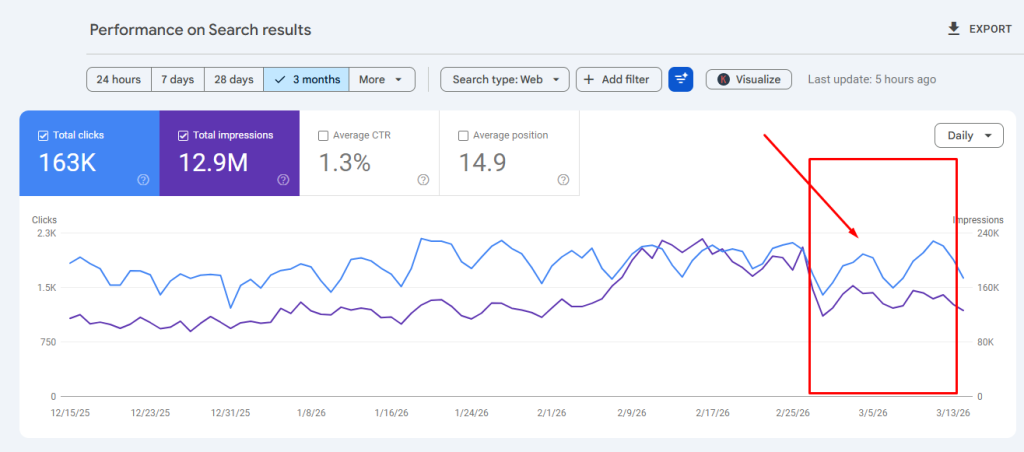
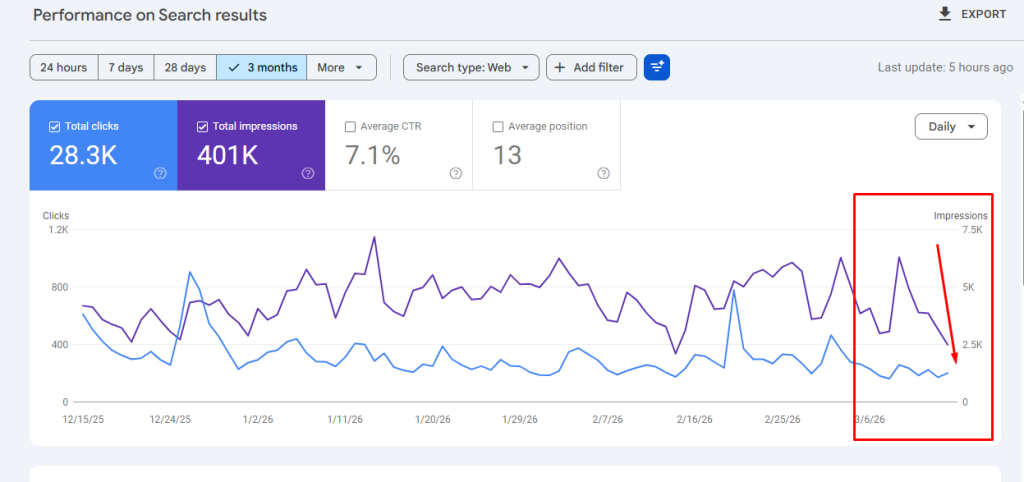
Do not guess. Open Google Search Console and filter your performance data from March 1 to today. Compare it against February 1 to 28. Look for pages that dropped more than 30 percent in clicks. Those are your investigation priorities.
Check Discover traffic separately. Navigate to Performance and select the Discover tab. Since the February Discover update and the March core update overlapped, your Discover traffic may tell a completely different story from your organic search numbers. Treat them as separate channels.
Google’s own guidance recommends waiting at least a full week after the rollout completes before drawing conclusions. Do not panic-edit during the rollout period.
Audit Your Content for Quality and Information Gain
For every page that lost visibility, ask one question: Does this page add something genuinely new that cannot be found in the top 10 results for the same query?
Use a simple content framework for each affected page. Keep pages that are still performing. Update pages that are outdated or thin with fresh data and deeper coverage. Consolidate competing pages that target the same keyword by merging them with 301 redirects. Delete pages with zero traffic, zero backlinks, and no relevance.
Do not change publication dates without making a real content update. Google catches cosmetic date changes, and it can hurt you further.
Strengthen Your E-E-A-T Signals
This is the single biggest lever you can pull right now. Add detailed author bios with credentials, education, and relevant experience to every piece of content. Link those bios to dedicated author pages on your site.
Add expert commentary to high-traffic articles. Real quotes from people with verifiable credentials carry significant weight. If you run a business site, make sure your About page clearly shows who is behind the content and why they are qualified.
For YMYL topics (health, finance, legal), this is not optional. It is a ranking requirement. Read our FAQs on E-E-A-T optimization for specific implementation guidance.
Fix Technical Performance Across Your Entire Site
This update evaluates Core Web Vitals more holistically. A fast homepage does not save you if your blog loads slowly.
Check these benchmarks in Google Search Console under the Core Web Vitals report:
- LCP (Largest Contentful Paint): under 2.5 seconds. Images, fonts, and server response time are the usual problems.
- INP (Interaction to Next Paint): under 200ms. JavaScript execution is the main driver.
- CLS (Cumulative Layout Shift): under 0.1. Dynamically loaded ads and font swap are common causes.
Technical fixes tend to show the fastest results. Some improvements can take effect within days. I cover the full technical audit process in my SEO algorithm recovery audit report.
Build Topical Authority and Monitor Recovery
Stop trying to rank for everything. Pick your area of genuine expertise and go deep. Build topic clusters with pillar pages linking to specific sub-topics. Publish original research. Run surveys, publish benchmark data, share internal case studies.
A single original data point is worth more than ten rewritten blog posts in Google’s current ranking system.
Fix internal linking so every important page receives links from other relevant pages on your site. Orphaned pages are invisible to crawlers and carry no topical authority signal.
Recovery from a core update typically takes months, not days. Google’s John Mueller has confirmed that sites can improve between updates with incremental gains. But full recovery often requires waiting for the next core update cycle.
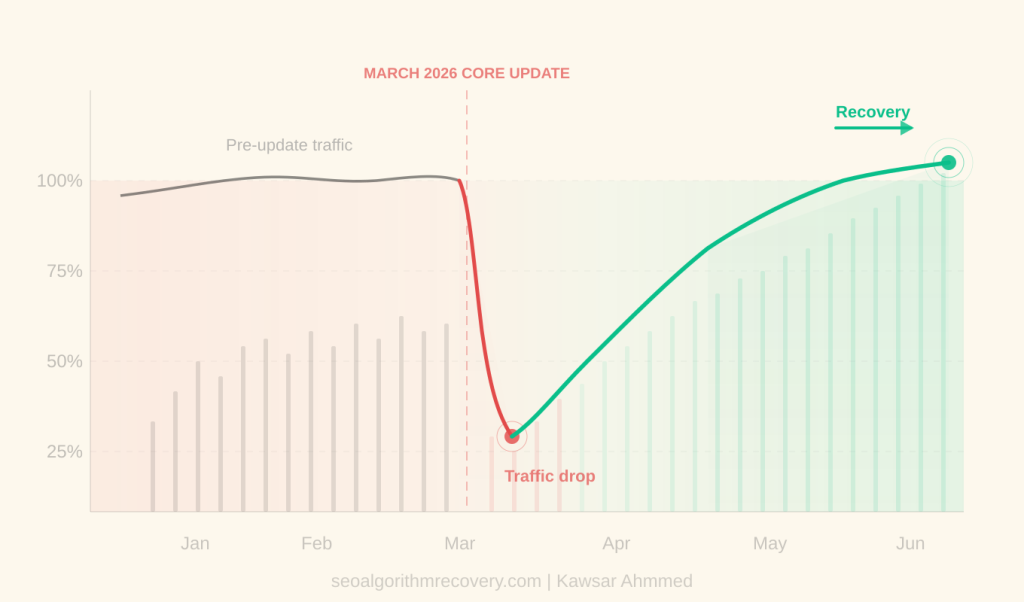
Before and After: What Recovery Looks Like?
Across the 300+ sites I have worked on, the pattern is consistent. Websites that invest in original content, clear expertise signals, and strong technical foundations recover. Those that chase shortcuts keep dropping.
After the March 2025 core update, one of my audit clients in the health niche had lost 60 percent of organic traffic. Within 8 weeks of implementing a full content audit, E-E-A-T overhaul, and technical cleanup, the site recovered 85 percent of its lost traffic before the next core update even rolled out.
The same methodology applies to the March 2026 update. The sites winning right now share three traits: original research, verifiable expertise, and a technically sound user experience.
You can see more examples of real recovery timelines on our case studies page.
Timeline: When to Expect Recovery
Here is a realistic recovery timeline based on what I have seen across hundreds of algorithm recovery projects:
Weeks 1 to 3 (during rollout): Rankings fluctuate heavily. Do not make hasty changes. Use this time to gather data and plan your audit.
Weeks 4 to 8: Rankings begin stabilizing. This is when you start implementing improvements based on your analysis. Technical fixes show the fastest returns.
Months 2 to 3: Google recrawls and reassesses improved content. You should see incremental gains from content updates and E-E-A-T improvements.
Next core update (3 to 4 months out): Full recovery often aligns with the next broad core update. Based on Google’s 2025 pattern (March, June, December), expect the next update around June or July 2026.
Google also runs smaller, unannounced core updates between major ones. Your improvements can show results before the next big cycle.
Did the March 2026 Core Update hit Your Site?
If your organic traffic dropped after early March 2026, do not wait for it to fix itself. Every week without action is lost revenue and lost visibility.
Get a free recovery audit now. I will personally analyze your site, identify exactly what the March 2026 update targeted, and give you a clear action plan to recover your rankings.
With 7+ years of specialized algorithm recovery experience and 300+ successful recovery projects, I know exactly what Google is looking for right now.
Follow me on LinkedIn and X (@kawsarahmmedseo) for real-time updates on Google algorithm changes and recovery strategies.