Full diagnostic case studies
The summaries above are outcomes. These are the diagnoses behind that kind of work: the actual Search Console figures, what the audit found, and the roadmap that followed. Client names are withheld under the confidentiality terms in the editorial policy, but every number is taken directly from the client's own data.
None of the three is a straightforward success story, which is deliberate. Two of them end with me telling the client the honest answer rather than the reassuring one. That is closer to what this work actually looks like.
Impressions up 21 percent, clicks flat
A home care provider across multiple US states believed it had lost traffic. It had not. Google was showing the site two million more times a quarter and those impressions were converting to nothing.
2.2% → 1.8% click-through rate · March 2025 Read the diagnosis → EcommerceSame content, two domains, one lost 97 percent
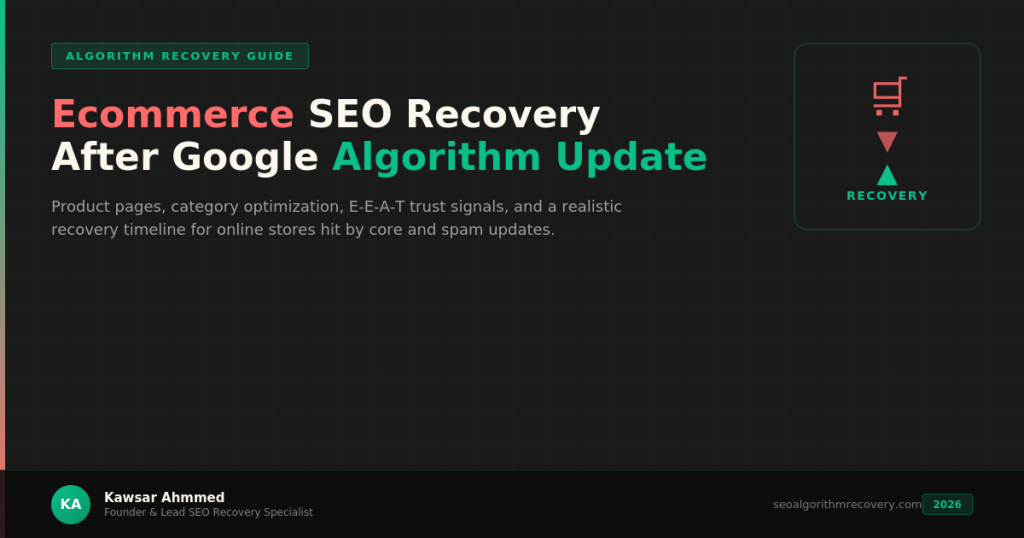
Two auto parts sites ran the same articles. One fell to six visits a month while its sister site grew 17 percent. As close to a controlled experiment as this work gets.
6 visits/month vs 1,857 · April 2024 Read the diagnosis → News publishingTraffic to zero at the March 2024 core update
A Canadian news publisher lost effectively all search traffic in one week. Every article was copied and auto-published. My assessment was that recovery would be genuinely difficult.
Flat line since March 2024 · Scaled content abuse Read the diagnosis →How to read a case study
Recovery case studies are easy to write badly. A percentage and a timeframe prove nothing on their own, because the reader cannot tell whether the site recovered, the market recovered, or the reporting window was chosen to flatter. Three questions are worth asking of anyone's case studies, including these.
- Is the baseline defined? Why: A recovery measured from the lowest point of a decline will always look impressive. The meaningful comparison is against performance before the drop.
- Is the cause named specifically? Why: Hit by an algorithm update is not a diagnosis. Which update, on what date, affecting which page group, is.
- Are the failures shown as well as the wins? Why: Around one in ten engagements does not recover because the cause is structural. A portfolio with no difficult cases in it is a selection, not a record.
The data sources and caveats behind every figure quoted on this site are set out in the methodology.
Before you get in touch
If your situation resembles one of these, you can run most of the same first-stage analysis yourself. The drop analyzer finds your exact break date and tells you whether you lost rankings or lost clicks, which is the distinction the healthcare case turned on. The page scope analyzer shows whether the loss is site-wide or confined to one section. Both are free and neither uploads your data.
Want to know which of these your site looks like?
Send your Search Console access or an export. Within 48 hours you get the likely cause, the update it correlates with, and an honest answer on whether recovery is realistic. Including if the answer is no.
Get free recovery audit