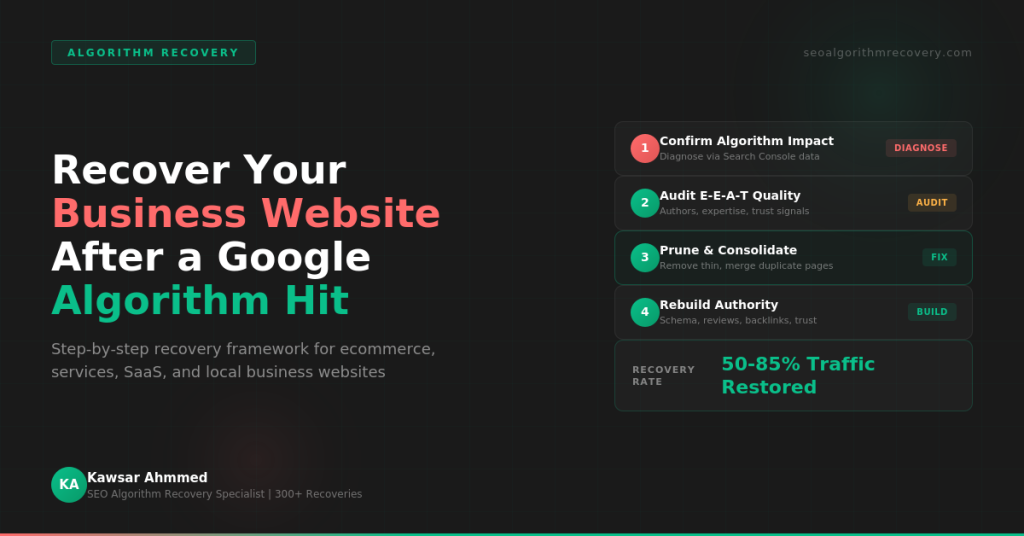
Recovering a business website after a Google algorithm hit starts with diagnosing whether the traffic drop came from a core update, spam update, or helpful content demotion. Over 55% of tracked websites experienced measurable ranking shifts during the March 2026 Core Update alone, and businesses across ecommerce, services, SaaS, and local sectors saw organic traffic decline by 20-60%. Recovery requires a structured approach: confirm the update impact in Google Search Console, audit content quality against E-E-A-T standards, prune thin or duplicate pages, rebuild authority signals, and monitor progress over 2-6 months.
Why Business Websites Lose Rankings After Algorithm Updates?
Google runs thousands of algorithm changes every year, but core updates are the ones that cause overnight traffic drops for business websites. These updates are not penalties. They are broad recalibrations of how Google evaluates content quality, relevance, and trustworthiness across the entire web.
The problem for most business owners is that their website was performing fine under the old evaluation criteria. When Google raises the bar, content that was “good enough” yesterday suddenly falls short compared to competitors who invested in deeper expertise and better user experience.
Here is what the recent data shows:
- 55% of tracked websites saw measurable ranking changes within two weeks of the March 2026 Core Update rollout
- Businesses relying on generic service pages with thin content experienced 20-35% organic traffic declines
- YMYL sectors (health, finance, legal) faced the steepest drops, with some sites losing 40-60% visibility
- Sites lacking visible author credentials, clear About pages, and referenced sources saw disproportionate declines
Whether you run a local service business, an e-commerce store, or a professional services firm, the recovery principles are the same. Google wants to see that your website exists to serve users, not to manipulate search rankings. If you need immediate expert guidance, working with a Google algorithm recovery specialist can accelerate the diagnostic and recovery process significantly.
Step 1: Confirm the Algorithm Hit in Google Search Console
Before changing anything on your website, confirm that the traffic drop was actually caused by an algorithm update. Ranking fluctuations happen daily, and misdiagnosis leads to wasted effort.
Open Google Search Console and compare your traffic data from the 14 days before the update rollout date against the 14 days after. Look for sudden drops in impressions and clicks that align with known update timelines. If the decline started on or within days of a confirmed update rollout, you are dealing with an algorithmic impact.
Key diagnostic signals to check:
- Site-wide decline vs. isolated pages. Core updates usually affect multiple pages or entire content categories, not just one URL
- Query-level analysis. Check which search queries lost impressions. If branded queries held steady but informational queries dropped, the issue is content quality, not a domain-level penalty
- Manual action check. Review the Manual Actions section in Search Console. If no manual action exists, your issue is algorithmic and recoverable through quality improvements
For businesses in health, finance, or legal sectors, the evaluation criteria are significantly stricter. Google applies heightened E-E-A-T standards to YMYL sites recovering from algorithm updates, and recovery in these verticals requires demonstrable professional credentials and verified expertise.
Step 2: Audit Content Quality Against E-E-A-T Standards
E-E-A-T stands for Experience, Expertise, Authoritativeness, and Trustworthiness. According to Google’s people-first content guidelines, every page on your website should demonstrate that it was created by someone with genuine knowledge and serves users better than competing pages.
Most business websites fail E-E-A-T audits in predictable ways:
- No author attribution. Blog posts and service pages lack named authors with verifiable credentials. A generic “Admin” or “Team” byline signals zero expertise to Google
- Missing About and team pages. Google’s quality raters evaluate whether the humans behind the website are identifiable and qualified. A missing or generic About page is a trust failure
- Thin service pages. Pages with 200-300 words of generic copy describing your services without case studies, process details, or specific expertise signals
- No original content. If every page on your site could be written by someone who has never worked in your industry, Google has no reason to rank you above competitors who demonstrate real experience
The fix is straightforward but requires effort. Add detailed author bios with real credentials, create comprehensive team pages, expand service pages with genuine case studies and process explanations, and ensure every piece of content reflects your actual business expertise.
Step 3: Prune Thin Content and Consolidate Pages
Business websites accumulate low-quality pages over time. Old blog posts, outdated service pages, duplicate location pages, and thin category pages all drag down your site-wide quality signals.
Google’s helpful content system evaluates your entire domain, not just individual pages. A website with 500 indexed pages where 200 are thin or outdated will score worse overall than a competitor with 150 well-crafted, authoritative pages.
Content pruning priorities for business websites:
- Identify pages with zero organic traffic over the past 12 months and either improve, consolidate, or noindex them
- Merge blog posts covering similar topics into comprehensive guides
- Remove or redirect outdated content that no longer reflects your current services or expertise
- Consolidate duplicate location pages into meaningful local content with genuine area-specific information
I cover the complete methodology in my content pruning strategy for SEO recovery guide, including how to decide which pages to keep, merge, or remove without losing valuable link equity.
Step 4: Rebuild Authority and Trust Signals
After cleaning up content quality, your website needs to demonstrate why Google should trust it as an authoritative source. This is where many business owners get stuck because authority building takes consistent effort over weeks and months.
Authority-building actions for business websites:
- Implement structured data markup. Add Organization, LocalBusiness, Person, and FAQ schema to help Google understand your entity credentials and service offerings
- Build a review and testimonial ecosystem. Genuine customer reviews on your Google Business Profile and embedded on your website signal real-world trust
- Earn contextual backlinks. Guest contributions, industry citations, and partnerships with relevant organizations build the kind of authority Google rewards
- Maintain consistent NAP information. For local businesses, consistent Name, Address, and Phone data across all directories reinforces entity verification
Local service businesses face additional challenges during algorithm recoveries. If your business serves a specific geographic area, review my dedicated guide on local SEO recovery after algorithm updates for location-specific recovery strategies.
Business Website Recovery: Before vs. After Implementation
| Recovery Area | Before Recovery | After Recovery |
| Content Quality | Thin service pages, generic blog posts, no original insight | Detailed case studies, expert-authored guides, process documentation |
| E-E-A-T Signals | No author bios, missing About page, generic team info | Named authors with credentials, detailed team page, schema markup |
| Content Volume | 400+ indexed pages, 40% thin or outdated | 200-250 high-quality pages, all current and relevant |
| Trust Signals | No reviews on site, inconsistent NAP, no structured data | Customer testimonials, consistent citations, full schema |
| Technical Health | Failing Core Web Vitals, mobile issues, crawl errors | Passing all CWV thresholds, clean crawl, fast load times |
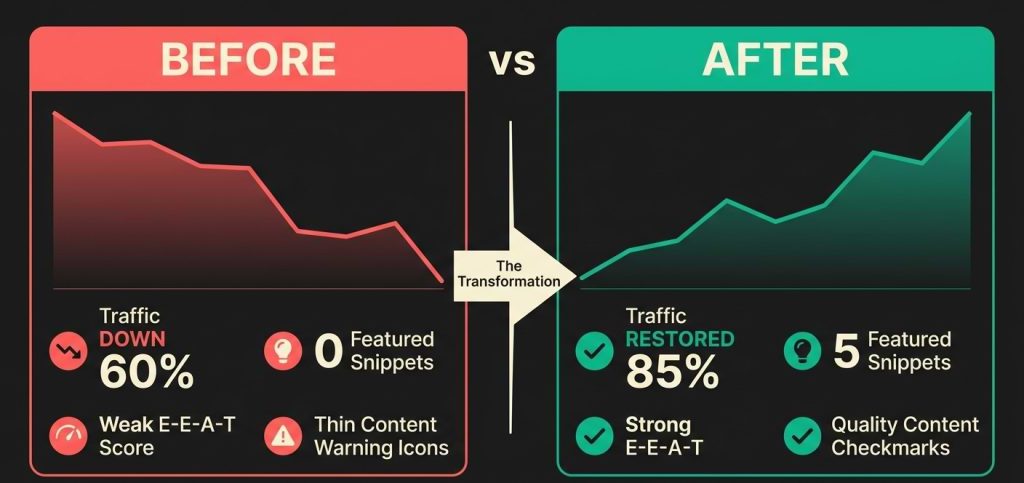
| Measurement | Organic traffic down 30-60%, leads declining, no featured snippets | Traffic recovery 50-85% within 2-6 months, lead flow restored, 3-8 featured snippets |
Realistic Recovery Timeline for Business Websites
Recovery speed depends on the severity of the hit, your business type, and how quickly you implement changes. Here are the realistic timelines I see across my recovery portfolio:
- Quick technical wins (2-4 weeks): Fixing Core Web Vitals, resolving crawl errors, and implementing structured data can show early improvements
- Standard business sites (2-4 months): Content audits, pruning, E-E-A-T improvements, and authority building produce measurable recovery for most business websites
- YMYL businesses (4-8 months): Health, finance, and legal websites require demonstrated professional credentials and sustained quality improvement before Google lifts quality demotions
Different business models face different recovery challenges. SaaS companies dealing with comparison page bloat need a different approach than affiliate sites rebuilding after HCU demotions. The recovery framework stays the same, but the specific actions depend on your business model and content structure.
Common Business Website Recovery Mistakes
- Panic-deleting content. Removing large sections of your website without analysis destroys link equity and indexed page value. Audit first, then prune strategically
- Changing everything at once. Implementing 50 changes simultaneously makes it impossible to measure what worked. Prioritize and batch your changes
- Ignoring technical SEO. Content quality matters most, but failing Core Web Vitals and mobile usability issues compound the problem. According to Search Engine Land’s recovery analysis, technical health is now a baseline requirement for ranking
- Hiring cheap content mills. Replacing thin content with more thin content from low-cost writers does not fix a quality demotion. Your recovery content needs genuine business expertise
- Expecting overnight results. Recovery takes 2-6 months. Businesses that give up after 4 weeks and revert changes lose their recovery progress entirely
Frequently Asked Questions
How do I know if my business website was hit by a Google algorithm update?
Check Google Search Console for sudden drops in impressions and clicks that align with known update dates. If the decline is site-wide or affects entire content categories starting on or near the update rollout, it is likely algorithmic. Also, check the Manual Actions section to rule out a direct penalty.
Can a business website fully recover from a Google algorithm hit?
Yes. Most business websites can recover 50-85% of lost traffic within 2-6 months through systematic content improvement, E-E-A-T strengthening, and technical optimization. Full recovery often occurs when Google’s next core update recognizes the quality improvements. Businesses with genuine expertise in their field have the strongest recovery prospects.
Does changing my website design help with algorithm recovery?
Design changes alone do not fix algorithmic demotions. However, improving page speed, mobile usability, and user experience through design refinements can support the recovery process. Focus on content quality and E-E-A-T first, then address design and technical issues as supporting improvements.
Should I stop publishing new content during recovery?
No. Continue publishing, but shift your strategy. Publish fewer, higher-quality pieces that demonstrate genuine expertise rather than maintaining a high-volume content calendar with thin posts. One expert-level article per week outperforms five generic posts in a recovery context.
How much does professional algorithm recovery cost?
Recovery costs vary based on website size, severity of the hit, and industry vertical. Most business website recoveries involve a comprehensive audit phase followed by 2-4 months of implementation. The investment is typically a fraction of the revenue lost from the organic traffic decline, making professional recovery a sound business decision.

Business Website Lost Organic Traffic After a Google Update?
I have recovered 300+ business websites across ecommerce, SaaS, healthcare, fintech, legal, and local service verticals. Every recovery starts with a free diagnostic audit to identify exactly what went wrong and a custom action plan to restore your organic visibility.
About the Author
Kawsar Ahmmed is the founder of SEO Algorithm Recovery and a Sr. SEO Strategy & Growth Consultant specializing in Google algorithm penalty recovery. With 7+ years of experience and 300+ successful website recoveries across ecommerce, SaaS, healthcare, fintech, and local business verticals, Kawsar helps businesses restore organic visibility after algorithm updates. Connect on LinkedIn or follow on X (@kawsarahmmedseo).