A newly launched crypto affiliate site lost effectively 100 percent of its Google visibility in about 72 hours, days after the August 2026 spam update completed. This is the full audit report, published with identifying details removed. It is unusual in one respect: the site never had a stable baseline to recover to, which changes the entire plan. Total performance across the three month window was 8 clicks from 3,320 impressions at an average position of 45.1.
Report snapshot
Period analysed: three months of Search Console data to 14 September 2026 · Total clicks: 8 · Total impressions: 3,320 · Average CTR: 0.2% · Average position: 45.1. Primary finding: post spam update visibility collapse on a new, low authority, affiliate heavy domain.
Executive summary
The client is a newly launched cryptocurrency content and affiliate site. Search Console shows the property earning its first impressions around 13 August 2026, climbing to roughly 250 to 280 impressions per day by 19 August, and holding that level until 31 August. Between 1 and 3 September, impressions collapsed to near zero and have stayed there.
The collapse pattern, the timing and the content profile all point the same way. The site was caught in the re-evaluation that followed the August 2026 spam update, confirmed as rolling out 18 to 21 August, amplified by the natural end of the new site freshness period. The pages carrying almost all of the visibility were exchange bonus code and referral code pages: the exact footprint Google’s spam systems are built to suppress, on a domain with no authority history, no earned backlinks and unproven E-E-A-T in a YMYL niche.
Important framing
This is not a recovery back to a former stable baseline. The site never had one. The honest goal is different: build the site’s first real, defensible baseline of trust and rankings. Quick fixes will not work here. Classification change will.
What happened: timeline reconstruction
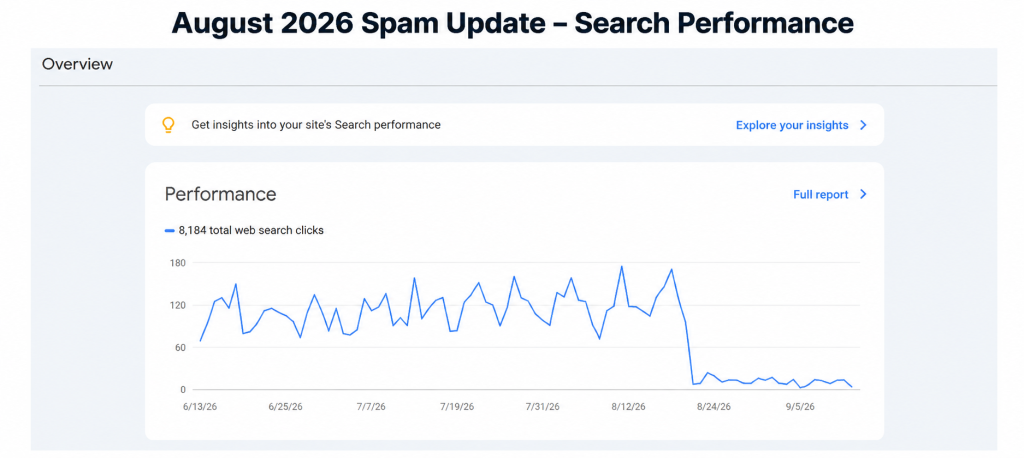
| Phase | Dates (2026) | What the data shows | Interpretation |
|---|---|---|---|
| 1. First indexing | Aug 13 to 15 | First impressions appear, near zero | Site enters Google’s index; crawl and discovery begin |
| 2. Fresh boost | Aug 16 to 19 | Rapid ramp to ~280 impressions per day | New site freshness period; Google tests the domain |
| 3. Testing plateau | Aug 20 to 31 | 200 to 270 impressions per day | Bonus code pages surface around positions 7 to 12 |
| 4. Collapse | Sep 1 to 3 | Impressions fall to near zero and stay there | Site is reclassified and suppressed |
The critical overlap
Spam update effects frequently continue to propagate for one to two weeks after the official completion date as classifiers are applied across the index. The collapse on 1 to 3 September sits squarely inside that propagation window.
A second force was acting at the same time. New domains commonly receive a temporary visibility boost while Google gathers real user data. When that period ends, rankings settle to what the site’s actual authority supports, and for a domain with essentially zero earned links that settling point is very low. The two effects compounded: the freshness boost expired at the same moment the spam classifier reached the site’s most visible content type.
Why this matters for the plan
If this were only freshness decay, publishing more content would slowly rebuild visibility. If it is a spam classification, more of the same content makes it worse. The evidence shows the spam side is real, so the plan must lead with cleanup and trust building rather than volume.
Root cause analysis
Four candidate causes were tested against the data rather than assumed.
| Candidate cause | Evidence for | Evidence against | Verdict |
|---|---|---|---|
| Manual action | Severe visibility loss | No manual action pattern in the data provided | Unlikely, verify in Search Console |
| Technical failure | Sudden total drop | Site loads fine, pages remain indexed, meta intact | Ruled out as primary |
| AI Overview CTR loss | Low CTR overall | Impressions collapsed too, not just clicks | Ruled out |
| Spam update plus authority deficit | Timing match, affiliate footprint, new domain | None material | Primary cause |
The affiliate footprint problem
Where the visibility actually lived is the most important finding in the dataset.
| Page | Clicks | Impressions | Avg position |
|---|---|---|---|
| /offer/kucoin-welcome-bonus/ | 2 | 737 | 12.7 |
| /binance-referral-code/ | 2 | 311 | 25.5 |
| /offer/binance-welcome-bonus/ | 0 | 119 | 53.1 |
| /offer/mexc-welcome-bonus/ | 0 | 40 | 29.9 |
| Top query: “kucoin bonus code” | 0 | 498 | 7.7 |
Bonus code, referral code and welcome offer pages accounted for the majority of meaningful impressions. Google’s spam policies explicitly target thin affiliation: pages whose primary value is the affiliate relationship rather than original information. On an established site with strong editorial content, a small offers section is survivable. On a brand new domain where offers are the main thing Google sees ranking, it defines the classification.
The last row is the warning sign. A page at position 7.7 with 498 impressions and zero clicks tells Google directly that users do not find it worth choosing. During the exact window when the site was being measured for the first time, its most visible page was proving unattractive to searchers.
The authority and E-E-A-T deficit
The educational content shows the opposite failure. The genuinely useful guides never ranked at all.
| Educational page | Impressions | Avg position |
|---|---|---|
| /hot-vs-cold-wallets/ | 526 | 74.6 |
| /public-vs-private-keys/ | 211 | 69.7 |
| /layer-1-vs-layer-2-blockchains/ | 193 | 60.1 |
| /crypto-volatility/ | 165 | 61.8 |
| /how-blockchain-technology-works/ | 164 | 61.7 |
| /stablecoins-explained/ | 115 | 61.5 |
Positions 60 to 80 for beginner crypto guides is not a penalty signature. It is what happens when correct but undifferentiated content competes in one of the most saturated YMYL niches with zero domain authority. Crypto is YMYL: Google applies its highest trust bar because bad information costs people money, and competing pages sit on domains with years of history, named expert authors and thousands of referring domains.
The site has made a visible start on trust signals. An authors page, editorial guidelines, disclaimers, affiliate disclosure and risk warnings all exist. Necessary, but not yet sufficient: the authors need verifiable real world identity and credentials, the content needs first-hand experience evidence, and the domain needs earned third party validation.
Data quality: inflated signals in the export
Two patterns should not be mistaken for real performance, and both inflate the apparent top ten footprint.
- Rank tracker noise. Queries containing search operators, such as a bonus code term followed by a long chain of site exclusions, are automated scraper or rank tracking queries rather than real users.
- Self search noise. Clusters of near identical queries in six word order variations, each with exactly one impression at positions 1 to 8, are consistent with someone checking their own article’s rankings.
After removing that noise, genuine top ten presence was concentrated almost entirely in the bonus code cluster that has now been suppressed. Real breadth is materially smaller than the raw count of 36 top ten queries suggests.
Complete issue register
Ordered by how much each issue blocks reclassification, which is not the same as how easy each is to fix.
| # | Issue | Severity | Category |
|---|---|---|---|
| 1 | Affiliate and bonus code pages dominate the ranking footprint of a new domain | Critical | Spam / classification |
| 2 | Zero earned backlink authority; no third party validation of the brand | Critical | Authority |
| 3 | YMYL niche with unverifiable author identities and credentials | Critical | E-E-A-T |
| 4 | Top ranking page earned 0 clicks from 498 top ten impressions | High | Engagement |
| 5 | Educational content correct but undifferentiated | High | Content quality |
| 6 | 77 indexed pages, many with under 20 lifetime impressions | High | Content quality |
| 7 | Site scaled to full size in roughly 6 weeks, a velocity pattern spam systems weight | Medium | Spam / classification |
| 8 | Affiliate redirect links in main navigation, repeated site wide | Medium | Spam / classification |
| 9 | Currency and licence taxonomy pages with near zero content depth risk index bloat | Medium | Technical / content |
| 10 | International scatter across 123 countries shows no market focus | Low | Strategy |
| 11 | Visible typos and grammar errors undermine stated editorial standards | Low | E-E-A-T |
| 12 | News articles decay to single digit impressions; effort is not compounding | Low | Strategy |
The recovery process
Four phases over 90 days. The order matters more than the list: cleanup before content, content before promotion. Publishing new articles onto a spam classified domain wastes them.
Phase 1: verify and stop the bleeding
- Confirm no manual action exists in Search Console.
- Export current indexing, crawl stats and page level data as the baseline for measuring recovery.
- Freeze publication of any new bonus code, referral code or offer pages. No exceptions during recovery.
- Remove affiliate redirect links from the main navigation. Offers can exist, but they must not be the skeleton of the site.
Phase 2: rebalance the content footprint
- Consolidate the offers cluster into one page per exchange, combining review, offer and referral information with genuine comparison detail. Redirect the thin duplicates into it.
- Noindex or fold in the near empty taxonomy pages until each has real content. Every indexed URL should earn its place.
- Rewrite exchange pages around first-hand experience: screenshots of the signup flow, actual fee receipts, tested withdrawal times. Experience is the part of E-E-A-T thin affiliate pages cannot fake.
- Fix every typo and grammar error site wide. A site claiming editorial standards cannot show spelling errors on its homepage.
- Upgrade author trust: real named authors with photos, verifiable profiles, stated credentials, and Person schema linking to them. Unverifiable authors are a ceiling on YMYL rankings.
Phase 3: rebuild with content that can actually rank
- Shift 80 percent of publishing effort to low competition educational content targeting long tail questions where authority requirements are lowest.
- Publish 15 to 20 manually written articles per month. AI scaled or templated output will re-trigger the same classification that caused the collapse.
- Build topic clusters rather than isolated posts: every new article links to its pillar and two siblings.
- Add unique data assets to flagship guides: an original fee comparison, a wallet setup checklist, a scam red flag checklist. Assets earn links; opinions do not.
Phase 4: earn the first authority signals
- Digital PR at small scale: pitch original data or expert commentary to crypto newsletters and mid tier publications. Five earned referring domains beat five hundred directory links.
- Build brand search through consistent social presence, off-site bylines and a newsletter. Branded search volume is a trust signal Google can measure.
- Narrow geographic focus to one or two primary markets and align content, regulation references and offers to them.
- Review against the KPIs below, and only then decide whether the offers cluster earns reintroduction into navigation.
Measuring recovery
| KPI | Baseline (14 Sep 2026) | 30 day target | 90 day target |
|---|---|---|---|
| Daily impressions | Under 10 | Stabilised, first uptick on new content | 150 to 300, majority from educational pages |
| Indexed pages earning 10+ monthly impressions | Under 15 | 20 | 40+ |
| Average position, educational cluster | 60 to 80 | 40 to 60 | 20 to 40 on long tail targets |
| CTR on top ten queries | 0% (bonus cluster) | n/a during rebuild | 2%+ on educational queries |
| Earned referring domains | ~0 | 2 to 3 | 8 to 12 |
| Share of impressions from offer pages | ~40% | Under 20% | Under 15% |
What not to do
- Do not publish more bonus code or referral pages while suppressed. Each one reinforces the classification.
- Do not buy backlinks or use link networks. A spam flagged new domain plus paid links is how suppressions become permanent.
- Do not mass generate AI content to rebuild volume. Scaled content abuse is an explicit spam policy and the velocity pattern is already a flag on this domain.
- Do not delete the site and restart on a new domain. The same content pattern earns the same classification, minus the trust pages already built.
- Do not chase news traffic as the primary strategy. The data shows news posts here decay to single digit impressions within two weeks.
Conclusion
This site was built in the shape Google’s spam systems are trained to catch: a young domain whose most visible pages exist to monetise branded exchange searches. The August 2026 spam update window closed on it before it had time to earn any counterbalancing trust.
The foundation pages for a legitimate site already exist, which puts it ahead of most sites in this situation. The path back is not mysterious but it is sequential: verify, clean up, rebalance toward genuinely useful educational content, prove real authorship, then earn the first external validation.
Collapsed after the August 2026 spam update?
This profile is recoverable, but only if the phases run in order. Send your Search Console access and within 48 hours I will tell you whether you have the same classification problem or something else entirely.
Get free recovery auditThe client is not named and identifying details are withheld under the confidentiality terms set out in the editorial policy. Figures are taken directly from the client’s Google Search Console during the September 2026 audit. Report prepared by Kawsar Ahmmed, 14 September 2026.
The wider pattern behind this case, and how to tell an unproven new domain from one that has actually been classified, is in my new site is not ranking at all.