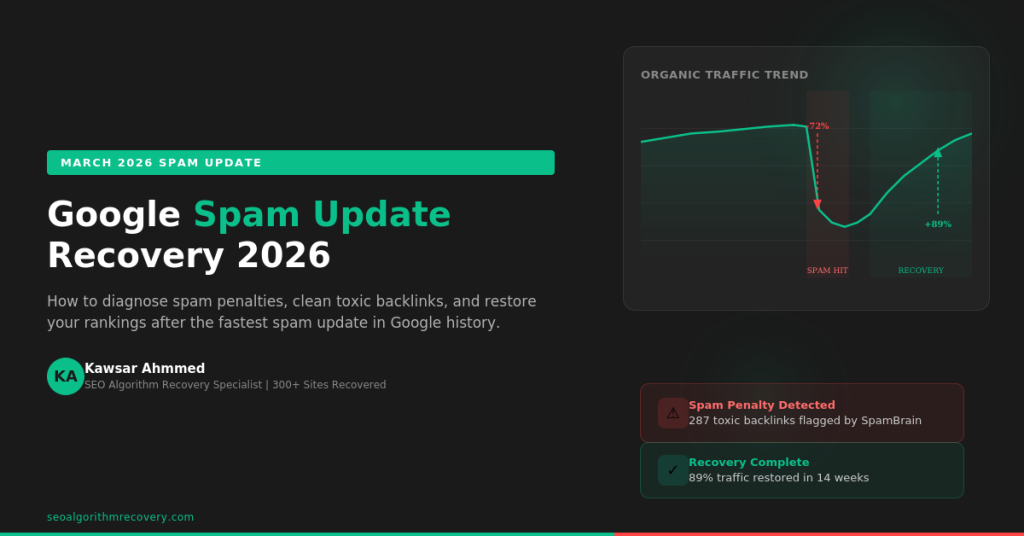
Google’s March 2026 Spam Update rolled out on March 24 and completed in under 20 hours, making it the fastest confirmed spam update in Google’s dashboard history. If your site lost rankings or traffic in the last 48 hours, this update is likely the reason. But here is the good news: spam penalties are recoverable when you follow the right process.
I have helped over 300 websites recover from Google algorithm penalties since 2018, including spam updates, core updates, and Helpful Content demotions. In this guide, I will walk you through how spam penalties actually work, how to diagnose whether your site was hit, and the exact recovery steps I use with my clients. If your website traffic dropped after a Google update in 2026, this framework will help you take action immediately.
Types of Google Spam Penalties: Algorithmic vs. Manual Action
Before you start fixing anything, you need to understand which type of spam penalty hit your site. Google enforces spam policies through two distinct mechanisms, and each requires a different recovery approach.
Algorithmic spam penalties are applied automatically by SpamBrain, Google’s AI-powered spam detection system. These penalties happen during spam update rollouts (like the March 2026 Spam Update) and do not come with any notification in Search Console. Your rankings simply drop. SpamBrain evaluates link patterns, content quality signals, and site behavior to flag violations without human review.
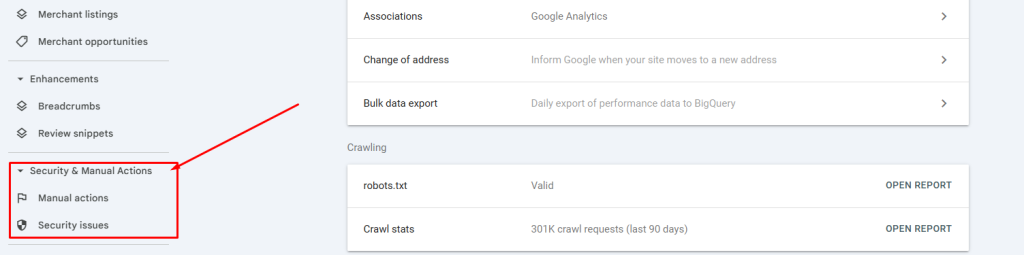
Manual actions are issued by Google’s human reviewers after a manual inspection of your site. You will find these listed under the Manual Actions tab in Google Search Console with a clear description of the violation. Common triggers include unnatural inbound links, thin content with no added value, cloaking, and pure spam. Manual actions require you to submit a reconsideration request after fixing the issues. For a deeper breakdown of how to tell the difference, see my guide on Google manual actions versus algorithm penalties.
How to Check If You Have a Spam Penalty (Search Console Walkthrough)?
The first step in any recovery is confirming that a spam update actually caused your traffic loss. Here is how to diagnose it using Google Search Console.
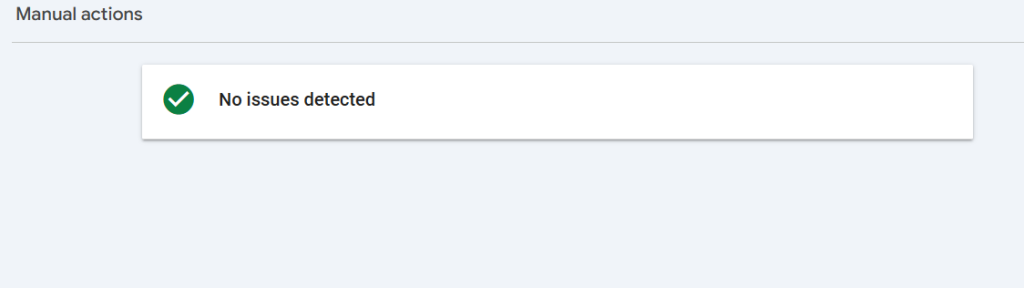
Check for manual actions. Log in to Google Search Console, navigate to Security and Manual Actions, and click Manual Actions. If the page shows no issues detected, your penalty is algorithmic. If a manual action is listed, you will see the specific violation and which pages or patterns are affected.
Correlate your traffic drop with update dates. Open the Performance report, set the date range to the last 3 months, and compare your click and impression trends against known update dates. The March 2026 Spam Update began rolling out on March 24 and finished by March 25. The August 2025 Spam Update ran from August 26 through September 22, 2025. If your decline aligns with either window, spam enforcement is the likely cause.
Check the Pages report for deindexed URLs. In the Pages section (formerly Coverage), look for pages that suddenly moved from indexed to excluded. A spike in “Crawled but not indexed” or “Discovered but not indexed” entries after a spam update often signals that Google flagged those pages as low-quality or spam-adjacent.
If your traffic drop does not align with spam update dates, you may be dealing with a core update penalty instead. My Google March 2026 Core Update recovery guide covers that scenario in detail.
Link Spam vs. Content Spam: Two Different Recovery Paths
Google’s spam policies target several categories of abuse, but the two most common triggers I see across client sites are link spam and content spam. Each requires a fundamentally different recovery strategy.
Link Spam Recovery
Link spam includes paid links, private blog networks (PBNs), excessive link exchanges, and any scheme designed to manipulate PageRank. SpamBrain has become significantly better at detecting these patterns since 2024, and the March 2026 update further refined its detection capabilities. Google’s own documentation warns that when link spam effects are removed, the ranking benefits those links generated are permanently lost.
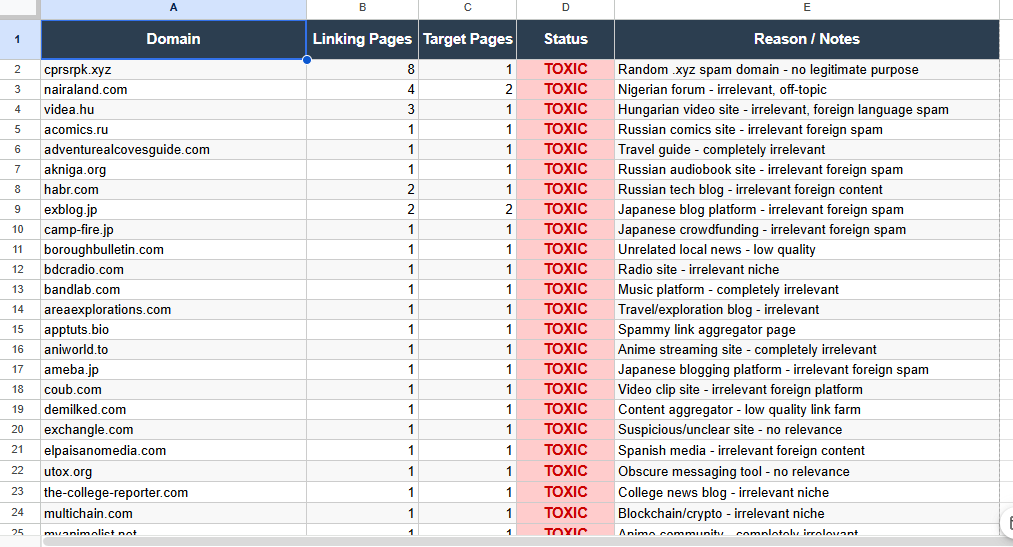
Recovery from link spam starts with a full backlink audit using tools like Ahrefs, Semrush, or Google Search Console’s Links report. You need to identify toxic referring domains, including sites with spam scores above 60, foreign-language gambling and pharma sites, link farms, and domains with no organic traffic of their own. Once identified, attempt manual removal by contacting webmasters, then compile the remaining toxic domains into a disavow file and submit it through Google’s Disavow Tool.
Content Spam Recovery
Content spam covers auto-generated content, scraped content, cloaking, doorway pages, and what Google now classifies as “scaled content abuse.” Since the March 2024 policy update, this category also includes AI-generated content published at scale without meaningful human oversight or added value.
Recovering from content spam requires aggressive content pruning. Audit every page on your site using Screaming Frog and flag pages with thin content (under 300 words with no unique value), duplicate or near-duplicate content, keyword-stuffed meta tags, or content that exists solely to target search queries without providing real answers. Pages that cannot be improved should be removed or noindexed. I have found across my client work that many sites hit by spam updates carry 30% to 50% dead-weight content that actively drags down the entire domain. My detailed Helpful Content Update recovery guide covers the content rewrite framework I use to transform thin pages into high-quality assets.
Toxic Backlink Cleanup and Disavow Process
The disavow process is one of the most misunderstood parts of spam recovery. Many site owners either skip it entirely or submit overly broad disavow files that remove legitimate links along with the toxic ones. Here is the process I follow with every client engagement.
Step 1: Export your full backlink profile. Pull backlink data from Google Search Console, Ahrefs, and Semrush. Cross-reference all three sources because no single tool captures everything.
Step 2: Score and categorize each referring domain. Flag domains with high spam scores, irrelevant anchor text (especially exact-match commercial anchors from unrelated sites), links from hacked or compromised sites, and links from known PBN networks.
Step 3: Attempt manual removal. Contact webmasters of the most harmful referring domains and request link removal. Document your outreach attempts because Google considers this effort when evaluating reconsideration requests.
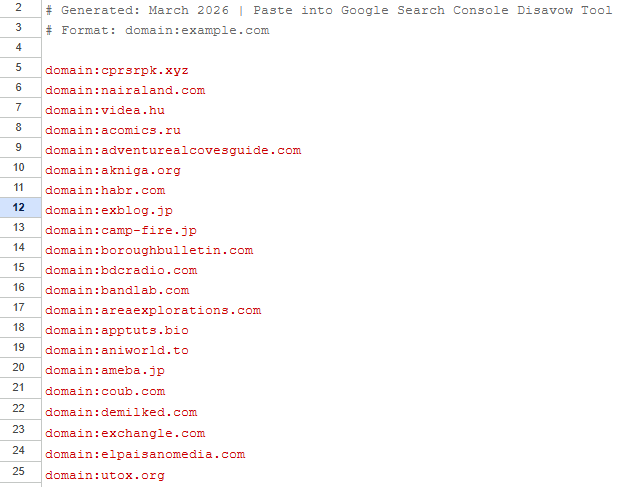
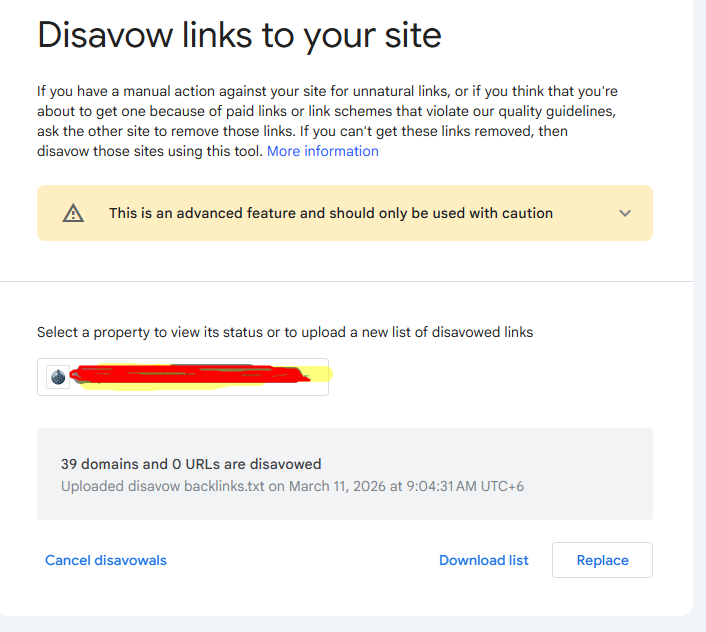
Step 4: Build and submit your disavow file. Format your file using domain-level disavows (domain:example.com) for entirely toxic domains and URL-level disavows for specific harmful pages on otherwise legitimate sites. Submit through Search Console’s Disavow Links tool.
Step 5: Monitor and wait. Google processes disavow files during subsequent crawls and updates. Recovery from link spam is gradual and can take anywhere from 4 to 12 weeks, depending on the severity of the profile.
Real Spam Recovery Case Study: Steel Fabrication Site (August 2025 Spam Update)
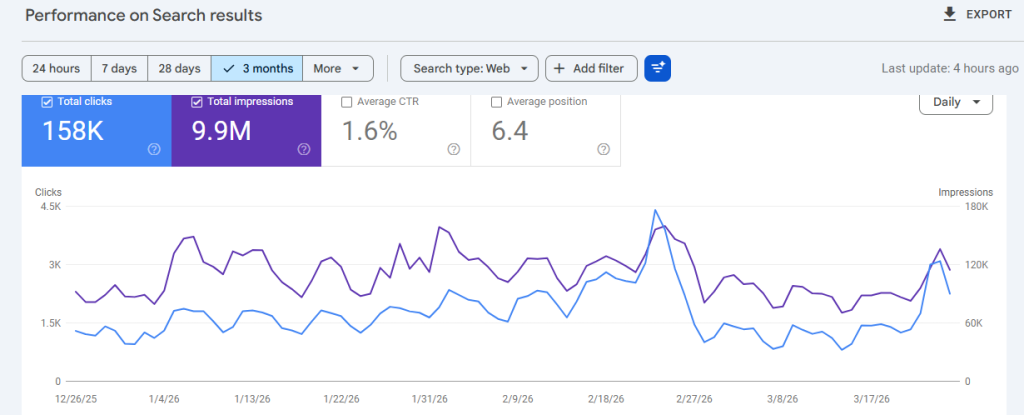
One of my clients, a Melbourne-based steel fabrication company, came to me after the August 2025 Spam Update wiped out 72% of their organic traffic over a 27-day rollout period. Their site had been performing well for over three years before the update hit.
The problem: A previous SEO provider had built over 340 backlinks from low-quality directories, foreign-language spam sites, and PBN domains between 2022 and 2024. The anchor text profile was heavily over-optimized, with 65% of links using exact-match commercial anchors like “steel fabrication Melbourne” and “custom metal work Australia.” On top of that, the site had 18 doorway pages targeting suburb-level variations with nearly identical content.
The recovery process: I ran a complete backlink audit and identified 287 toxic referring domains. After manual outreach removed 43 links, I submitted a disavow file covering the remaining 244 domains. Simultaneously, I consolidated the 18 doorway pages into 4 high-quality service area pages with unique content, local case studies, and proper E-E-A-T signals. I also rebuilt the site’s author and about pages to strengthen trust signals, following the approach outlined in my complete audit report methodology.
The result: Within 8 weeks, the site regained 61% of its lost traffic. By week 14, traffic had recovered to 89% of pre-penalty levels. The site also gained 12 new keyword positions in the top 10 for terms it had never ranked for previously, because the cleaned-up link profile and improved content quality gave Google a much clearer picture of the site’s actual relevance and authority.
What does the March 2026 Spam Update Means Going Forward?
The March 2026 Spam Update completed its rollout in under 20 hours, making it the shortest spam update on record. While Google did not announce any new spam policy categories with this update, the speed and global scope suggest that SpamBrain’s detection capabilities have matured significantly. Sites relying on legacy link schemes, thin-scaled content, or expired domain abuse are at greater risk than ever.
If you have not already done so, now is the time to run a post-update audit of your site. Check your backlink profile for toxic links that may have been tolerated before but are now actively penalized. Review your content inventory for pages that exist solely to capture search traffic without providing genuine value. And ensure your site’s E-E-A-T signals clearly demonstrate who is behind the content and why they are qualified to publish it. My Google algorithm update tracker keeps a running timeline of every confirmed update so you can correlate traffic changes with specific rollout windows.
Hit by a Google Spam Update?
I specialize in spam penalty recovery and have helped 300+ sites regain their rankings after algorithmic and manual penalties. If your site was affected by the March 2026 Spam Update or any previous spam enforcement, I can diagnose the root cause and build a recovery plan tailored to your situation.

How SpamBrain Works in 2026?
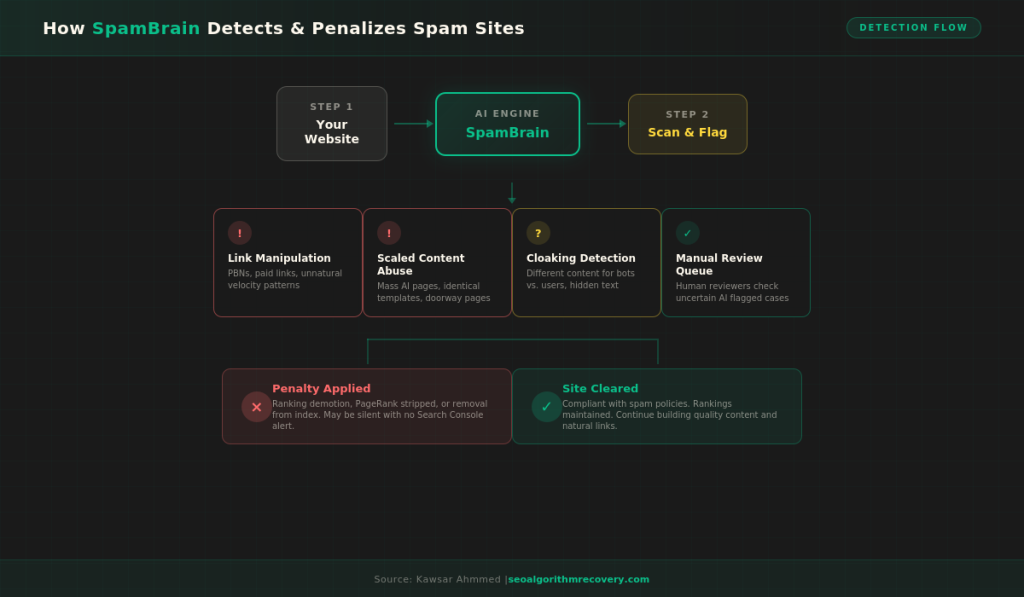
SpamBrain is Google’s machine learning spam detection engine. Unlike older rule-based algorithms like Penguin or Panda, SpamBrain learns and adapts. It identifies spam patterns by comparing flagged sites against known spam clusters and evolves its detection capabilities with each update. Here is what it targets:
- Keyword stuffing and hidden text manipulation across all content types
- Cloaking, including AI crawler-specific markdown pages confirmed as a violation in February 2026
- Manipulative link schemes including AI-refreshed PBNs and indirect paid link structures
- Scaled content abuse from mass-produced AI pages with identical templated formatting
- Scraped or auto-generated doorway pages designed to funnel traffic artificially
- Site reputation abuse (parasite SEO) where third-party content exploits host domain authority
In my experience recovering 300+ sites, SpamBrain penalties are the hardest to diagnose because they do not always appear as manual actions in Search Console. Google can silently cut a site’s PageRank-passing ability without notification. A content pruning strategy combined with spam signal cleanup is often the fastest recovery path.
March 2026 Spam Updates: What Changed?
Google released two spam updates in March 2026. The first, launched on March 24, completed in under 20 hours, making it the fastest confirmed spam update in Google’s history. It primarily targeted AI-generated doorway pages and scaled content abuse.
The second wave focused on the link graph. It went after how sites acquire authority through manipulation, specifically targeting AI-refreshed PBNs, indirect paid link structures, and parasite SEO arrangements where commercial content exploits high-authority host domains.
| Factor | Wave 1 (March 24) | Wave 2 (Late March) |
| Primary Target | AI doorway pages, scaled content | Link schemes, parasite SEO, PBNs |
| Rollout Speed | Under 20 hours | Several days |
| Detection Method | Content pattern analysis via SpamBrain | Link graph + velocity pattern detection |
| Recovery Path | Remove or rewrite spammy content | Disavow toxic links, fix link velocity |
| Measurement | Track indexed pages, GSC impressions | Monitor referring domains in Ahrefs/Semrush |
What a Former Google Spam Fighter Revealed (April 2026)?
Pedro Dias, who spent nearly six years on Google’s Search Quality team fighting spam across five languages, shared rare insider insights in an April 2026 interview. His revelations provide a unique window into how intent, not just technique, drives Google’s enforcement decisions.
- Entry-level spam reviewers process a daily queue of sites that SpamBrain cannot classify with certainty, manually reviewing each flagged case
- Google distinguishes between sites that accidentally violate guidelines and those with a pattern of deliberate manipulation
- Silent penalties exist: Google can strip a site’s PageRank-passing ability without any notification in Search Console, especially for repeat offenders
- Creating separate markdown or JSON pages exclusively for AI crawlers is officially classified as cloaking by both Google and Bing as of February 2026
This is why a proper reconsideration request strategy matters for visible manual actions. For silent algorithmic suppression, you need a full diagnostic approach since there is no notification to respond to.
Common Mistakes That Trigger Spam Detection
After auditing hundreds of penalized websites, I consistently see these patterns triggering SpamBrain and Google’s manual review teams:
- Publishing 50+ AI-generated pages weekly with identical formatting templates, triggering scaled content abuse detection
- Buying backlinks in burst patterns followed by dormant periods, which flags unnatural link velocity
- Hosting unrelated third-party commercial content on subdomains or subdirectories now triggers page-level penalties
- Serving different content to Googlebot than to human visitors, with cloaking detection now expanded to AI crawler-specific pages
- Deleting pages after traffic drops instead of improving them, destroying internal link equity and historical authority signals
Want this handled for you? The penalty and spam recovery service starts with a free 48 hour diagnosis that tells you whether you have a manual action, an algorithmic demotion, or neither.
Frequently Asked Questions
How long does it take to recover from a Google spam update?
Recovery timelines vary based on the severity and type of spam violation. Link spam penalties typically take 4 to 12 weeks after submitting a disavow file and fixing issues. Content spam recovery depends on how quickly you can prune or rewrite the flagged pages. In most cases, my clients see initial recovery signs within 6 to 8 weeks of completing the cleanup.
Can I recover from a spam penalty without a disavow file?
If your penalty is purely content-related, yes. Content spam recovery focuses on removing or improving low-quality pages rather than addressing backlinks. However, if your backlink profile contains toxic links, the disavow file is essential. Ignoring a toxic link profile means Google will continue to associate your site with manipulative link patterns, even if you fix everything else.
What is the difference between a spam update and a core update?
Spam updates enforce Google’s spam policies by penalizing sites that violate rules around link manipulation, cloaked content, and scaled content abuse. Core updates reassess overall content quality and relevance across the entire index. A site can be hit by both simultaneously. If you are unsure which update affected you, my Bing AI citations and search visibility guide explains how diversifying your search presence can reduce dependency on a single algorithm.
Does the March 2026 Spam Update target AI content?
Google has stated that AI-generated content is not automatically spam. However, AI content published at scale without human editorial oversight, original insight, or genuine expertise can trigger spam enforcement under the “scaled content abuse” policy introduced in March 2024. If you are using AI to create content, ensure every page is reviewed, edited, and enhanced by a human expert before publishing.
Should I wait for the next update to recover, or start fixing now?
Start immediately. Google’s spam detection systems operate continuously, not just during named updates. Fixing spam issues now means your improvements will be recognized during the next crawl cycle, and you will be in a stronger position when the next update rolls out. Waiting only extends the period of lost traffic and revenue.
About the Author: Kawsar Ahmmed is the founder of SEO Algorithm Recovery, a specialized consultancy that has recovered 300+ websites from Google penalties and algorithm updates since 2018. With 7+ years of hands-on recovery experience across e-commerce, SaaS, publishing, and local business verticals, Kawsar delivers penalty assessments within 48 hours and maintains an 8/10 success rate across all recovery engagements. Connect with Kawsar on LinkedIn or X (@kawsarahmmedseo).