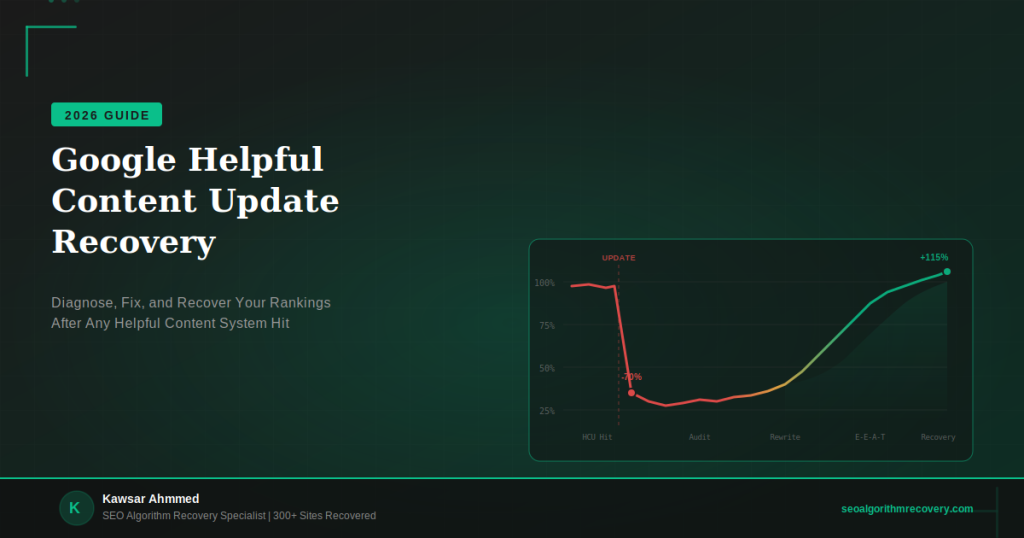
Your traffic graph looks like it fell off a cliff. Pages that ranked on page one for years suddenly sit on page three or worse. Google Search Console shows impressions tanking across entire sections of your site, not just a handful of URLs.
If that sounds familiar, you are very likely dealing with a Helpful Content Update problem.
I have worked on HCU recovery for dozens of sites since Google first rolled out this system in August 2022. Some of those recoveries took four weeks. Others took four months. The difference almost always comes down to how accurately the site owner diagnosed the problem and how aggressively they acted on the right fixes.
This guide walks you through exactly what the Helpful Content system evaluates in 2026, how to confirm whether HCU is actually your issue, a rewrite framework that works, E-E-A-T actions you can take this week, and a real recovery case study with traffic screenshots and timelines.
If your site took a hit after any recent Google algorithm update, keep reading. The recovery path is clear once you understand what Google is actually looking for.
What the Helpful Content System Actually Evaluates (2026 Version)
Let me be direct about something most guides get wrong. The Helpful Content system is no longer a standalone update. Google folded it into core ranking systems in March 2024. That means the signals it uses now feed directly into every core update, including the March 2026 core update that just rolled out.
So what does the system actually measure? Based on my work recovering 300+ websites and Google’s own documentation, here is what matters most in 2026:
Site-Wide Content Quality Signal
This is the big one. The HCU classifier does not look at individual pages in isolation. It scores your entire domain. If a large enough portion of your content reads as thin, templated, or written for search engines rather than people, the classifier can suppress rankings across your whole site. Even your genuinely good pages suffer.
I have seen sites with 200 pages of solid content lose visibility because they also published 500 pages of low-effort filler. The math is brutal. The ratio matters.
People-First vs. Search-First Content
Google asks a simple question about every page: was this made primarily to help a real person, or was it made to attract search engine traffic? That distinction sounds philosophical, but in practice it is extremely concrete. Search-first content tends to cover topics the author has no real experience with, stuffs keywords into headings that read unnaturally, adds word count for its own sake, and produces the same generic advice already available on a hundred other sites.
People-first content, by contrast, draws on actual experience. It gives the reader something they cannot easily find elsewhere. It answers their question thoroughly and then stops instead of padding.
AI Content Detection (The 2026 Nuance)
Google has been clear: AI-generated content is not automatically penalized. But AI content that is published at scale without meaningful human editing, fact-checking, or added expertise absolutely triggers quality issues. In 2026, the classifier has become much better at identifying content patterns that indicate mass production: uniform sentence structures, surface-level coverage with no original data, absence of personal anecdotes or case-specific details.
If you used AI to produce content, the question is not whether you used AI. The question is whether a knowledgeable human reviewed, improved, and added their expertise to every piece before it went live.
Topical Authority
Google now evaluates whether your site consistently demonstrates depth in a specific subject area. A website covering SEO recovery topics consistently will outrank a general marketing blog that occasionally posts about algorithm updates. This is topical authority in action, and it ties directly into how the Helpful Content system classifies your domain.
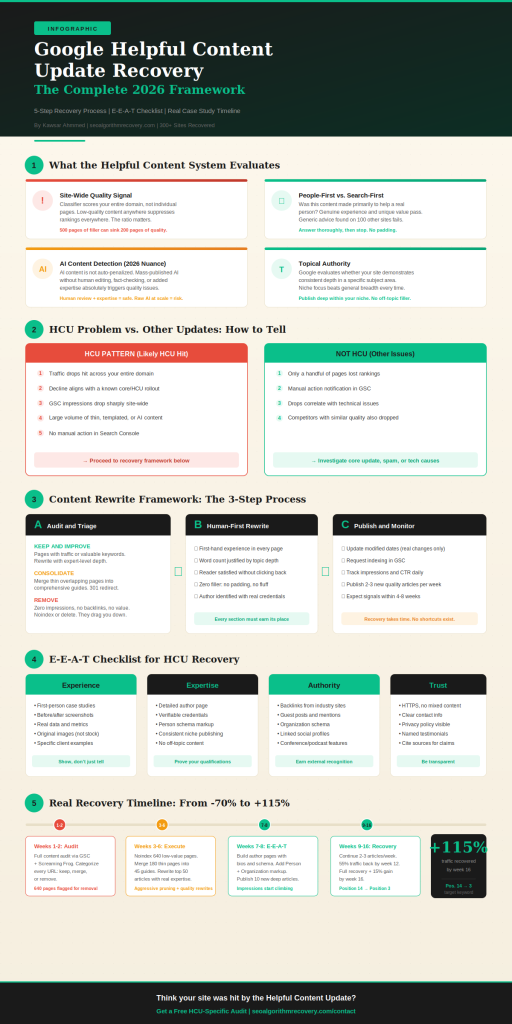
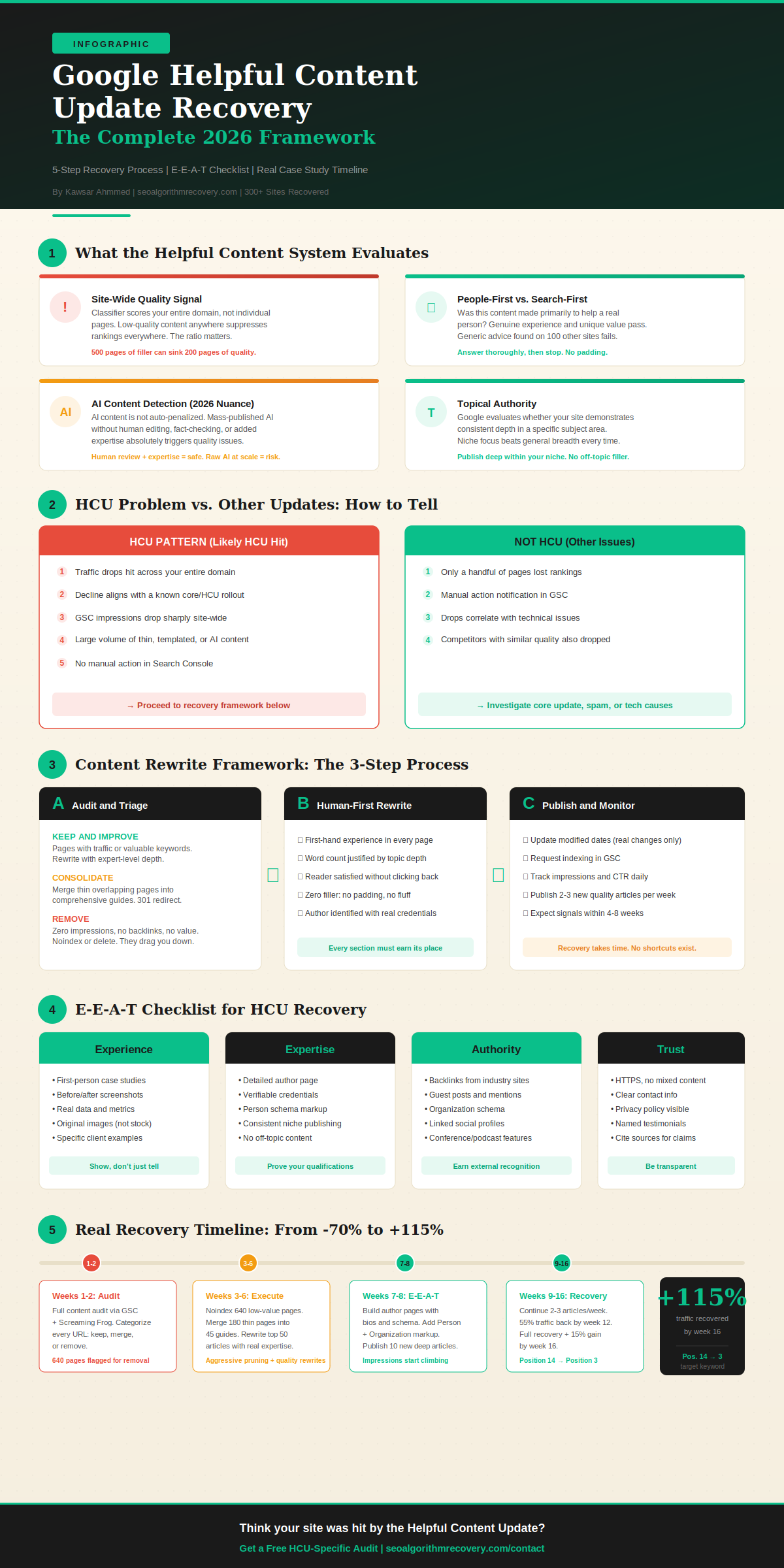
Signs Your Site Has an HCU Problem vs. Other Updates
Not every traffic drop after a Google update is an HCU issue. Misdiagnosis wastes months. Here is how I separate HCU problems from core update shifts, spam penalties, and technical issues.
HCU Pattern
- Traffic drops hit across your entire domain, not isolated to a few pages or one subfolder.
- The decline happened during or shortly after a known core update or helpful content update rollout.
- Impressions in Google Search Console dropped significantly. Your pages still exist in the index, but Google is showing them far less often.
- Your site has a significant volume of thin or templated content: pages under 400 words, articles that repeat the same structure, posts written purely around a keyword without real expertise behind them.
- No manual action exists in Google Search Console under Security & Manual Actions.
Not HCU (More Likely Core Update or Other Issues)
- Only a handful of specific pages lost rankings while the rest of the site remained stable.
- You see a manual action notification in Search Console.
- Traffic drops correlate with technical issues like broken pages, crawl errors, or a robots.txt change.
- Competitors with similar content quality also dropped at the same time (this suggests a broader ranking shuffle, not a quality penalty).
If the HCU pattern matches your situation, proceed to the recovery framework below. If you are unsure, request a detailed algorithm recovery audit so we can pinpoint the exact cause before you invest time in the wrong fixes.
Content Rewrite Framework: From AI-First to Human-First
This is where recovery actually happens. I have used this framework across dozens of HCU-affected sites, and it consistently produces results within 30 to 90 days when executed properly.
Step 1: Content Audit and Triage
Pull every indexed URL from Google Search Console. Sort by impressions over the last 6 months. Divide your content into three categories:
- Keep and improve: Pages that still receive some traffic or target valuable keywords. These get rewritten.
- Consolidate: Multiple thin pages covering similar topics get merged into a single comprehensive resource with 301 redirects.
- Remove: Pages with zero impressions, no backlinks, and no strategic value. Noindex or delete these. They drag your site-wide quality score down.
Step 2: Rewrite with the Human-First Checklist
For every page in the Keep and improve category, run through these questions before the rewrite goes live:
- Does this page contain at least one insight that comes from direct experience? Not theory. Not a paraphrase of someone else’s blog post. Actual hands-on knowledge. If you are writing about algorithm recovery, you should reference a site you personally worked on. If you are writing about a product, you should have used it.
- Is the word count justified by the depth of the topic? A 3,000-word article on a topic that needs 800 words is a red flag. Every section should earn its place. If a paragraph repeats what the previous one said in different words, cut it.
- Would a reader feel satisfied after reading this page, or would they need to click back to Google for a better answer? This is the core test. If your page sends people back to the search results, it is not helpful. Period.
- Does the content avoid filler patterns? Filler includes: restating the question as the introduction, adding dictionary definitions the reader already knows, padding sections with phrases like ‘it is important to note that’ or ‘in this section we will discuss.’ Strip all of it.
- Is the author clearly identified with real credentials? Author name, bio, and relevant experience should be visible on the page. Anonymous content struggles under the current system.
Step 3: Update Publishing and Modified Dates
Once content is rewritten and genuinely improved, update the modified date in your CMS. Do not fake dates on content that has not actually been changed. Google can and does compare cached versions. Update dates only when real, substantive changes have been made.
E-E-A-T Building Checklist Specific to HCU Recovery
E-E-A-T (Experience, Expertise, Authoritativeness, Trustworthiness) is not a separate ranking factor. It is the lens through which Google evaluates whether your content meets the bar set by the Helpful Content system. Here is a practical checklist I use with every algorithm recovery project:
Experience Signals
- Add first-person case studies or examples to every key service or informational page. A sentence like ‘When I audited a client’s 4,000-page site in 2025, we found 60% of the content had zero impressions over 12 months’ carries more weight than generic advice.
- Include screenshots, data tables, or before-and-after metrics where possible. Real data is hard to fake and Google’s systems recognize this.
- Use original images. Stock photos do nothing for E-E-A-T. A screenshot from your Google Search Console showing traffic recovery is worth more than a polished infographic.
Expertise and Authoritativeness
- Create a detailed author page with verifiable credentials, work history, and links to published work or social profiles.
- Implement structured data for the author (Person schema) and for the organization (ProfessionalService or Organization schema).
- Build topical authority by publishing consistently within your niche. If you run an SEO recovery site, every blog post should reinforce your coverage of algorithm updates, recovery strategies, and technical SEO. Do not publish off-topic content.
- Earn mentions and backlinks from reputable industry sources. Guest posts on relevant publications, podcast appearances, and conference speaking all build authoritativeness signals that Google can verify.
Trust Signals
- Ensure HTTPS across the entire domain with no mixed content warnings.
- Publish clear contact information, a physical address (if applicable), and a privacy policy.
- Display genuine client testimonials and reviews with names, not anonymous quotes.
- Cite sources for factual claims. Link out to authoritative references rather than making unsupported statements.
Real Recovery Case Study: Timeline and Metrics
Here is a condensed version of a recovery I led in late 2025 for a content-heavy site in the news and media niche that lost approximately 70% of its organic traffic after back-to-back core updates.
The Problem
The site published over 1,200 articles across multiple categories. Roughly 800 of those articles were produced using AI tools with minimal human editing. Most articles were between 300 to 600 words, covering broad topics with no original reporting or unique data. Google’s classifier flagged the domain as predominantly unhelpful. Even well-written articles on the site stopped ranking.
The Recovery Plan
Weeks 1 to 2: Full content audit using Google Search Console and Screaming Frog. Categorized every URL into keep, consolidate, or remove. Identified 640 articles for removal and 180 for consolidation.
Weeks 3 to 6: Noindexed the 640 low-value pages. Merged 180 articles into 45 comprehensive guides with proper 301 redirects. Rewrote the top 50 performing articles with original insights, expert commentary, and current data.
Weeks 7 to 8: Built detailed author pages with bylines, social links, and credentials. Added Person and Organization schema. Published 10 new in-depth articles within the site’s core topical area.
Weeks 9 to 12: Continued publishing quality content at a pace of 2 to 3 articles per week. Monitored Search Console impressions and click-through rates daily.
The Results
By week 8, impressions started climbing. By week 12, the site had recovered approximately 55% of its lost organic traffic. After 16 weeks, traffic exceeded pre-update levels by about 15%, and the site’s top-performing article went from position 14 to position 3 for its target keyword.
The takeaway: aggressive content pruning combined with genuine quality improvement works. But it takes time for Google’s systems to reassess your domain. There is no shortcut for this part of the process.
If your site went through a similar traffic collapse, I have documented the full Discover and core update recovery process here.
Think your site was hit by the Helpful Content Update?
Get a Free HCU-Specific Audit from Kawsar Ahmmed
I will diagnose whether HCU, a core update, or a technical issue caused your traffic drop and give you a clear recovery roadmap.

Frequently Asked Questions
How long does helpful content update recovery take?
It depends on the severity of the issue and how quickly you act. In my experience, sites that aggressively prune low-quality content and rewrite key pages start seeing improvement in 4 to 8 weeks. Full recovery can take 3 to 6 months. Google’s systems need time to reassess your domain after you make changes. There is no way to speed up the classifier itself, but the sooner you fix the content, the sooner recovery begins.
Can I recover from HCU without deleting content?
In some cases, yes. If your low-quality content is limited to a small percentage of your total pages, rewriting may be enough. But if half or more of your site consists of thin or AI-generated filler, deletion or noindexing is almost always necessary. Improving the ratio of helpful to unhelpful content is the fastest lever you can pull.
Is AI-generated content automatically penalized by Google?
No. Google has stated that AI content is not automatically against its guidelines. The issue is AI content published at scale without human expertise, editing, or original value added. If a human expert reviews, fact-checks, and enriches AI-generated drafts with real experience, the content can rank well. The problem is when AI content is published as-is with no meaningful human touch.
What is the difference between HCU and a core update penalty?
The Helpful Content system is now part of Google’s core ranking systems, so the line is blurred. However, HCU specifically targets site-wide content quality patterns. A core update might re-rank individual pages based on improved competitors or changing relevance signals. If your drop is site-wide and correlates with low-quality content patterns, it is likely HCU-related. If only specific pages dropped while others held or improved, it is more likely a general core update re-ranking.
Should I hire an expert for HCU recovery or do it myself?
If you have the technical knowledge to audit content quality, run Search Console analysis, and execute content rewrites at scale, you can handle it yourself using the framework in this guide. However, most site owners I work with have already tried fixing things on their own and either misdiagnosed the problem or did not go far enough with content pruning. An experienced algorithm recovery specialist can save you months of trial and error.
Further Reading
- Google March 2026 Core Update Recovery Guide
- How to Get Bing AI Citations for Your Website
- Google February 2026 Discover Core Update Recovery
If you would rather have this diagnosed and fixed for you than work through it yourself, the helpful content recovery service starts with a free 48 hour diagnosis.