Expired domain abuse is a Google spam policy that targets the practice of purchasing an expired domain name and repurposing it primarily to manipulate search rankings by hosting content that provides little to no value to users. Google formalized this as a violation in March 2024.
Buying an expired domain for its backlink authority used to be one of the fastest shortcuts in SEO. That shortcut is now a direct path to a penalty. Google has spent the last two years building detection systems that identify when an aged domain is being used to game rankings rather than serve a genuine audience.
I have worked on recovery cases where site owners invested thousands of dollars into expired domains only to watch their entire site disappear from the index within weeks. The penalty is avoidable if you understand what triggers it, and recoverable if you act quickly. If your website traffic dropped after a recent Google update and you are running a site on a previously expired domain, this guide will help you determine whether expired domain abuse is the cause.
How Expired Domain Abuse Became a Formal Spam Policy?
Google announced expired domain abuse as a new spam category in March 2024 alongside the core update and spam policy overhaul. The policy was clear from the start: repurposing an expired domain to boost low-value content using the domain’s inherited authority signals is spam.
Google’s own documentation provides specific examples of what this looks like in practice:
- Affiliate content hosted on a site previously used by a government agency
- Commercial medical products sold on a domain that formerly belonged to a nonprofit medical charity
- Casino or gambling content published on a former elementary school website
Google was direct in its language: “Expired domain abuse isn’t something people accidentally do.” This was a deliberate signal that the policy targets intentional manipulation, not legitimate domain acquisitions. Since March 2024, enforcement has escalated through every major spam update cycle, with SpamBrain receiving upgrades in August 2025 and again in March 2026.
How SpamBrain Detects Expired Domain Misuse?
SpamBrain is the AI system behind every Google spam update. It analyzes patterns across the entire web and flags sites that show manipulation signals. For expired domains specifically, SpamBrain evaluates multiple detection layers simultaneously.
| Detection Signal | What SpamBrain Analyzes |
| Topical Mismatch | New content is completely unrelated to the domain’s historical topic. A former education site now publishing crypto trading guides is an obvious flag. |
| Ownership Change Patterns | Domain registration transfer followed by immediate content overhaul and aggressive publishing. The timeline gap between expiration and relaunch is a strong signal. |
| Backlink Profile Anomalies | Inherited backlinks pointing to content that no longer exists or is topically irrelevant. Anchor text mismatch between old links and new content. |
| Content Quality Ratio | High volume of thin, templated, or AI-generated pages published immediately after domain acquisition without original research or expertise signals. |
| Redirect Chains | Expired domains used as 301 redirect vehicles to pass authority to an unrelated money site. SpamBrain evaluates the entire link graph to spot these patterns. |
According to industry data, roughly 40% of abused expired domains carry toxic backlink histories that compound the penalty risk. Running a complete SEO audit on any expired domain before building on it is not optional in 2026. It is the minimum requirement. You can review Google’s full spam policies for the complete list of violations that SpamBrain targets.
Signs Your Expired Domain Triggered a Penalty
Expired domain abuse can result in either a manual action or an algorithmic demotion. The symptoms differ, and misdiagnosing the type leads to wasted recovery effort. I have written a detailed comparison of manual actions vs. algorithmic penalties that covers the diagnostic process in depth. Here are the key indicators specific to expired domain abuse:
Manual Action Indicators
- A “Site reputation abuse” or “Pure spam” manual action notification appears in Google Search Console
- Entire site or large sections suddenly disappear from the index
- The manual action appeared shortly after a spam update rollout
Algorithmic Demotion Indicators
- Gradual traffic decline across the entire domain, not isolated to specific pages
- Rankings drop for keywords that previously ranked well based on inherited authority
- New content fails to index or indexes but ranks nowhere despite strong on-page optimization
- The decline timeline aligns with a core or spam update (check the Google Search Status Dashboard for exact dates)
If the decline coincides with increased AI content detection enforcement, the problem may be compounded. Many expired domain operators fill their sites with AI-generated content at scale, which triggers both expired domain abuse and scaled content abuse simultaneously.
Recovery Options: Save the Domain or Start Fresh
The recovery path depends on how severely the domain is compromised and whether the abuse was intentional or inherited. Here is the decision framework I use with clients.
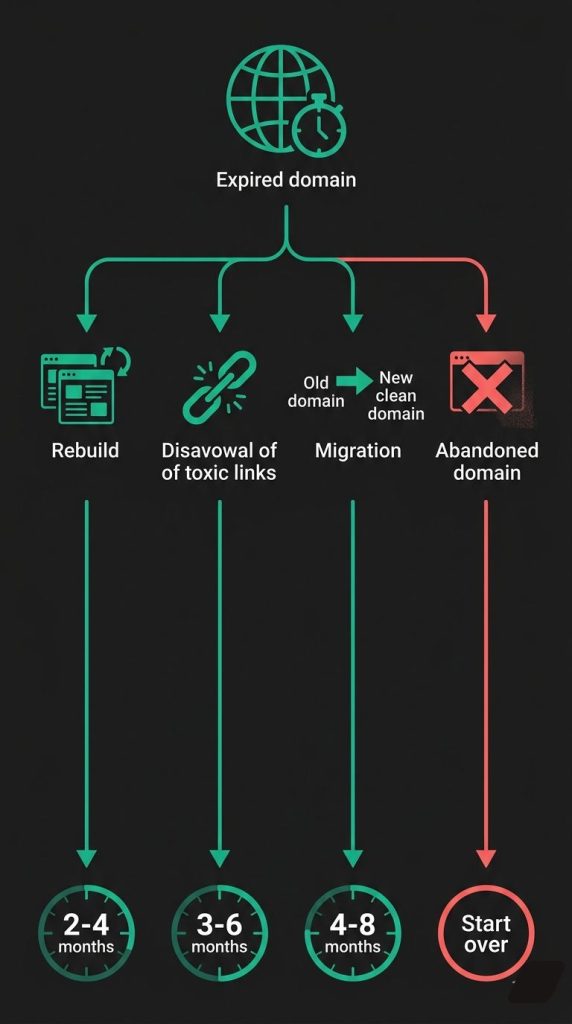
Option 1: Rebuild Content Relevance on the Existing Domain
This works when the domain has a clean manual action history and the content mismatch is moderate. Remove all content that is unrelated to the domain’s original topic. Rebuild the site with original, expert-level content that aligns with the domain’s historical authority. Resubmit the sitemap and monitor indexing patterns over 60 to 90 days.
Option 2: Clean Up Inherited Toxic Links
Use Ahrefs, Semrush, or Google Search Console’s link report to identify backlinks pointing to pages that no longer exist or that came from spammy sources. Build a disavow file for links that are clearly manipulative. This is especially important when the expired domain was previously part of a private blog network.
Option 3: Migrate to a Fresh Domain
This is the right choice when the domain carries a manual action, has a deeply toxic backlink profile, or was previously used for content that is completely unrelated to your business. Do not redirect the expired domain to the new one. That transfers the penalty. Start clean, build authority from scratch, and focus on earning links through original content.
| The domain was part of a PBN network | Recommended Action | Expected Recovery Timeline |
| Moderate topical mismatch, no manual action | Rebuild content relevance on existing domain | 2 to 4 months |
| Toxic backlink profile inherited from previous owner | Disavow toxic links + content rebuild | 3 to 6 months |
| Manual action issued, severe topical mismatch | Migrate to a fresh domain | 4 to 8 months (new domain authority building) |
| Domain was part of a PBN network | Abandon the domain entirely | Start from zero on a clean domain |
Google has stated that improvements only become visible when automated systems recognize compliance over a period of months. Patience is part of the process. You can review my full recovery audit methodology for a detailed look at how I structure recovery timelines for clients dealing with domain-level penalties.
When Buying an Expired Domain Is Not Abuse?
Google’s policy specifically says it is fine to use an old domain name for a new, original site that is designed to serve people first. The violation is about intent and execution, not the act of purchasing an expired domain itself. If you acquire a domain in your industry, build genuinely helpful content, and do not rely on inherited backlinks to rank, you are not violating the policy. The line is clear: domains purchased to exploit old authority signals for content that adds no value are spam. Domains purchased for legitimate business use with original content are not. This same principle applies across Google’s broader content quality framework, including the standards enforced through the Discover core update and helpful content systems.
Need Help Diagnosing an Expired Domain Penalty?
If you built a site on an expired domain and your rankings have collapsed, the first step is figuring out whether expired domain abuse is actually the cause or whether a separate algorithm update hit your content quality or backlink profile.
I offer a free expired domain penalty diagnosis. Send me your domain and Search Console access, and I will tell you within 48 hours exactly what triggered the drop, whether recovery is viable on the existing domain, and what the fastest path to restored rankings looks like. With 300+ successful recoveries across ecommerce, healthcare, SaaS, and local businesses, I have seen every variation of this penalty and know how to fix it.
Request your free assessment at seoalgorithmrecovery.com/contact.
About the Author
Kawsar Ahmmed is the founder of SEO Algorithm Recovery and a specialist in Google penalty diagnosis and recovery. With 7+ years of focused experience and 300+ successful site recoveries, he helps businesses regain lost organic traffic after algorithm updates, manual actions, and spam penalties. Learn more about his recovery framework and audit process.