What is a post-update SEO audit checklist?
A post-update SEO audit checklist is a structured framework that helps you diagnose exactly why your site lost rankings after a Google algorithm update. It covers four core areas: technical SEO health, content quality signals, on-page optimization gaps, and backlink profile issues. Running this audit within 7 to 14 days of an update gives you the fastest path to recovery.
Why You Need a Structured Audit After Every Algorithm Update?
I have recovered over 300 websites from Google algorithm penalties since 2018. The single biggest mistake I see site owners make after a ranking drop is reacting without a diagnosis. They start changing title tags, rewriting random pages, or disavowing links before they even know what triggered the decline.
That approach wastes weeks and often makes things worse.
A structured SEO audit checklist eliminates the guesswork. Instead of scrambling, you follow a systematic process that isolates the actual problem. Whether your traffic dropped after the March 2026 Core Update, a spam penalty, or a Helpful Content system adjustment, this checklist tells you exactly where to look and what to fix.
In 2026, Google evaluates sites across multiple quality dimensions simultaneously. A single-layer audit focused only on technical issues or only on content is not enough. The checklist below covers all four pillars that determine whether your site recovers or continues to decline.
Section 1: Technical SEO Audit Checklist
Technical SEO is the foundation. If Google cannot crawl, render, or index your pages properly, no amount of content improvement will bring your rankings back. Start here before touching anything else.
| Check Item | What to Audit and Why |
| Crawlability | Check robots.txt for accidental blocks. Verify Googlebot can access CSS, JS, and critical resources. Review crawl stats in Search Console for crawl errors and response code spikes. |
| Indexing Status | Run site:yourdomain.com to check indexed page count. Compare against your sitemap. Look for pages dropping out of the index after the update, which signals a quality-based deindexing. |
| XML Sitemap Health | Confirm your sitemap includes only indexable, canonical URLs. Remove 404s, redirected URLs, and noindexed pages. Submit a fresh sitemap through Search Console after cleanup. |
| Core Web Vitals | Check PageSpeed Insights for LCP, INP, and CLS scores on your top 20 landing pages. Google treats CWV as a tiebreaker, but poor scores compound the impact of other quality issues. |
| HTTPS and Security | Every page should load over HTTPS with a valid SSL certificate. Check for mixed content warnings. Confirm all internal links, canonicals, and sitemap URLs reference the HTTPS version. |
| Mobile Usability | Test your top pages with Google’s mobile-friendly test. With mobile-first indexing, Google uses your mobile version for ranking. Layout shifts, tap target issues, and viewport problems hurt recovery. |
| Redirect Chains | Audit for redirect chains longer than two hops. Each redirect dilutes PageRank and increases crawl latency. Flatten chains to direct 301 redirects from source to final destination. |
| Server Response Time | Target TTFB under 200ms. Slow server responses signal infrastructure problems that affect Googlebot’s crawl efficiency. Check hosting performance during peak traffic hours. |
Pro tip: Export your Search Console coverage report before and after the update date. Comparing the two snapshots reveals exactly which pages Google removed from the index or flagged with new issues. I use this approach in every algorithm recovery audit I deliver to clients.
Section 2: Content Quality Audit Checklist
Content quality is the primary target of most Google algorithm updates in 2025 and 2026. The Helpful Content Update system now runs continuously as part of Google’s core ranking infrastructure. If your content does not demonstrate genuine expertise, experience, and usefulness, it will lose visibility regardless of how strong your technical SEO is.
| Check Item | What to Audit and Why |
| Thin Content Identification | Pages with fewer than 300 words of substantive content are high-risk. Run a crawl with Screaming Frog to flag pages by word count. Thin pages either need expansion with original analysis or consolidation into stronger pages. |
| AI Content Detection | Google does not penalize AI content by default, but it does penalize low-quality AI content that lacks originality. Review pages that lost rankings and check whether they read like generic AI output without unique data points, expert perspective, or first-hand experience. |
| Topical Authority Gaps | Map your existing content against topic clusters. Algorithm updates reward sites that demonstrate depth across a subject area. Scattered, unrelated content signals a lack of topical focus to Google’s systems. |
| Search Intent Alignment | For every page that lost rankings, search the target keyword and analyze the current top 10 results. If Google now shows a different content format or intent type, your page may need restructuring to match what Google considers the right answer. |
| Content Freshness | Pages with outdated statistics, year references, or stale information get deprioritized after core updates. Update data points, remove obsolete sections, and add current year context where relevant. |
| Duplicate and Cannibalization | Run a site-level search for your target keywords. If multiple pages compete for the same term, Google splits authority between them. Consolidate or differentiate cannibalized pages with distinct intent targeting. |
From my experience recovering sites hit by the Helpful Content system, the fastest wins come from identifying and improving (or removing) the bottom 20% of your content. Pages with high impressions but zero clicks, pages with bounce rates above 85%, and pages that cover topics outside your core expertise are the usual culprits. I covered this process in detail in my guide on whether Google penalizes AI-generated content.
Section 3: On-Page SEO Audit Checklist
On-page optimization failures are often invisible until an algorithm update exposes them. These are the structural signals Google uses to understand what your page is about, how authoritative the author is, and whether the content deserves a top-10 position.
| Check Item | What to Audit and Why |
| Title Tag Optimization | Your title tag should include the primary keyword naturally within the first 60 characters. After an update, check if competing pages have shifted their title strategy. Align your titles with the current SERP format Google rewards. |
| Meta Description CTR | While not a direct ranking factor, meta descriptions affect click-through rates. Low CTR sends negative engagement signals to Google. Write descriptions that address the user’s pain point and include a clear value proposition. |
| Heading Structure (H1-H3) | Every page needs exactly one H1 that matches the search intent. Use H2s for major sections and H3s for subsections. Heading hierarchy helps Google understand content structure and can trigger featured snippet selection. |
| Internal Linking Architecture | Pages that lost rankings after an update often have weak internal linking. Add contextual links from high-authority pages to pages that need ranking support. Use descriptive anchor text that reflects the target page’s primary keyword. |
| Schema Markup Implementation | Structured data helps Google understand your content type and can earn rich results. Implement Article, FAQPage, HowTo, and BreadcrumbList schemas on relevant pages. Validate with Google’s Rich Results Test. |
| Image Alt Text and Compression | Every image should have descriptive alt text with natural keyword integration. Compress images to WebP format where possible. Large unoptimized images slow page load and hurt Core Web Vitals scores. |
| E-E-A-T Author Signals | Add visible author bylines, link to detailed author bio pages, and include credentials relevant to the topic. Google’s quality raters specifically evaluate whether content creators have demonstrated expertise and first-hand experience. |
If your site was hit by the March 2026 Core Update, pay special attention to E-E-A-T author signals. The update increased weighting on verifiable authorship, particularly for informational and YMYL content. Sites without visible author credentials saw the steepest drops across the data I tracked from my audit portfolio.
Section 4: Backlink Profile Audit Checklist
Toxic backlinks and unnatural link patterns are among the top reasons sites fail to recover after algorithm updates. Even if links were not the primary trigger, a polluted backlink profile prevents Google from trusting your site enough to restore rankings. My guide on spam update recovery covers this in depth, but here is the audit framework.
| Check Item | What to Audit and Why |
| Toxic Link Identification | Export your full backlink profile from Ahrefs or Semrush. Flag links from spammy domains, PBNs, link farms, foreign-language sites unrelated to your niche, and sites with DR below 10 and no organic traffic. These are your disavow candidates. |
| Anchor Text Distribution | A natural backlink profile has diverse anchor text. If more than 15% of your anchors are exact-match keywords, Google may view this as manipulative. Map your anchor text ratios and compare against top-ranking competitors. |
| Link Velocity Analysis | Sudden spikes in new backlinks (especially from low-quality sources) trigger algorithmic scrutiny. Check your link acquisition timeline for unnatural patterns that coincide with ranking drops. |
| Disavow File Management | If you identify toxic links, create or update your disavow file in Google Search Console. Disavow at the domain level for clearly spammy sources. Review your existing disavow file to ensure it is not accidentally blocking valuable links. |
| Referring Domain Quality | Count the percentage of referring domains that have actual organic traffic and topical relevance to your site. A healthy profile has 70%+ referring domains with real authority, not just domain rating numbers. |
| Lost and New Links | Check which backlinks you gained or lost around the update date. Losing links from high-authority pages can amplify ranking drops. Identify opportunities to reclaim lost links through outreach. |
How to Use This Checklist: Step-by-Step Recovery Process
Running through the checklist items above is only valuable if you follow a structured recovery sequence. Here is the exact process I use with clients who come to me after losing traffic to a Google update.
Step 1: Confirm the Update Impact (Day 1)
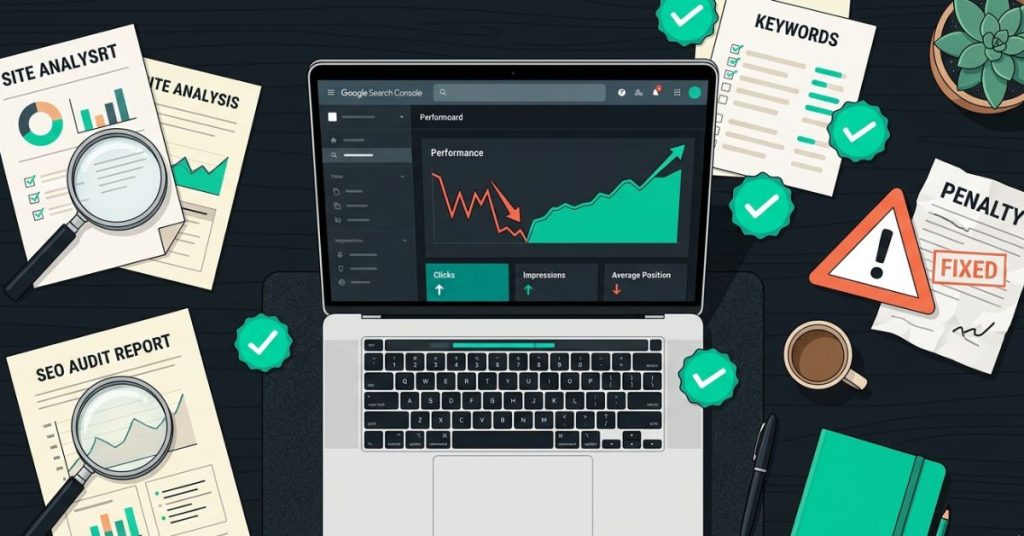
Log into Google Search Console and compare your traffic for the 7 days after the update against the 7 days before. Identify which pages, queries, and countries lost the most impressions and clicks. Cross-reference the update date against Google’s Search Status Dashboard to confirm which update hit your site.
Step 2: Run the Technical Audit (Days 2 to 3)
Crawl your entire site with Screaming Frog or Sitebulb. Export the technical issues list and prioritize blockers: indexing errors, broken canonicals, orphan pages, and crawl budget waste. Fix critical technical issues before moving to content.
Step 3: Audit Content Quality (Days 3 to 5)
Sort your pages by traffic loss severity. For each affected page, evaluate content depth, search intent alignment, E-E-A-T signals, and freshness. Flag pages for rewriting, consolidation, or removal.
Step 4: Fix On-Page Signals (Days 5 to 7)
Update title tags, heading structure, internal links, and schema markup on affected pages. Strengthen author attribution and add any missing E-E-A-T elements. Ensure every page has a clear, specific purpose that matches what Google currently rewards for that keyword.
Step 5: Clean Your Backlink Profile (Days 7 to 10)
Export your backlink data, identify toxic links, and submit an updated disavow file if needed. Simultaneously, begin outreach to reclaim any recently lost high-quality backlinks.
Step 6: Monitor and Iterate (Days 10 to 30)
Track ranking movements and organic traffic daily for 30 days after implementing changes. Google typically takes 2 to 4 weeks to reassess a site after improvements. If recovery is partial, repeat the audit cycle focusing on pages that have not yet responded.
Do Not Forget AI Search Engines
In 2026, your visibility is not limited to Google. AI-powered search engines like Bing’s Copilot, Perplexity, and Google’s own AI Overviews pull from the same content signals that traditional algorithms evaluate. If your audit reveals structural data gaps, missing schema markup, or poor content organization, you are losing visibility across multiple search surfaces simultaneously.
My analysis of how Bing AI citations work showed that sites with clear heading structures, FAQ schema, and concise answer blocks get cited significantly more often in AI-generated responses. These are the same signals that also improve your Google rankings.
5 Common Mistakes to Avoid During Post-Update Audits
1. Reacting too fast. Do not make sweeping changes within the first 48 hours of an update. Rankings often fluctuate during rollout. Wait for the update to finish before diagnosing.
2. Changing everything at once. If you rewrite content, update technical settings, and disavow links simultaneously, you will never know which fix actually worked. Make changes in batches and measure each one.
3. Ignoring Search Console data. Your GSC data is the single most reliable diagnostic tool. External rank trackers can show misleading volatility. Always verify with first-party data.
4. Copying competitor strategies blindly. Just because a competitor ranks after the update does not mean their approach will work for your site. Different sites have different authority profiles, content histories, and trust signals.
5. Skipping the backlink audit. Even if the update was content-focused, a dirty backlink profile amplifies negative signals. Always include backlink hygiene in your audit.
Download the Free SEO Audit Checklist Template
I have packaged all four audit sections above into a downloadable PDF template you can use for your own site. It includes tick boxes, priority columns, and space for notes. Enter your email on the contact page, and I will send it directly.
Need expert help instead? I offer a free preliminary audit where I diagnose the exact algorithm update that affected your site and outline a recovery plan specific to your situation. Book a free audit with Kawsar Ahmmed.
Frequently Asked Questions
How soon should I run an SEO audit after a Google update?
Wait until Google confirms the update rollout is complete (usually 1 to 2 weeks). Then run your audit immediately. Acting during the rollout period can lead to misdiagnosis because rankings are still fluctuating.
Can I recover from a Google algorithm penalty without professional help?
Yes, if the issues are straightforward, like thin content or missing meta tags. But complex cases involving multiple overlapping penalties, toxic backlink profiles, or site-wide Helpful Content demotions typically require specialist intervention. The checklist above gives you the diagnostic framework to assess whether you can handle it yourself.
How long does recovery take after an algorithm update?
It depends on the severity and type of update. Technical fixes can show results within 1 to 2 weeks after recrawling. Content-based recovery typically takes 4 to 8 weeks. Full recovery from a Helpful Content demotion can take 3 to 6 months because Google needs to reassess your entire site.
Does Google penalize AI-generated content?
Google does not penalize content simply because it was generated by AI. It penalizes content that is low quality, unhelpful, or lacks originality regardless of how it was produced. The key is ensuring AI-assisted content includes genuine expertise, original analysis, and human editorial oversight.
What tools do I need to run this SEO audit?
At minimum, you need Google Search Console (free), a site crawler like Screaming Frog (free for up to 500 URLs), and a backlink analysis tool like Ahrefs or Semrush. PageSpeed Insights and Google’s Rich Results Test are also free and essential for the technical and schema portions of the audit.
Final Thoughts
Every algorithm update is a ranking reset, not a ranking death sentence. The sites that recover fastest are the ones that follow a disciplined audit process instead of panicking. This checklist gives you the same framework I use across 300+ client recoveries.
If you have gone through this checklist and still cannot identify the root cause of your traffic drop, the issue may require deeper analysis. Feel free to reach out for a free site diagnosis. I respond to every request within 24 hours.
Kawsar Ahmmed
SEO Algorithm Recovery Specialist