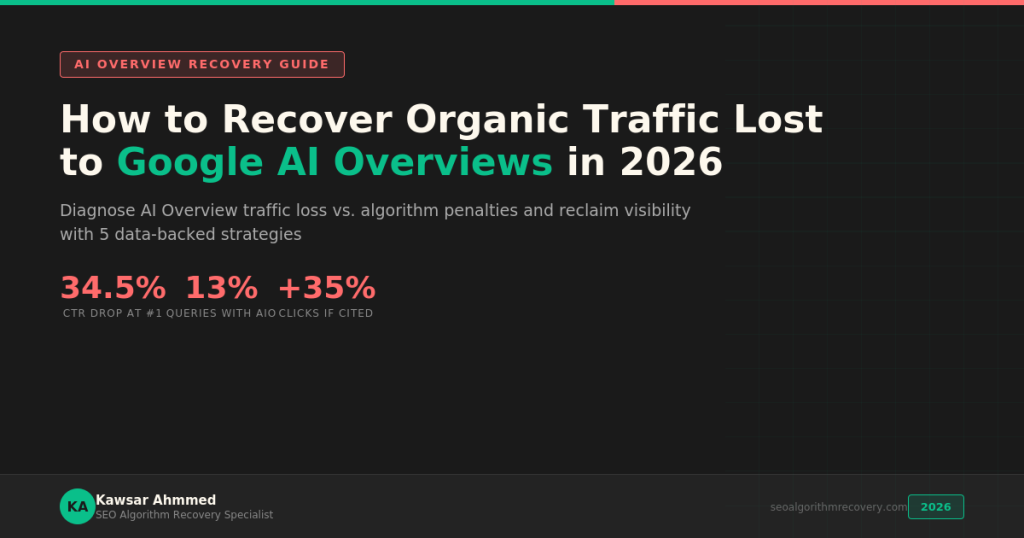
If your organic traffic started declining in late 2025 or early 2026 without any obvious algorithm penalty, you may not have a content quality problem at all. Google AI Overviews are now answering user queries directly on the search results page, absorbing clicks that used to go to your website. According to a large-scale Ahrefs study covering 300,000 keywords, position-1 organic CTR drops by up to 34.5% when an AI Overview appears above traditional results.
This is not a temporary disruption. AI Overviews currently appear on roughly 13% of all queries in 2026, up from under 5% during the initial 2025 rollout. Industry analysts project coverage will reach 20-25% by year-end 2026. For informational content, the impact is even steeper, with some publishers reporting CTR declines of 30-40% on queries where AI summaries fully answer the user’s question.
I have worked with over 300 websites recovering from various forms of Google traffic loss, and what makes AI Overviews particularly challenging is that traditional recovery signals do not apply. Your rankings may look fine. Your content quality may be excellent. But your clicks are disappearing because the search results page itself has changed. In this guide, I will walk you through how to tell if AI Overviews caused your traffic drop, which content types are most vulnerable, and five strategies to reclaim or redirect your visibility.
How to Tell if AI Overviews Caused Your Traffic Drop vs. an Algorithm Update?
The first step in any traffic recovery is accurate diagnosis. I see site owners assume they were hit by a core update or a spam penalty when the real culprit is AI Overviews cannibalizing their clicks. The diagnostic signals are very different, and confusing the two leads to wasted effort on the wrong fixes.
Here is a diagnostic framework I use when auditing client sites to separate AI Overview traffic loss from algorithmic penalties.
| Diagnostic Signal | AI Overview Traffic Loss | Algorithm Penalty |
| Rankings in GSC | Stable or improved | Dropped significantly |
| Impressions | Stable or increased | Declined sharply |
| Clicks | Declining despite stable rankings | Declining with rankings |
| CTR trend | Gradual CTR erosion over weeks | Sudden CTR drop on a specific date |
| Affected queries | Informational, how-to, definition queries | Broad or category-specific |
| Timing | Gradual, no correlation with update dates | Aligned with confirmed update rollout |
| Manual action in GSC | None | Possible (check Security & Manual Actions) |
The tell-tale pattern of AI Overview traffic loss is this: impressions hold steady or even increase, but clicks and CTR decline gradually. One documented case study showed impressions up 27.56% year-over-year while clicks dropped 36.18% and CTR fell from 5.98% to 3.35%, despite average rankings improving by 14%. If you are seeing this pattern in your Google Search Console data, AI Overviews are the likely cause.
To confirm, manually search your top declining keywords on Google. If an AI Overview panel appears above the organic results, that query is being affected. You can also use Ahrefs or Semrush to filter keywords by SERP features and identify which of your ranking keywords now trigger AI Overviews.
If your diagnosis points to an actual algorithm penalty rather than AI Overview cannibalization, the recovery path is different. I recommend starting with a structured SEO audit checklist after a Google algorithm update to identify the specific issues a core or spam update targeted on your site.
Which Content Types and Industries Are Most Affected by AI Overviews?
AI Overviews do not affect every website equally. The impact varies dramatically by industry and content type, and understanding where your site falls on this spectrum determines your recovery strategy.
AI Overview Exposure by Industry (2026 Data)
According to BrightEdge tracking data from February 2025 through February 2026, healthcare faces the highest AI Overview exposure at approximately 70% of queries, driven by patient education, symptom searches, and treatment research. Education and technology sectors follow closely, while e-commerce queries see AI Overviews just 4% of the time. This means a health content publisher and an online retailer face fundamentally different strategic challenges.
| Industry | AI Overview Exposure | Traffic Risk Level |
| Healthcare / YMYL | ~70% | Very High |
| Education | ~60% | Very High |
| B2B Technology / SaaS | ~55% | High |
| Finance / Insurance | ~45% | High |
| Travel / Hospitality | ~30% | Medium |
| Local Services | ~15% | Low-Medium |
| E-commerce | ~4% | Low |
Content Types at Greatest Risk
Informational queries are absorbing the heaviest losses. Definitions, explanations, how-to answers, and factual lookups are exactly the type of content AI Overviews are designed to summarize. Studies show informational queries trigger AI Overviews up to 39.4% of the time, while transactional queries where users intend to purchase, navigational queries for specific websites, and local searches requiring current business information remain relatively protected.
If your site relies heavily on informational content for top-of-funnel traffic, you are in the highest-risk category. Publishers, educational platforms, and content-driven health sites have reported cumulative traffic declines ranging from 30% to as high as 42% since AI Overviews expanded. As Search Engine Journal reported in their analysis of AI Overview impact on publishers, some media companies have seen CTR drops as steep as 89% on certain informational search queries.
For YMYL industries like healthcare and finance, the overlap between AI Overview exposure and Google’s spam and quality update scrutiny creates a compounding problem. Sites that already lacked strong E-E-A-T signals before AI Overviews rolled out are now losing traffic from two directions simultaneously.
5 Strategies to Reclaim Visibility When AI Overviews Appear for Your Keywords?
Recovering traffic lost to AI Overviews requires a fundamentally different approach than traditional algorithm recovery. You are not fixing a penalty. You are adapting to a structural change in how Google displays search results. Here are five strategies I recommend to clients based on what is working in 2026.
Strategy 1: Get Cited Inside AI Overviews Instead of Competing Against Them
This is the single most impactful shift in SEO strategy for 2026. Data shows that sites referenced as sources within AI Overviews earn 35% more organic clicks than sites that simply rank below the AI panel. Instead of trying to outrank an AI Overview, you want to become one of the 3-5 sources it cites.
How to earn AI Overview citations:
Place direct, concise answers in the first 50-60 words of each section. AI systems prioritize content that directly addresses the query upfront rather than burying the answer after a long introduction.
Use clear heading hierarchies that match user query phrasing. Structure subheadings as the exact questions your audience searches. This creates a direct match between queries and your content structure, increasing citation probability.
Implement structured data markup. Add TechArticle, FAQPage, and HowTo schema on every applicable page. Structured data does not guarantee citation, but it makes your content significantly easier for AI systems to parse, attribute, and reference.
Demonstrate first-hand expertise with named authors. AI Overviews preferentially cite sources that show evidence of real-world experience. Author bylines with verifiable credentials, case studies with specific data points, and content referencing proprietary research all increase citation authority.
The sites that AI Overviews consistently cite share a common pattern: they demonstrate genuine expertise through original research, named authors with verifiable credentials, and content depth that goes beyond surface-level summaries. This is where the overlap between AI Overview optimization, answer engine optimization (AEO), and generative engine optimization (GEO) is strongest.
Strategy 2: Shift High-Value Content Toward Commercial and Transactional Intent
AI Overviews appear far less frequently on transactional and commercial queries. WebFX 2026 benchmarks show that e-commerce queries trigger AI Overviews only about 4% of the time compared to nearly 40% for informational queries. If your content strategy is heavily weighted toward pure informational content, redistributing effort toward commercial-intent pages can protect a larger share of your traffic.
Content types that remain protected from AI Overview cannibalization:
Comparison guides with original testing data. When you compare products, tools, or services using your own hands-on evaluation, AI Overviews cannot replicate the proprietary findings.
Pricing and cost analysis pages. Users searching for pricing information need current, specific numbers that change frequently, making these queries poor candidates for AI summarization.
Product reviews with firsthand experience. Reviews grounded in actual use, with original photos, performance metrics, and pros and cons based on real testing, retain click-through because AI cannot fabricate this evidence.
Interactive tools and calculators. ROI calculators, audit tools, and diagnostic quizzes require user input, which means users must visit your site to access them.
This does not mean abandoning informational content entirely. It means restructuring your content funnel so that your most critical conversion pages target query types that AI Overviews cannot easily answer.
Strategy 3: Create Content That Requires a Site Visit to Access
AI Overviews summarize text. They cannot replicate interactive tools, proprietary databases, downloadable templates, live calculators, or dynamic data visualizations. If you are losing traffic on informational queries, one of the most effective responses is to convert that content into a format that AI cannot fully reproduce on the SERP.
Practical examples of this approach:
Instead of publishing a static article listing SEO audit steps, offer an interactive audit checklist tool that personalizes recommendations based on the user’s inputs. Instead of a flat comparison table, build a filterable comparison widget. Instead of a written walkthrough, create a diagnostic quiz that outputs a customized recovery plan.
The underlying principle is simple: if your content can be fully consumed without clicking through to your site, AI Overviews will eventually summarize it. Content that requires interaction, personalization, or access to proprietary data forces the click.
Strategy 4: Invest in Original Research and Proprietary Data
AI Overviews pull from existing content across the web. If your content contains the same information as 50 other articles, AI has no reason to cite you specifically. Original research, unique datasets, case studies with real before-and-after metrics, and first-hand expert analysis are the content types that AI systems prioritize as citation-worthy sources.
The reason original data works is that AI Overviews need to attribute specific claims. When your site is the primary source of a statistic, a case study, or a unique methodology, the AI system must cite you to maintain accuracy. Generic advice articles that repackage existing information offer no attribution advantage.
From my own recovery work, I have found that publishing specific, data-backed case studies drives both AI citations and direct trust signals. When I documented the real impact of AI-generated content on Google rankings using actual audit data from client sites, that content performed significantly better in both traditional search and AI citation metrics than generic advice articles covering the same topic.
Strategy 5: Diversify Traffic Sources Beyond Google Organic Search
This is the strategic reality that many site owners resist, but the data is clear. Relying solely on Google organic search traffic is no longer a viable long-term strategy. Zero-click searches now account for approximately 60% of all queries, with mobile zero-click behavior reaching 77%. By the end of 2026, analysts project that 25% of organic search traffic will shift to AI chatbots and voice assistants as a permanent structural change.
Channels growing while organic search declines:
Google Discover grew 30% over the same period that traditional search traffic fell. Discover operates on engagement signals, content freshness, and strong headlines rather than keyword targeting, making it a valuable alternative channel.
YouTube is where most publishers plan to increase investment in 2026. Video content is inherently resistant to AI Overview summarization and builds brand authority that strengthens all other channels.
Email newsletters and LinkedIn provide direct audience relationships that no algorithm change can disrupt. For B2B audiences especially, building a subscriber base is the most reliable long-term traffic insurance.
Sites that previously recovered from expired domain abuse penalties or site reputation abuse demotions learned this lesson early. Rebuilding traffic from a single source creates the same vulnerability that caused the original loss. A diversified traffic strategy is not just good practice for AI Overview adaptation. It is the foundation of a resilient online business.
How to Identify Commercial-Intent Keywords That AI Overviews Do Not Trigger Yet?
Not every keyword in your portfolio is exposed to AI Overview cannibalization. Identifying the queries where AI Overviews do not yet appear gives you an immediate opportunity to protect and grow traffic on those terms.
Here is the process I use with clients:
- Export your full keyword list from Google Search Console (Performance > Search Results > Queries). Focus on keywords where you hold positions 1-10 with meaningful impression volume.
- Cross-reference with Ahrefs or Semrush SERP feature data to flag which keywords currently trigger AI Overviews. Both tools now include AI Overview tracking in their SERP feature reports.
- Segment your keywords into three buckets: AI Overview present (high risk), AI Overview absent (protected), and AI Overview intermittent (monitor closely).
- Prioritize content investment on AI Overview absent keywords with commercial or transactional intent. These are your protected traffic sources where traditional SEO still delivers full click-through value.
Queries with purchase intent, brand comparisons, pricing research, and local service searches are the categories least likely to trigger AI Overviews in 2026. Doubling down on content that targets these query types gives you a more resilient traffic base while competitors chase informational rankings that AI Overviews are actively cannibalizing.
Restructuring Content for AI Citation Potential
Getting sourced inside AI Overviews rather than losing traffic to them requires specific content formatting adjustments. Based on analysis of which sites AI Overviews consistently cite, here are the structural elements that improve your citation probability.
Lead with direct answers. Place a concise, factual answer to the target query within the first 50-60 words of your content. AI systems prioritize content that directly addresses the query upfront rather than burying the answer after a long introduction.
Use clear, question-based headings. Structure subheadings as the questions your audience is actually searching. This creates a direct match between user queries and your content hierarchy, increasing the likelihood that AI systems identify your content as a relevant source.
Include structured data markup. Implement FAQPage, HowTo, and TechArticle schema on every applicable page. Structured data does not guarantee AI citation, but it makes your content significantly easier for AI systems to parse, attribute, and reference.
Demonstrate first-hand expertise. AI Overviews preferentially cite sources that show evidence of real-world experience. Author bylines with verifiable credentials, case studies with specific data points, and content that references proprietary research all increase citation authority.
Optimize for featured snippets simultaneously. Content structured to win featured snippets, short paragraph answers, definition formats, and numbered step lists, follows the same formatting principles that AI Overviews use to identify citation-worthy sources. Winning a featured snippet often correlates with earning an AI Overview citation.
These content principles strengthen your site’s performance across SEO, answer engine optimization (AEO), and generative engine optimization (GEO). If you are already following a strong E-E-A-T framework, you are well-positioned. If not, I recommend reading my guide on how to distinguish a manual action from an algorithmic penalty to make sure you are solving the right problem before investing in AI Overview optimization.
Frequently Asked Questions
How do I know if my traffic drop is from AI Overviews or a Google algorithm update?
Check Google Search Console for the pattern of stable or increasing impressions combined with declining clicks and CTR. If your rankings have not dropped but your clicks have, AI Overviews are the likely cause. If rankings and impressions both dropped sharply around a confirmed update date, you are dealing with an algorithmic penalty.
Can I block Google AI Overviews from using my content?
Google’s AI Overviews use the same Googlebot crawler as traditional search. Blocking the crawler through robots.txt would also remove you from regular search results entirely, which is counterproductive. The more effective strategy is to optimize for AI citation rather than trying to opt out.
Do AI Overviews affect e-commerce sites?
E-commerce queries trigger AI Overviews only about 4% of the time based on 2026 data, making online retailers relatively protected compared to publishers and informational content sites. However, product research and comparison queries are seeing increased AI Overview presence, so monitoring is still important.
How long does it take to recover traffic lost to AI Overviews?
Unlike algorithm penalty recovery, AI Overview traffic loss is a structural change rather than a penalty to reverse. Recovery involves adapting your content strategy to earn AI citations and diversifying traffic sources. Most sites I work with begin seeing measurable improvements in AI citation rates within 4-8 weeks of implementing the strategies outlined above.
Is AI Overview optimization the same as GEO or AEO?
There is significant overlap. Generative engine optimization (GEO) focuses on visibility across all AI-powered search platforms, while answer engine optimization (AEO) targets featured snippets and direct-answer formats. AI Overview optimization is a subset of GEO specifically focused on Google’s AI summary panels. The content principles of all three are very similar: structured answers, original expertise, and strong E-E-A-T signals.
Not Sure If Your Traffic Drop Is from an Algorithm Update or AI Overviews?
Get a free traffic loss diagnosis from Kawsar Ahmmed. I will analyze your Google Search Console data, identify whether AI Overviews, a core update, a spam penalty, or a combination is behind your traffic decline, and provide a clear recovery roadmap.
Request your free audit at seoalgorithmrecovery.com