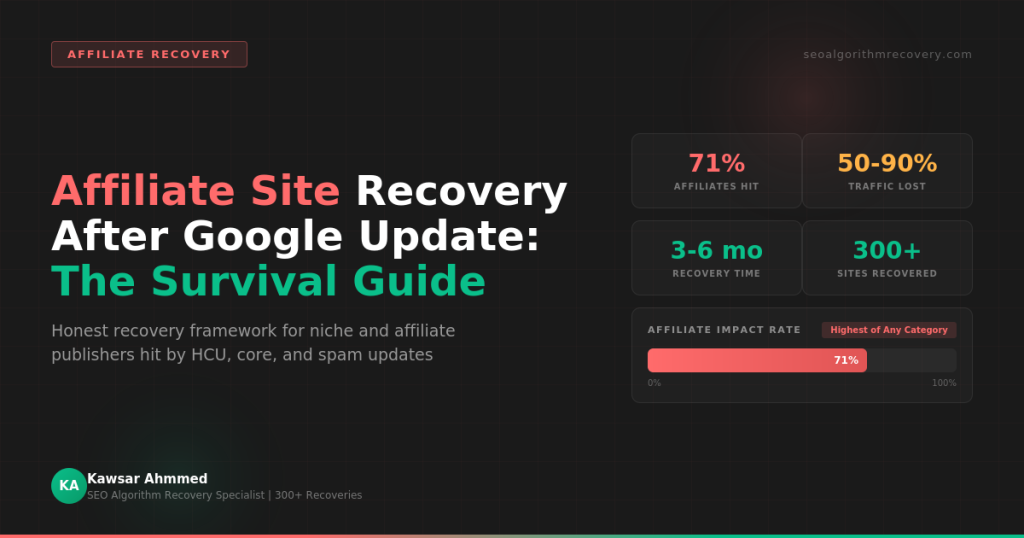
Affiliate site recovery after a Google update requires honest assessment of whether your site can survive under Google’s current quality standards. Since the September 2023 Helpful Content Update, affiliate sites have been the hardest-hit category across every major algorithm update, with 71% experiencing measurable traffic declines. Recovery is possible for affiliate sites that add genuine first-hand product experience, reduce their commercial intent ratio, rebuild E-E-A-T signals, and shift from search-first content to user-first content. This guide covers the specific recovery framework I use with affiliate site owners, including when to fix, when to pivot, and when to start fresh.
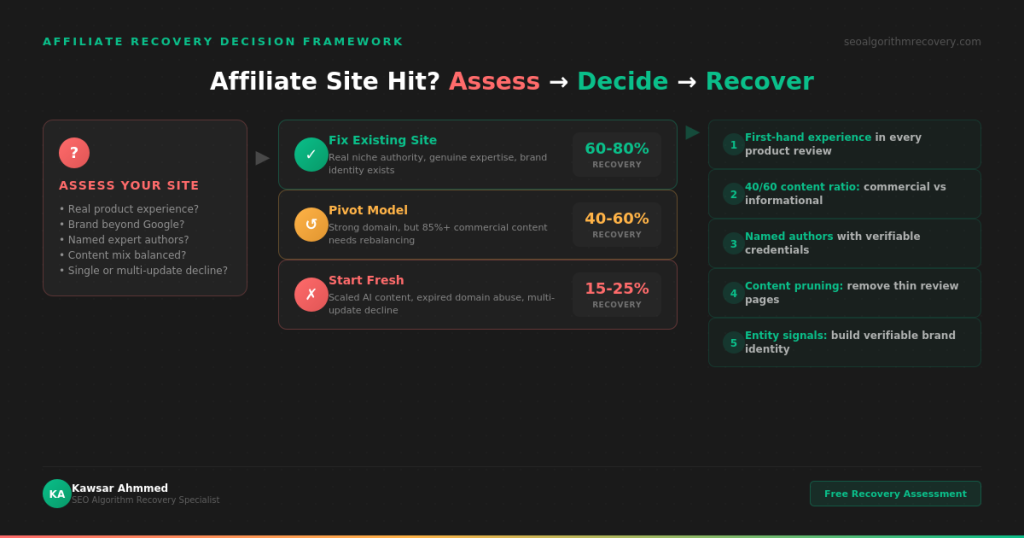
Why Affiliate Sites Are Google’s Primary Target?
Let me be direct: Affiliate sites have been under sustained algorithmic pressure since September 2023, and the situation has not improved. Every major Google update since the Helpful Content Update has disproportionately impacted affiliate and niche sites.
I have worked with affiliate site owners who lost 50-90% of their organic traffic overnight and spent months trying tactics that made no difference. The frustration is real. But understanding why Google targets affiliate sites is the first step toward determining whether recovery is even realistic for your specific site.
Here is what the data shows across recent updates:
- 71% of affiliate sites experienced negative ranking impacts during the December 2025 Core Update, the highest percentage of any content category
- 32% of travel publishers (213 out of 671 analyzed) lost more than 90% of organic traffic after the HCU
- Affiliate sites with thin product reviews saw 60-80% traffic declines across the March 2026 Core Update
- Sites where the primary purpose is generating affiliate commissions rather than helping users are now classified as low-quality by Google’s systems
The core problem is structural. Most affiliate sites were built with a single purpose: rank for commercial keywords and earn commissions through affiliate links. Google’s helpful content system now evaluates whether a site would have a reason to exist if search engines did not. For many affiliate sites, the honest answer is no.
The Affiliate Recovery Decision: Fix, Pivot, or Start Fresh
Before investing time and money into recovery, every affiliate site owner needs to make an honest assessment. Not every affiliate site can or should be recovered. I tell clients this upfront because wasting six months on a site that Google has permanently reclassified as low-quality helps nobody.
Here is how I evaluate affiliate sites during recovery consultations:
Fix the existing site when:
- Your site has genuine topical authority in a specific niche and your content goes beyond surface-level product summaries
- You or your team have real first-hand experience with the products you review and can prove it with original photos, testing data, and detailed usage insights
- Your site has a recognizable brand identity, an established audience, and traffic sources beyond just Google organic search
- The traffic drop correlates with content quality signals rather than a site-wide spam update penalty
Pivot the business model when:
- Your domain has strong authority and backlink profile but your content model relies entirely on templated product reviews and comparison tables
- You can transition from pure affiliate monetization to a hybrid model combining affiliate content with informational guides, tools, or community features
- Your niche has room for genuine editorial content that serves users beyond just purchase decisions
Start fresh when:
- Your site was built entirely around scaled AI content, expired domain authority abuse, or mass-produced reviews with no original insight
- Google has applied a site-wide quality demotion that has persisted through multiple update cycles without any recovery signal
- The cost of rewriting and restructuring the entire site exceeds the cost of building a new, properly structured site from scratch
This is the hardest conversation I have with affiliate site owners. But honesty saves time and money. If your site falls into the “start fresh” category, I would rather tell you now than bill you for three months of recovery work that will not produce results.
Adding First-Hand Experience to Product Reviews
If your affiliate site passes the recovery assessment, this is the single biggest lever you have. Google’s E-E-A-T framework now treats the first “E” (Experience) as the primary differentiator between affiliate content that ranks and affiliate content that gets demoted.
The problem with most affiliate product reviews is obvious: the reviewer has never touched the product. They compile specifications from manufacturer websites, paraphrase other reviews, and add affiliate links. Google’s systems have become remarkably good at identifying this pattern.
How to add genuine experience signals to affiliate content:
- Original product photography. Take your own photos of the products you are reviewing. Stock images and manufacturer press photos signal zero first-hand experience
- Specific usage details. Mention how long you used the product, specific scenarios where it excelled or failed, and details a researcher could not fabricate. “The battery lasted 6.5 hours during my hiking trip” beats “the battery lasts up to 8 hours”
- Documented testing methodology. If you review tech products, show your testing setup. If you review kitchen products, show them in your kitchen. Verifiable context matters
- Honest negative assessments. Affiliate reviews that praise every product equally are a red flag. Genuine reviews include honest criticism and specific scenarios where a product is not the right choice
- Named author with verifiable expertise. Every review needs a byline from a real person with a detailed author page showing their credentials and experience in the niche
According to Search Engine Land’s core update analysis, industry reporting consistently shows that affiliate sites with thin, templated, or low-value content face the steepest declines during algorithm updates. The sites that recover are those demonstrating genuine product expertise through verifiable first-hand experience.
Reducing Commercial Intent Ratio
One pattern I see across every struggling affiliate site is an overwhelming percentage of commercially-focused pages. When 80-90% of your indexed content exists to drive affiliate conversions, Google classifies your entire site as commercially motivated rather than user-focused.
The fix is not removing affiliate content. The fix is building a content ecosystem where affiliate reviews are surrounded by genuinely helpful informational content that serves your audience beyond purchase decisions.
Practical steps to rebalance your content mix:
- Aim for a 40/60 split. No more than 40% of your indexed pages should be commercially focused (reviews, comparisons, buying guides). The remaining 60% should be informational content that genuinely helps your audience
- Create how-to guides and tutorials. If you review cameras, publish photography tutorials. If you review kitchen tools, publish recipes. Show that your site serves users who are not actively shopping
- Build resource hubs. Comprehensive guides on topics adjacent to your niche establish topical authority without commercial intent
- Implement strategic content pruning to remove thin review pages that add no unique value and consolidate overlapping product comparisons
The sites I have recovered successfully shifted from “affiliate site that publishes content” to “content site that includes affiliate monetization.” That distinction matters to Google’s quality systems. If you are also dealing with a Helpful Content Update demotion, rebalancing your commercial ratio is a critical early step in the recovery process.
Affiliate Recovery: Before vs. After Implementation
This table shows the typical transformation during an affiliate site recovery engagement.
| Recovery Area | Before Recovery | After Recovery |
| Content Mix | 85-90% commercial, 10-15% informational | 40% commercial, 60% informational + editorial |
| Product Reviews | Templated, no original photos, specs copied from manufacturer sites | First-hand testing, original photography, honest pros/cons |
| E-E-A-T Signals | No author pages, generic “Editorial Team” byline | Named reviewers with credentials, author pages, schema markup |
| Content Volume | 500+ thin pages covering every product in niche | 150-200 deep reviews + 200+ informational guides |
| User Engagement | High bounce rate, low dwell time, pogo-sticking | Longer sessions, internal navigation, return visitors |
| Measurement | Traffic down 50-90%, zero featured snippets, declining domain authority | Traffic recovery 40-70% within 3-6 months, featured snippets for informational queries, growing authority |
Realistic Recovery Odds for Affiliate Sites
I believe in honesty over hype. Here is my realistic assessment based on recovering affiliate sites across multiple update cycles.
Recovery is likely (60-80% probability) when:
- The site was hit by a single update (core or HCU) and has not declined through multiple consecutive updates
- The site has a real brand presence beyond Google organic traffic, including direct visitors, email subscribers, or social following
- The site owner is willing to invest in original product testing and authentic editorial content
- Traffic decline is concentrated in specific content categories rather than site-wide
Recovery is difficult (20-40% probability) when:
- The site has been declining steadily through three or more consecutive updates since September 2023
- The site relies entirely on AI-generated or heavily outsourced content with no editorial oversight
- The domain was purchased specifically for its authority rather than built organically
- There is no identifiable person or team behind the content with verifiable expertise in the niche
Understanding these odds matters because it affects your recovery strategy. A site with strong recovery probability justifies a full recovery investment. A site with low odds might benefit more from a pivot or fresh start. For a broader view of how different business models approach recovery, compare the challenges facing SaaS companies recovering from algorithm updates with affiliate-specific recovery.
Common Affiliate Recovery Mistakes
I see these same errors repeated by affiliate site owners attempting recovery without specialized guidance.
- Publishing more of the same content. Adding 50 more templated product reviews will not fix a quality demotion. Volume caused the problem; more volume will not solve it
- Disavowing all backlinks. Affiliate sites often panic-disavow their entire backlink profile. Unless you have a confirmed link spam penalty, this destroys the authority you need for recovery
- Hiding affiliate links instead of earning them. Cloaking affiliate links or reducing their visibility does not fix the underlying content quality issue. Google evaluates the content, not just the monetization method
- Waiting for Google to “reverse” the update. The HCU signal is now integrated into Google’s core ranking systems. There is no reversal coming. The only path forward is genuine quality improvement
- Ignoring entity and trust signals. If Google cannot verify who you are and why you are qualified to review products in your niche, no amount of content improvement will restore rankings
Frequently Asked Questions
Can affiliate sites still rank on Google in 2026?
Yes, but only affiliate sites that demonstrate genuine first-hand product experience, maintain strong E-E-A-T signals, and serve users beyond just purchase decisions. The traditional model of scaling templated reviews across hundreds of products is dead. Affiliate sites that survive treat product reviews as editorial content backed by real expertise, not keyword-targeting exercises.
How long does affiliate site recovery take?
Affiliate site recovery typically takes 3-6 months for sites with moderate damage and strong recovery fundamentals. Sites that have been declining through multiple updates since 2023 may take 6-12 months or may not fully recover to previous traffic levels. The key variable is how quickly you can add genuine experience signals and rebalance your content mix.
Should I remove all affiliate links during recovery?
No. Removing affiliate links does not fix a quality demotion because Google evaluates content quality, not monetization method. Keep your affiliate links but ensure the content surrounding them provides genuine value independent of the commercial intent. The goal is content that would be equally useful even without affiliate links.
Is the Helpful Content Update penalty permanent?
The HCU signal is not technically a penalty. It is a site-wide quality classification that runs continuously. Google’s documentation confirms that if the classifier determines unhelpful content has not returned long-term, the classification will eventually be lifted. However, recovery requires sustained, genuine quality improvement over months, not quick fixes. Working with an algorithm recovery specialist can significantly accelerate this timeline.
What percentage of affiliate sites actually recover after HCU?
Based on industry data and my own recovery portfolio, roughly 15-25% of HCU-impacted affiliate sites achieve meaningful recovery. The sites that recover share common traits: genuine product expertise, willingness to overhaul their content model, identifiable team with verifiable credentials, and diversified traffic sources beyond Google organic. The majority of affiliate sites that fail to recover are those unwilling to fundamentally change their content approach.

Affiliate Site Traffic Collapsed After a Google Update?
I have recovered affiliate and niche sites across multiple update cycles. With 7+ years of specialized recovery experience and 300+ successful recoveries, I will give you an honest assessment of your site’s recovery potential and a custom action plan if recovery is viable.