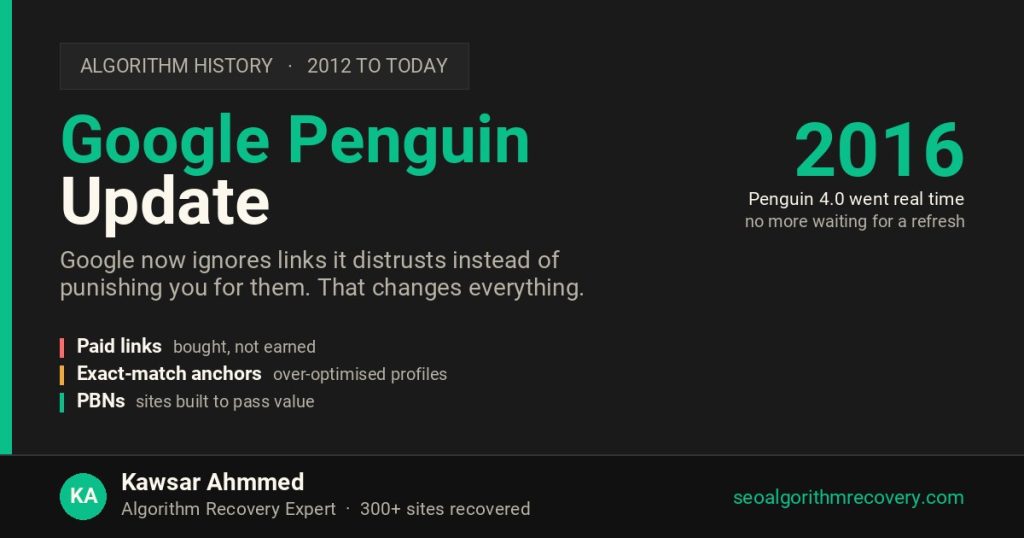
Google Penguin launched on April 24, 2012 and demoted sites using manipulative links and keyword stuffing, affecting around 3 percent of English queries. For four years it ran as a periodic filter, so a site that cleaned up its links stayed demoted until the next refresh, sometimes for over a year. Penguin 4.0 in September 2016 changed that completely: link evaluation became real time, granular, and devaluing rather than punishing. Penguin then merged into the core systems. Understanding that shift explains why link recovery today is faster than core update recovery, and why most sites should never touch a disavow file.
What Penguin targeted
Google announced it as a webspam algorithm update. The industry named it Penguin. It was aimed at the tactics that dominated SEO in 2012, when link volume and exact-match anchor text were the most reliable route to ranking.
| What Penguin targeted | Why it was a problem | Measurement (how it looked in 2012) | Status in 2026 |
|---|---|---|---|
| Paid and exchanged links | Links bought rather than earned | Link networks, paid directories, reciprocal schemes | Still a spam policy violation |
| Over-optimised anchor text | Unnatural share of exact-match commercial anchors | Half a profile pointing at one money phrase | Devalued automatically, rarely penalised |
| Article directory and comment links | Placed at scale with no editorial judgement | Thousands of links from unrelated low-quality sites | Ignored rather than counted against you |
| Private blog networks | Sites built solely to pass link value | Same registrant, same template, same outbound pattern | Covered by expired domain abuse policy, 2024 |
| Keyword stuffing | Repetition to trigger relevance signals | Keyword-dense footers and hidden text | Still a spam policy violation |
Six months after Penguin, in October 2012, Google launched the disavow links tool. That sequence matters: the tool exists because Penguin created a problem site owners could not otherwise solve, namely links they could not get removed. It was never intended as routine maintenance, which is a point covered in the disavow file template and builder.
The refresh problem, 2012 to 2016
Penguin’s first four years produced the most painful recovery waits in search history, and the reason was purely mechanical. Penguin ran periodically. Between refreshes, the data was frozen. A site could remove every bad link, upload a disavow file, and still sit demoted for a year because Google had not re-run the filter.
| Date | Release | Measurement (wait since previous) |
|---|---|---|
| April 24, 2012 | Penguin 1.0 | Around 3 percent of English queries affected |
| May 22, 2013 | Penguin 2.0 | Roughly 13 months after launch |
| October 4, 2013 | Penguin 2.1 | About 4 months |
| October 17, 2014 | Penguin 3.0 | Over 12 months, the longest wait |
| September 23, 2016 | Penguin 4.0, real time and in core | Nearly 2 years since the last refresh |
Between Penguin 3.0 and Penguin 4.0, sites that had done everything right waited almost two years for a reassessment that might restore their business. That period is the reason experienced practitioners are cautious about link work: the cost of getting it wrong used to be measured in years.
Penguin 4.0: three changes that still define link handling
September 2016 was not another refresh. It changed how links are treated in three ways that remain in force today.
- Real time. Why: Link evaluation now updates as Google recrawls, so improvements register within weeks rather than waiting for a scheduled refresh. This is the reason link and spam recoveries are faster than core update recoveries, as set out in how long recovery takes.
- Granular. Why: Effects can apply to specific pages or sections rather than the whole domain. A single bad campaign no longer necessarily sinks the entire site.
- Devaluing rather than demoting. Why: This is the most important and least understood change. Google now generally ignores links it does not trust instead of penalising the site receiving them. The link stops helping; it does not actively hurt.
That third point is why Google says most sites do not need a disavow file, and why the reflexive disavowing that dominated 2013 to 2016 is now usually a mistake. If a spam link is being ignored, disavowing it changes nothing. If you disavow a good link by accident, you lose real value and it takes weeks to reverse.
Where link enforcement went after Penguin
Penguin stopped being named, but link spam enforcement continued under different labels and increasingly through SpamBrain, Google’s machine learning spam detection system.
- July 2021 link spam update. Why: Targeted affiliate and sponsored links that were not properly qualified, nudging the industry toward correct rel attributes.
- December 2021 and December 2022 link spam updates. Why: The December 2022 release used SpamBrain to neutralise both the spam links and the credit they had passed, meaning some sites saw a drop simply because artificial support was removed.
- March 2024 spam policies. Why: Expired domain abuse formalised enforcement against private blog networks built on repurposed domains, which had been a Penguin target since 2012.
- 2026 spam updates. Why: Google confirmed the August 2026 spam update does not target link spam specifically, which is a useful diagnostic detail. A drop during a spam update is more likely a content or policy issue than a link one.
The December 2022 case is worth dwelling on because it produces a confusing pattern. Nothing was penalised, but rankings fell, because links that had been carrying the site were discounted. In practice that is indistinguishable from a demotion, and it is one of the harder diagnoses in the seven causes of a drop with no update.
What Penguin teaches about link work today
- Confirm links are the cause before doing link work. Why: Most drops attributed to links turn out to be content or technical. Check the drop date against link spam updates specifically, not just any update, using the date checker.
- Disavow what you built, not what a tool flagged. Why: Toxicity scores are vendor estimates. The links that matter are the ones you or an agency paid for or placed, because those are the ones a manual reviewer would judge.
- A manual action changes everything. Why: Algorithmic link handling devalues quietly. A manual action for unnatural links is a human decision requiring a reconsideration request, and it is the one case where a disavow file is clearly required.
- Losing artificial support is not a penalty. Why: If your rankings depended on links Google has now discounted, the fix is earning real ones, not removing the discounted ones.
- Expect weeks, not days. Why: Real time means Google applies changes as it recrawls each linking page, which still takes time across a large profile. The full method is in the backlink audit and disavow guide.
Frequently asked questions
What was the Google Penguin update?
A webspam algorithm launched on April 24, 2012 that demoted sites using manipulative link building and keyword stuffing. It affected around 3 percent of English queries and ran as a periodic filter until September 2016.
Is Google Penguin still running?
Not as a named system. Penguin 4.0 became part of the core ranking systems in September 2016 and link evaluation now runs continuously and in real time. Link spam enforcement continues through SpamBrain and periodic link spam updates.
Does Penguin still penalise sites for bad links?
Generally no. Since Penguin 4.0, Google devalues links it does not trust rather than penalising the site receiving them. The link stops passing value instead of counting against you, which is why most sites do not need a disavow file.
Do I still need to disavow links in 2026?
Only in specific cases: a manual action for unnatural links, or a known history of bought or scaled link building that you cannot get removed. Disavowing on the basis of a tool’s toxicity score is more likely to cost you real links than to help.
How long did Penguin recovery take?
Before 2016, until the next refresh, which meant waits of four months to over two years. Since Penguin 4.0 became real time, link improvements register as Google recrawls the linking pages, typically over weeks rather than years.
What is the difference between Panda and Penguin?
Panda judged content quality at site level. Penguin judged the trustworthiness of links pointing at a site. Both were absorbed into the core ranking systems in 2016, and their judgements still operate there. See the Google Panda update for the content side.
Think your link profile is the problem?
Most sites that suspect links have a content or technical cause instead, and disavowing the wrong things is slow to undo. Send your Search Console access and within 48 hours I will tell you whether links are actually involved. Free, no obligation.
Get free recovery auditSources: Google Search Central announcement of the April 2012 webspam algorithm update and subsequent Penguin releases; Google announcement of Penguin 4.0 as real time and part of the core algorithm, September 2016; Google announcements for the July 2021, December 2021 and December 2022 link spam updates including SpamBrain neutralisation; March 2024 spam policy documentation; August 2026 spam update dashboard entry; link recovery outcomes from client engagements, 2017 to 2026.