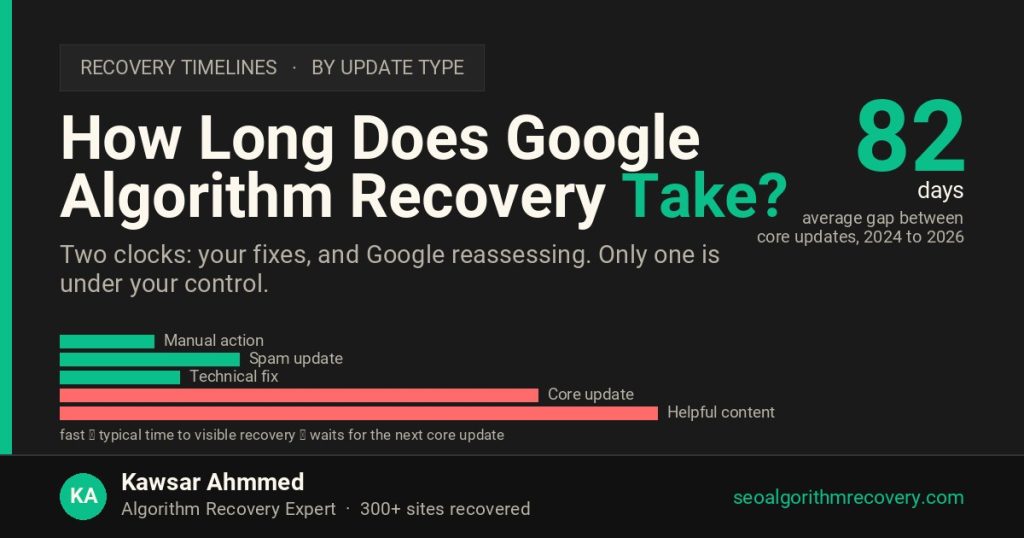
Google algorithm recovery takes two to four months in most cases, and the update type sets the clock, not the amount of work you do. Spam, link and technical fixes can show within two to six weeks because those systems reassess continuously. Core update and helpful content demotions cannot recover until Google runs another core update, and the gap between core updates has averaged 82 days over the last two years. Implementation itself usually takes two to six weeks. Anyone promising recovery by a fixed date is guessing.
The honest answer: two clocks, not one
Every recovery has two separate timelines and confusing them is why expectations break down. The first is how long the fixes take to implement. That is under your control and usually runs two to six weeks. The second is how long Google takes to notice and reassess. That is not under your control at all, and for core updates it can be months.
A client who fixes everything in three weeks and sees nothing for another ten weeks has not failed. They are waiting on the second clock. Understanding which clock you are on is the difference between staying the course and panicking into changes that make things worse.
Recovery timelines by update type
These are the ranges I quote from 300+ recovery engagements since 2017. The Measurement column tells you what to watch so you know the fix is working before rankings move.
| Update type | Implementation | Time to visible recovery | Measurement (early signal) |
|---|---|---|---|
| Manual action | 1 to 3 weeks | Days to 4 weeks after the reconsideration request is approved | Manual Actions report in Search Console clears |
| Spam update (SpamBrain) | 2 to 4 weeks | 2 to 8 weeks; spam systems run continuously | Affected page group stops declining, then recovers first |
| Link spam or toxic backlinks | 2 to 6 weeks | 4 weeks to 6 months; disavow processing is slow | Referring domain quality improves in your backlink tool |
| Technical or indexing regression | Days to 2 weeks | 1 to 4 weeks after recrawl | Pages indexed count recovers in the Pages report |
| Reviews or product system | 3 to 6 weeks | Weeks; the reviews system runs continuously | Review pages regain impressions before clicks |
| Core update | 3 to 6 weeks | Next core update, historically 43 to 147 days away | Impressions rise before positions, on improved pages only |
| Helpful content demotion | 4 to 8 weeks | Next core update, often two cycles for full recovery | Site-wide impressions stop falling, then flatten |
| AI Overview click displacement | 1 to 3 weeks | 2 to 6 weeks; not an algorithm penalty | Click-through rate recovers while position stays flat |
Why core update recovery has to wait
The core ranking systems do not re-score your site continuously. They re-score it during a core update. If you were demoted in one core update and you fix the cause the following week, your improved site sits at the demoted position until Google runs the next core update and re-evaluates it.
That gap is measurable. Using the confirmed dates on the live update tracker, here is how long site owners actually had to wait between core updates:
| From | To | Wait after the first update completed | Measurement |
|---|---|---|---|
| March 2024 core update | August 2024 core update | 118 days | Longest single wait in this period |
| August 2024 core update | November 2024 core update | 69 days | Typical quarterly cadence |
| November 2024 core update | December 2024 core update | 7 days | Unusually short; two updates back to back |
| December 2024 core update | March 2025 core update | 85 days | Typical |
| March 2025 core update | June 2025 core update | 95 days | Typical |
| June 2025 core update | December 2025 core update | 147 days | Longest gap on record in this window |
| December 2025 core update | March 2026 core update | 88 days | Typical |
| March 2026 core update | May 2026 core update | 43 days | Shortest recent gap |
Average across those eight intervals: 82 days, or roughly twelve weeks. The range is 7 to 147 days. That is the honest planning number. If someone tells you a core update recovery will be done in six weeks, ask them which core update they expect to deliver it.
The rollout itself adds time too. Recent core updates have taken 12 to 24 days to complete, and rankings often move in both directions during that window. Judging recovery before a rollout finishes is a common and expensive mistake. See the core update recovery service for how I plan around this cycle.
What makes recovery faster
You cannot change when the next core update runs. You can change how much of it you are ready for. These five factors consistently shorten the total timeline in my engagements.
- Correct diagnosis in week one. Why: The single biggest time sink is fixing the wrong thing. A site that spends two months rewriting content when the real cause was a canonical error has burned a full core update cycle. The Search Console diagnosis method takes days, not months.
- A narrow fix rather than a site-wide rewrite. Why: Consolidating 40 thin pages is achievable in three weeks. Rewriting 400 is not, and the extra 360 pages usually were not the problem.
- Fast implementation capacity. Why: If your developer queue is six weeks deep, add six weeks. Recovery speed is often an internal resourcing question, not an SEO one.
- Fixing during a rollout, not after. Why: Changes shipped while a core update is still rolling out are sometimes picked up in the same rollout. It does not always work, but it costs nothing to try.
- No further changes once the fix is in. Why: Continuous tinkering resets the evidence. Google needs a stable version of your site to reassess. Freeze, then wait.
What makes recovery slower or impossible
Not every site recovers. I turn down engagements when these conditions are present because the honest answer is that recovery is not the right investment.
- The business model itself is what Google demoted. Why: Sites built entirely on scaled or aggregated content have nothing to fix without becoming a different site. The scaled content abuse cases that recover are the ones willing to change the model.
- Multiple overlapping causes. Why: A site with a link penalty, thin content and a technical problem needs three fixes and three reassessment cycles. Six months minimum, often more.
- A long history of manipulation. Why: Sites with years of paid links need the disavow to age. Six months is realistic, and see the backlink audit guide for what that process involves.
- Competitors improved while you stood still. Why: Sometimes you did not drop, they rose. No amount of fixing recovers a position that a better page now holds. This needs new competitive work, not recovery work.
- The traffic was never going to come back. Why: If AI Overviews now answer the query, the click is gone regardless of your rank. That needs a different strategy, not a recovery plan.
What partial recovery looks like
Full return to previous traffic is not the usual outcome and should not be the only measure of success. Across my engagements, a realistic distribution looks like this.
| Outcome | How often | What it looks like | Measurement |
|---|---|---|---|
| Full recovery | Roughly 3 in 10 | Traffic returns to or exceeds pre-drop levels | Clicks match the pre-drop 28-day average |
| Strong partial | Roughly 5 in 10 | 60 to 90 percent of lost traffic returns, often on fewer, better pages | Clicks recover while total indexed pages fall |
| Stabilised | Roughly 1 in 10 | Decline stops, small gains, site no longer at risk | Month-over-month clicks flat instead of falling |
| No recovery | Roughly 1 in 10 | Cause is structural or the market moved | Cause identified, recommendation is to rebuild or pivot |
The partial recoveries are worth more than the number suggests. A site that returns 70 percent of its traffic on half as many pages usually converts better and costs less to maintain than it did before the drop.
A realistic month-by-month plan
This is the shape of a core update recovery engagement, the slowest and most common type.
- Weeks 1 to 2: diagnosis. Why: Date matching against the update tracker, scope analysis by page template, manual action check, competitor comparison. Output is one prioritised cause, not a list of everything wrong.
- Weeks 2 to 6: implementation. Why: Consolidation, pruning, expertise signals, technical fixes. Ordered by impact so the highest-value work ships first in case the next core update arrives early.
- Weeks 6 to 8: freeze and verify. Why: No further changes. Confirm crawling and indexing of the changed pages so Google has the new version before reassessment.
- Weeks 8 onward: wait for the core update. Why: Historically 43 to 147 days from the previous one. Monitor impressions, not positions; impressions move first.
- During the rollout: hold. Why: Rankings swing both ways for 12 to 24 days. Judge nothing until Google marks the update complete on the status dashboard.
- After the rollout: measure and plan. Why: Compare the 28 days after completion against the 28 days before the original drop. Then decide whether a second cycle is needed.
Frequently asked questions
How long does Google algorithm recovery take on average?
Two to four months for most sites. Implementation takes two to six weeks; the wait for Google to reassess takes the rest. Spam and technical fixes are faster, often two to eight weeks. Core update recovery waits for the next core update, historically 43 to 147 days apart.
Can a site recover before the next core update?
Only if the cause was not the core system. Manual actions, spam issues, link problems and technical regressions are reassessed continuously and can recover at any time. A core update demotion cannot lift until another core update runs.
How long after a core update should I see recovery?
Wait until Google marks the rollout complete, then measure the following 28 days. Rankings move in both directions during a rollout, so anything measured mid-rollout is unreliable.
Why has my traffic not recovered after months of work?
The most common reasons are a wrong diagnosis, continuous changes that prevent stable reassessment, multiple overlapping causes, or the traffic being lost to AI Overviews rather than a ranking drop.
Is it worth paying for recovery if it takes months?
That depends on what the traffic is worth. If lost organic traffic represents meaningful revenue, a two to four month recovery is usually cheaper than replacing that traffic with paid ads. If the site was low value before the drop, rebuilding may be the better investment.
Does recovery mean traffic returns to exactly what it was?
Usually not. Around three in ten engagements reach full recovery. Five in ten reach a strong partial recovery of 60 to 90 percent, often on fewer and better pages.
Want a realistic timeline for your site, not a generic range?
Send your Search Console access or export. Within 48 hours I tell you which update hit you, which clock you are on, and roughly when to expect movement. Free, no obligation.
Get free recovery auditSources: confirmed rollout dates from the Google Search Status Dashboard as recorded on this site’s live update tracker; Google Search Central guidance on core updates and reconsideration requests; outcome distribution and implementation timings from client engagements between 2017 and 2026.