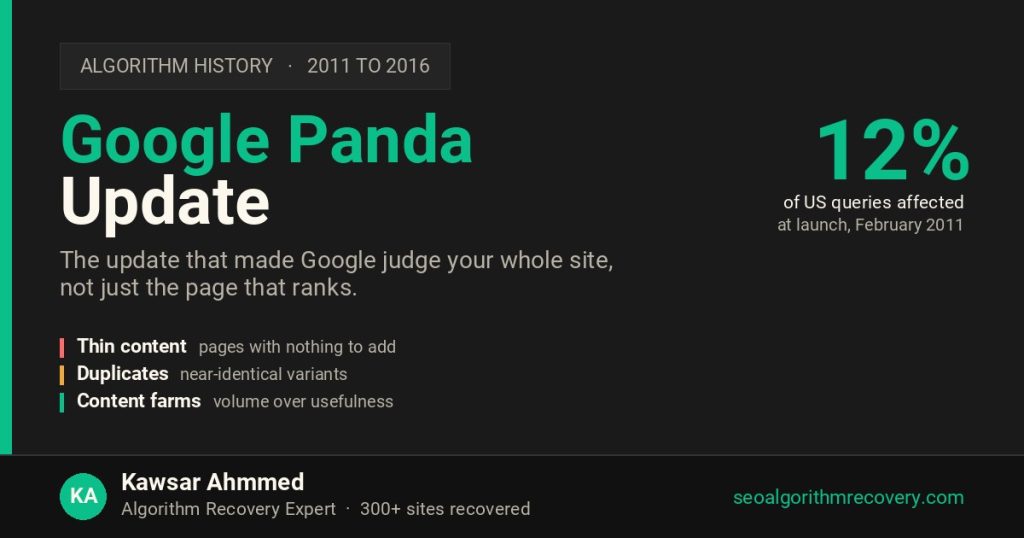
Google Panda launched on February 23, 2011 and targeted thin, duplicated and low-value content, affecting around 12 percent of US search queries. It was the first Google update to apply a site-level quality judgement, meaning weak pages could drag down the ranking of strong ones on the same domain. Panda ran as a separate filter through roughly 28 refreshes until Google folded it into the core ranking systems in January 2016. It is no longer a named system, but the judgement it introduced is still active and still causes more recovery work than any other single idea in search.
What Panda targeted
The industry initially called it the Farmer update, because content farms producing large volumes of shallow articles were the most visible casualties. Google named it internally after Navneet Panda, the engineer whose work made the approach possible.
Shortly after launch Google published a list of questions site owners could ask themselves about content quality. Those questions are the clearest statement of what Panda was measuring, and they read almost identically to the helpful content guidance published eleven years later.
| What Panda demoted | Why it was a problem | Measurement (how it looked in 2011) | Modern equivalent |
|---|---|---|---|
| Thin content pages | Little substance beyond the keyword | Hundreds of near-identical short pages | Scaled content abuse policy, 2024 |
| Duplicate and near-duplicate pages | The same text across many URLs | City and product variants sharing most of their text | Deduplication and site diversity systems |
| Content farms | Volume produced to catch searches, not to help | Article directories and answer mills | Helpful content system, merged into core 2024 |
| High ad-to-content ratio | Reader has to work around the layout | Ads above the fold pushing content down | Page experience and intrusive interstitial rules |
| Unhelpful user-generated content | Forums and comments producing indexable noise | Thousands of thin thread pages indexed | Same judgement, now inside core |
| Low-value affiliate pages | Manufacturer descriptions with a buy button | No original assessment of the product | Reviews system, experience requirement |
The idea that changed SEO: site-level judgement
Before Panda, ranking was largely a page-by-page contest. A weak page ranked poorly and a strong page ranked well, independently. Panda broke that assumption. It scored the site as a whole, so a domain carrying a large volume of thin pages saw its good pages demoted too.
This is the origin of content pruning as a recovery tactic, and it is still the single most counterintuitive thing I have to explain to clients. Removing pages to gain traffic sounds wrong. It works because the ratio of useful to useless content on the domain is what is being judged, not the count of pages. The method is in the content pruning strategy.
Every site-level system since has worked on the same principle. The August 2022 and September 2023 helpful content updates were Panda’s direct descendants, applying a site-wide classifier that held entire domains down regardless of individual page quality. Sites demoted in September 2023 recovered the same way sites demoted by Panda did: by changing the overall composition of the site, not by improving a handful of pages.
Timeline: from filter to core
| Date | Event | Measurement (impact) |
|---|---|---|
| February 23, 2011 | Panda launches in the United States | Around 12 percent of US queries affected |
| April 11, 2011 | Rolled out to English-language queries worldwide | Roughly 2 percent of additional queries |
| 2011 to 2015 | Approximately 28 refreshes and data updates | Recovery only possible when a refresh ran |
| May 2014 | Panda 4.0, a significant algorithm change | Large movements for press release and aggregator sites |
| July 2015 | Panda 4.2, rolled out slowly over months | Impact spread out and hard to attribute |
| January 2016 | Panda confirmed as part of the core ranking systems | No further named Panda updates |
The refresh cycle is the detail worth understanding. Between 2011 and 2015, a site that fixed its content problems stayed demoted until Google ran the next Panda refresh, which could be months away. That is exactly the situation core update demotions create today, and it is why recovery timelines are driven by Google’s reassessment schedule rather than by how fast you work.
Is Panda still running in 2026?
Not as a named system. Since January 2016 there is no Panda filter to be hit by, no Panda refresh to wait for, and no Panda penalty to recover from. Anyone selling Panda recovery as a distinct service in 2026 is describing something that has not existed for a decade.
The judgement, though, never stopped. Content quality is evaluated continuously inside the core ranking systems and reassessed in each core update. If your site was demoted for thin or duplicated content in 2026, the mechanism is a core update, not Panda, and the fix is the same work under a different name. That distinction matters for diagnosis: check your drop date against confirmed core updates using the date checker rather than looking for a Panda refresh that will never come.
What Panda teaches about recovery today
- Audit the whole domain, not the pages that dropped. Why: Site-level judgements are caused by the weakest part of the site, which is often not the part losing traffic. The pages that dropped may be your best ones.
- Count what is actually earning impressions. Why: Export 16 months of Search Console data and find pages with near-zero impressions. On most demoted sites that is 40 to 70 percent of the index, and it is the clearest place to start.
- Consolidate before deleting. Why: Merging five thin pages into one good one preserves the links and history that deletion throws away. Delete only what has no value in any form.
- Fix the production process, not just the archive. Why: Panda-era sites that pruned and then resumed publishing the same way were demoted again. The ratio has to stay fixed.
- Expect the wait. Why: Then it was the next Panda refresh, now it is the next core update. Either way you fix, freeze and wait, as covered in the first 48 hours checklist.
Frequently asked questions
What was the Google Panda update?
A quality algorithm launched on February 23, 2011 that demoted sites with thin, duplicated or low-value content. It affected around 12 percent of US queries and introduced site-level quality scoring, where weak pages could pull down the rankings of strong pages on the same domain.
Is Google Panda still active?
Not as a separate system. Google confirmed in January 2016 that Panda had become part of the core ranking systems. Content quality is now assessed continuously and reassessed during core updates, so there are no more Panda refreshes.
How do you recover from a Panda-style demotion?
Audit the whole domain, identify pages with no impressions or no purpose, consolidate what can be merged and remove what cannot, then hold the site stable until the next core update reassesses it. Improving only the pages that lost traffic rarely works.
Was Panda a penalty?
No. Panda was algorithmic, so there was no notice in Search Console and no reconsideration request. A penalty in Google’s terminology means a manual action taken by a human reviewer, which is a different process entirely.
What replaced Panda?
The core ranking systems absorbed it in 2016, and the helpful content system extended the same site-level quality idea from 2022 before itself merging into core in March 2024. Each generation kept the underlying judgement and changed only the machinery.
Site-wide drop that improving individual pages has not fixed?
That pattern is almost always a site-level quality judgement, and it needs a different approach from page-level work. Send your Search Console access and within 48 hours I will tell you which part of the site is holding the rest down. Free, no obligation.
Get free recovery auditSources: Google Search Central announcements on the February 2011 quality update and its April 2011 international rollout; Google’s guidance on building high-quality sites, May 2011; Google confirmation that Panda became part of the core ranking systems, January 2016; helpful content system documentation and the March 2024 core update announcement; site-level recovery patterns from client engagements, 2017 to 2026.