A fintech SEO agency helps financial technology companies rank higher in Google and earn citations inside AI-generated answers from ChatGPT, Claude, Gemini, and Google AI Overviews. In 2026, optimizing for both traditional search engines and large language models (LLMs) is essential for fintech brands that want to acquire customers, build trust, and generate organic leads.
Why Fintech Companies Need a Specialized SEO Strategy?
Fintech operates under pressures most industries never face. Regulatory compliance, YMYL (Your Money or Your Life) scrutiny from Google, and complex buyer journeys all demand content that goes beyond basic keyword optimization.
Google evaluates financial content through a higher credibility standard. Expertise and reputation carry far more weight than in other verticals. According to Google Search Central, content on financial topics must demonstrate first-hand experience, recognized expertise, and clear sourcing to perform well in search results.
The AI in fintech market reached $36.61 billion in 2026, growing at a 22% CAGR. With 51% of consumers now relying on AI tools for financial advice, fintech brands that ignore LLM visibility are losing ground to competitors who show up in AI-generated answers every single day.
If your fintech site experienced a sudden traffic drop after a recent core update, the problem likely involves both traditional ranking signals and AI discovery gaps. A proper Google algorithm recovery strategy now requires fixing both dimensions at once.
How Search Discovery Changed for Fintech in 2026?
The way people discover financial products has split into two channels. Traditional Google search still drives volume. But AI-powered platforms now process over 2 billion queries daily.
Here is what the data shows:
- AI-referred visitors convert at 4.4x the rate of organic search visitors (Semrush, 2025).
- ChatGPT citations for financial queries grew 556% through 2025.
- Gartner projected a 25% decline in classic web search traffic by 2026 as users shift to AI answers.
- 71.5% of users have tried AI search tools, and 14% use them daily.
This means fintech companies must optimize for two systems simultaneously. Google rewards strong E-E-A-T signals, clean technical SEO, and authoritative backlinks. LLMs reward structured content, semantic clarity, entity consistency, and citation-worthy data points.
A thorough SEO audit checklist after a Google algorithm update should now evaluate both traditional ranking factors and AI discoverability gaps.
Traditional SEO vs. LLM Optimization for Fintech
| Factor | Traditional SEO | LLM/GEO Optimization |
| Discovery Model | 10 blue links on SERPs | Single synthesized AI answer |
| Ranking Signal | Backlinks, keywords, domain authority | Entity signals, semantic density, citations |
| Content Format | Keyword-optimized landing pages | Passage-level, citation-ready content |
| Trust Evaluation | E-E-A-T, PageRank, site age | Source credibility, regulatory validation |
| User Behavior | Click-through from search results | Brand cited inside AI-generated response |
| Measurement | Rankings, traffic, CTR | Share of model, citation frequency, sentiment |
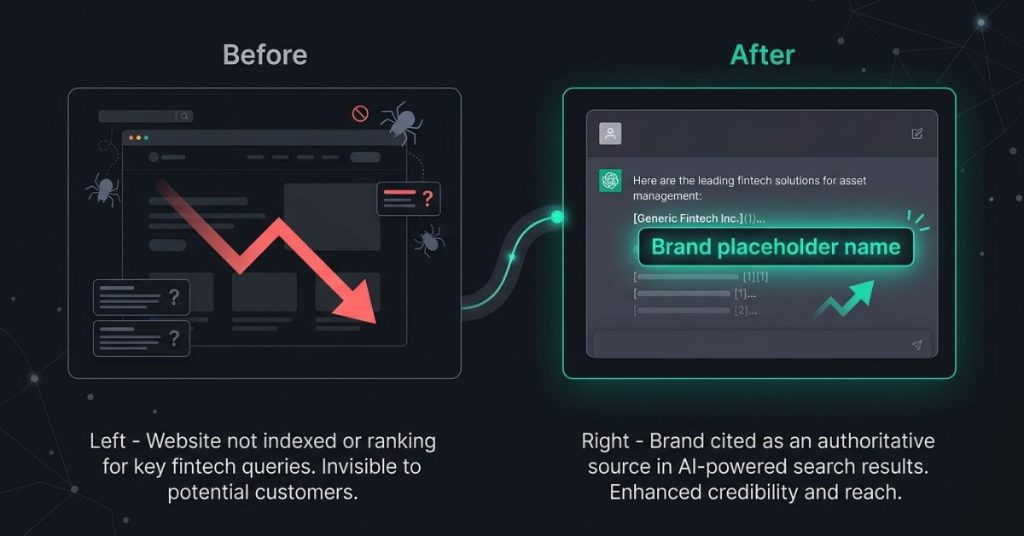
5 Strategies to Improve Fintech Visibility in LLMs
1. Build Entity-Level Authority Across the Web
LLMs do not rank pages the way Google does. They synthesize answers from entities they trust. For fintech brands, entity authority starts with consistent brand mentions across high-trust sources.
Where do LLM citations actually come from? Data from Otterly.AI breaks it down:
- 30% of citation links come from news and media outlets.
- 19% of ChatGPT citation links are drawn from Reddit.
- 6% come from Wikipedia.
- OpenAI has partnerships with 100+ media outlets, making press coverage especially valuable.
Start by auditing your brand presence across all surfaces where LLMs pull data. Fix inconsistent company descriptions, outdated team bios, and missing schema markup. A detailed SEO algorithm recovery audit report should include an entity consistency check as a standard part of the process.
2. Create Compliance-Aware, Citation-Worthy Content
Fintech content must satisfy two gatekeepers. Google evaluates it through YMYL and E-E-A-T frameworks. LLMs evaluate it for factual density, structured clarity, and source credibility.
Benchmark data from Q1 2026 found that smaller fintechs with structured, compliance-aware content consistently outranked legacy banks in AI recommendations across ChatGPT, Perplexity, Gemini, and Google AI Overviews. Legacy bank websites loaded with legal disclaimers and complex navigation make it harder for AI systems to extract clear product information.
The winning formula combines regulatory-safe language with clear product explanations. Attach real author names with verifiable credentials. Include licensed advisor commentary. Link to official regulatory sources. Structure every article so AI crawlers can extract passage-level answers without guessing.
3. Implement Structured Data for Dual Discovery
JSON-LD schema markup serves double duty. It helps Google understand content relationships, and it helps LLM crawlers identify entities, credentials, and factual claims.
For fintech brands, the essential schema types include Organization (with regulatory details), Person (for author credentials), FAQPage (for conversational queries), and FinancialProduct (for service pages). A study published by Semrush on AI search trends confirms that AI platforms may generate more referral traffic than traditional search by 2028, making structured data even more critical.
4. Optimize for Conversational Query Patterns
Only 30% of ChatGPT prompts match traditional search queries. The remaining 70% are entirely new types of intent, including multi-step financial comparisons, scenario-based questions, and regulatory clarification requests.
Fintech brands need content that answers the way real users ask AI tools for help. Map the conversational queries your audience is actually typing:
- “What is the best business banking platform for startups with international payments?”
- “How do neobanks protect deposits compared to traditional banks?”
- “Should I use a robo-advisor or human financial advisor for retirement?”
Content that anticipates follow-up questions ranks higher in AI search because it matches natural conversation flow. If your fintech site lost significant traffic to zero-click results, learning how to recover traffic lost to Google AI Overviews is one of the most practical recovery steps you can take right now.
5. Leverage Digital PR and Community Signals
Modern AI systems treat brand mentions as primary authority signals. Frequent, consistent mentions across trusted sources strengthen your recognition inside generative engines.
LinkedIn has evolved into a publishing platform that search algorithms actively use to assess expertise. Executive thought leadership posts and industry commentary build the semantic footprint LLMs rely on when generating financial recommendations. Research shows 64% of US Reddit users are more likely to trust a financial services company that participates authentically on the platform.
For fintech brands, the action plan is simple: publish data-backed insights on LinkedIn, contribute genuine answers in relevant Reddit communities, and pitch original research to industry media outlets. Each verified mention deepens the model’s confidence in your brand.
How to Measure Fintech LLM Visibility?
Tracking your brand inside AI-generated answers requires different tools than traditional rank tracking. LLM visibility monitoring measures three core signals:
- Share of model: how often your brand appears in AI responses.
- Sentiment accuracy: whether mentions are positive and factually correct.
- Citation sources: which content pages the AI cites when recommending you.
Run quarterly benchmarks by testing 30 to 50 common fintech queries across ChatGPT, Perplexity, Gemini, and Google AI Overviews. Track which brands get mentioned, whether your citations are accurate, and where competitors appear. This can be done with just 2 to 3 hours of structured testing per quarter.
Continue measuring traditional SEO signals in parallel: rankings for buying-intent keywords, lead volume, pipeline attribution, and organic conversion rates. The strongest fintech SEO programs track both traditional and AI metrics side by side.
Common Mistakes That Kill Fintech LLM Visibility
Avoid these common errors that prevent fintech brands from appearing in AI-generated answers:
- Missing author attribution on YMYL financial content.
- Publishing thin pages targeting single keywords instead of covering topics comprehensively.
- Blocking AI crawlers through overly restrictive robots.txt configurations.
- Relying on AI-generated content without expert review or editorial oversight.
- Inconsistent brand name, description, or product details across web properties.
- No structured data (schema markup) on key service and product pages.
A thorough technical and content audit is the first step toward fixing these issues and positioning your fintech brand for sustainable visibility across both search and AI platforms.