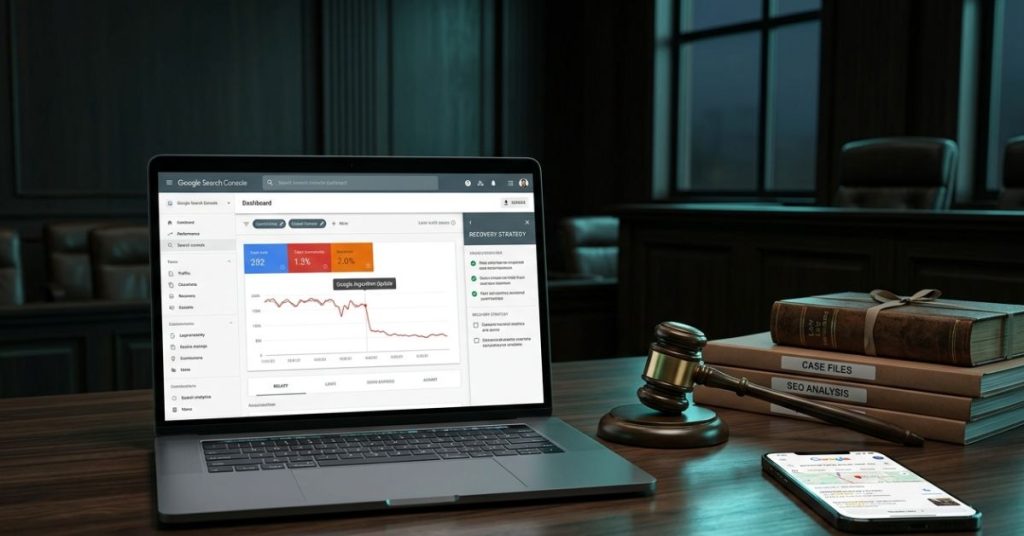
A law firm SEO expert helps legal practices recover lost rankings and rebuild organic visibility after Google algorithm updates. In 2026, law firms face higher E-E-A-T standards, AI-driven search changes, and frequent core updates that can erase months of SEO progress overnight. Working with a specialist who understands YMYL compliance, local search, and algorithm recovery is the fastest path to restoring traffic and generating qualified leads.
Why Law Firms Are Highly Vulnerable to Google Algorithm Updates?
Legal services fall under Google’s YMYL (Your Money or Your Life) category. That means Google applies stricter quality standards to law firm websites than to most other industries. A single core update can shift rankings dramatically for firms that rely on outdated SEO tactics.
The numbers tell the story clearly:
- 96% of potential clients use a search engine during their research process.
- Organic search drives 53% of all law firm website traffic.
- SEO-generated leads convert at 14.6%, nearly 4x higher than Google Ads leads at 3.75%.
- 58% of Google searches now end without a click, thanks to AI Overviews and featured snippets.
- The 3-year ROI for law firm SEO averages 526%.
When a core update hits, law firms with thin practice area pages, weak author signals, or artificially built backlink profiles tend to lose the most. Firms with genuinely useful content and earned authority tend to hold or improve their positions.
What Changed for Law Firm SEO in 2026?
Google rolled out several major updates in late 2025 and early 2026, including the December 2025 Core Update, the March 2026 Core Update, and the March 2026 Spam Update. Each one targeted low-quality content, manipulative link practices, and sites that lack genuine expertise signals.
For law firms specifically, three shifts stand out.
AI Overviews now dominate legal queries.
When someone searches “how to file for divorce in Texas” or “what to do after a car accident,” Google often shows an AI-generated summary above all organic results. If your content is not structured for AI citation, you lose visibility even if you technically rank on page one. This same pattern is reshaping other YMYL verticals too, including fintech companies optimizing for LLM visibility.
E-E-A-T enforcement is stricter than ever.
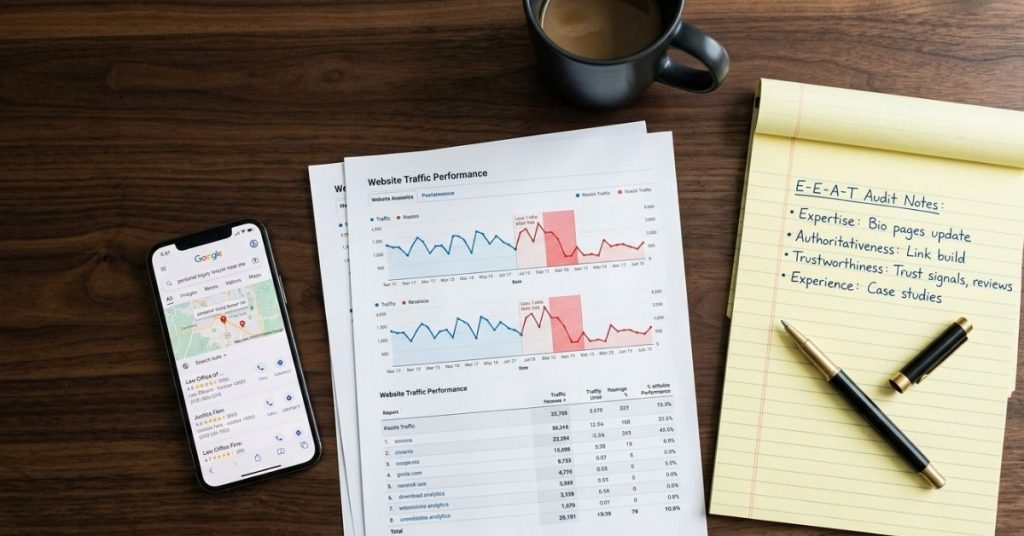
Attorney bios now need verified credentials, bar admissions, and links to external publications. Generic “about us” pages without real practitioner details are treated as a trust deficit by Google’s quality systems. As Google’s helpful content documentation makes clear, content on legal and financial topics must demonstrate first-hand experience and recognized expertise.
AI-generated content is under scrutiny.
Many law firms adopted AI writing tools to scale blog production in 2024 and 2025. Google’s spam updates now detect patterns of low-value, mass-produced content. If your firm published dozens of city-specific pages with minimal variation, you may already be affected. Understanding whether Google is penalizing AI-generated content is critical before publishing any more automated pages.
Algorithm Penalty vs. Manual Action: Know the Difference
Not every traffic drop is the same. Law firms that lose rankings need to diagnose whether the cause is an algorithmic shift or a manual penalty issued by Google’s webspam team.
| Factor | Algorithm Update Hit | Manual Action Penalty |
| Cause | Broad quality reassessment by Google’s systems | Human reviewer flags violations |
| Notification | No direct notification from Google | Alert appears in Search Console |
| Timing | Gradual decline during update rollout | Sudden, sharp drop in visibility |
| Recovery Path | Improve content quality, E-E-A-T, and technical SEO | Fix violations + submit reconsideration request |
| Timeline | Wait for next core update (weeks to months) | Review processed within days to weeks |
| Measurement | Track rankings, impressions, and CTR trends in GSC | Monitor Manual Actions tab and resubmission status |
Many law firm owners confuse these two situations and waste time on the wrong recovery steps. If you are not sure which type hit your site, read the full breakdown on Google manual action vs. algorithm penalty differences before taking any action.
5 Recovery Strategies for Law Firms Hit by Google Updates
1. Audit and Strengthen E-E-A-T Signals
Every attorney on your site needs a detailed bio page with bar number, jurisdictions, education, published articles, and speaking engagements. Link each blog post to the author’s bio. Add schema markup (Person, Attorney, LegalService) so Google and AI crawlers can verify credentials programmatically.
2. Rebuild Practice Area Pages with Topical Depth
Thin practice area pages with 300 words of generic copy do not compete in 2026. Build content clusters around each practice area. A personal injury hub page, for example, should link to detailed sub-pages covering car accidents, truck accidents, slip and fall, wrongful death, and settlement process guides. Law firms that blog consistently pull in 400% more traffic than firms with inactive blogs.
3. Fix Technical SEO Foundations
Mobile drives 7x more traffic than desktop in the legal industry. If your site loads slowly on phones, you are losing most of your audience before they read a single word. Run Core Web Vitals checks, fix crawl errors, implement HTTPS, and clean up your site structure. Law firm websites with organized structures index 30% faster in Google.
4. Clean Up Toxic Backlinks
Some law firms still use SEO providers who buy links from low-quality directories or PBN networks. Google’s spam updates target these tactics aggressively. Audit your backlink profile using Ahrefs or Semrush, identify spammy referring domains, and submit a disavow file if needed. Professional firms like Ed Parsons CPA in specialized financial and legal services understand that earned authority always outperforms manufactured link schemes.
5. Optimize for Local Search and AI Discovery
93% of the time, Google’s local pack appears before regular search results for location-based legal queries. Keep your Google Business Profile accurate, encourage genuine client reviews, and maintain consistent NAP (name, address, phone) across Avvo, FindLaw, Justia, Super Lawyers, and Martindale-Hubbell.
At the same time, structure your content for AI citation. FAQ blocks, clear heading hierarchies, and direct answers to conversational queries increase your chances of appearing in AI Overviews and LLM-generated recommendations. A proper Google algorithm recovery service now addresses both local SEO and AI discoverability as standard practice.

Common Law Firm SEO Mistakes to Avoid
- Publishing dozens of city+keyword pages with nearly identical content.
- Using AI-generated blog posts without attorney review or editorial oversight.
- Neglecting attorney author bios on YMYL legal content.
- Buying backlinks from legal directories with no real authority.
- Ignoring mobile speed and Core Web Vitals performance.
- Treating SEO as a one-time project instead of an ongoing practice.
- No structured data (schema markup) on practice area and attorney pages.
- Blocking AI crawlers with restrictive robots.txt settings.
The firms that survive algorithm updates are the ones that were already doing the right things consistently. Every update rewards genuine expertise and penalizes shortcuts.
What to Look for in a Law Firm SEO Expert?
Not every SEO provider understands the unique demands of legal marketing. When evaluating an SEO expert for your law firm, ask these questions:
- Do they have documented experience recovering YMYL sites after core updates?
- Can they show before-and-after traffic data from real law firm clients?
- Do they understand E-E-A-T requirements specific to legal content?
- Will they audit both traditional SEO and AI discoverability together?
- Do they offer ongoing monitoring or just a one-time fix?
The best law firm SEO experts combine technical audit skills with content strategy, local SEO expertise, and an understanding of how Google’s quality systems specifically evaluate legal websites.

Did your law firm lose rankings after a recent Google update? Get a free algorithm recovery audit from Kawsar Ahmmed and get a clear diagnosis of what went wrong and how to fix it.