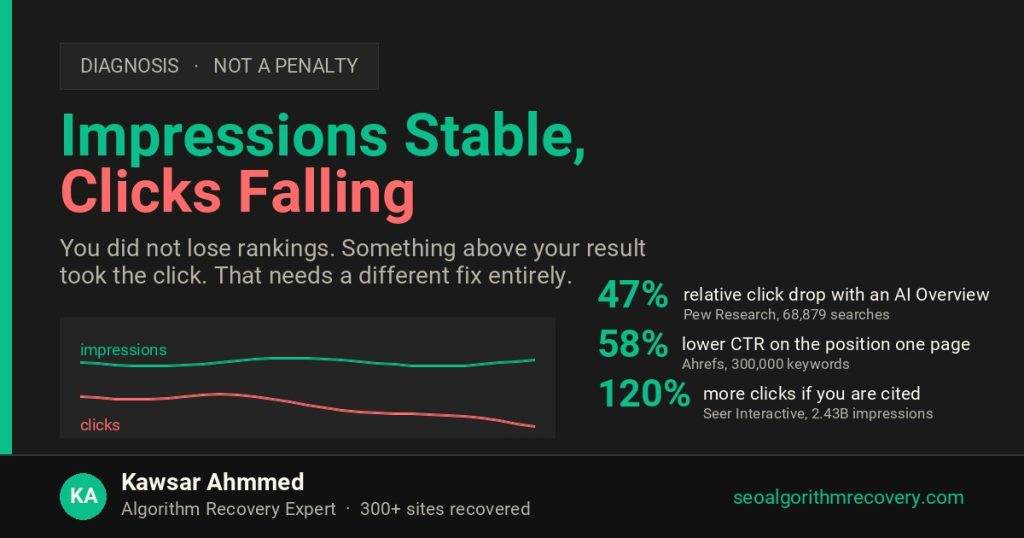
If your Search Console impressions and average position are flat while clicks fall, you did not lose rankings. Something above your result took the click, and in 2026 that is usually an AI Overview. This is not an algorithm penalty, it will not recover at the next core update, and rewriting your content for quality often makes it worse. The fix is a format and query targeting change. Confirming which one you are facing takes about ten minutes in Search Console.
The three-line signature
Open Search Console, go to Performance, and switch on all four metrics: clicks, impressions, average CTR and average position. The relationship between those four lines separates click displacement from a ranking loss faster than any other check.
| Clicks | Impressions | Average position | Measurement (what it means) | Correct response |
|---|---|---|---|---|
| Down | Flat or up | Flat or improved | Click displacement. You still rank, something took the click. | Format and query targeting change |
| Down | Down | Worse | Genuine ranking loss. You fell in the results. | Diagnose the update or the technical cause |
| Flat | Down | Improved | Reporting artefact, not a real change | No action, compare clicks not impressions |
| Down | Down | Flat | Fewer searches happening, or seasonality | Compare with the same period last year |
| Down sharply | Down sharply | Much worse | Possible manual action or technical fault | Check Manual Actions and the Pages report |
The first row is the pattern this page is about. If that is what you are seeing, stop looking for a quality problem. There may not be one.
Confirming it is an AI Overview and not something else
Search Console does not label AI Overview impressions separately, so confirmation is manual. Four checks, in order.
- Filter the Queries report to the queries that lost the most clicks, then search each one in an incognito window. Why: If an AI Overview sits above the organic results, you have your answer in under a minute. Do five or six queries, not one, because AI Overview presence varies by query.
- Check whether the losses cluster on question-shaped and informational queries. Why: AI Overviews appear far more often on definitional, comparison and how-to queries than on transactional ones. If your guides lost clicks while your commercial pages held, that distribution is itself evidence.
- Check whether the decline is gradual rather than a single step. Why: Algorithm drops usually show a visible step on one date. AI Overview coverage expands query by query over weeks, so the line slopes rather than breaks.
- Check whether you are cited inside the AI Overview. Why: Being cited materially changes the outcome. Seer Interactive found that cited brands earn roughly 120 percent more organic clicks per impression than uncited brands on the same AI Overview query. Cited and still losing clicks is a different problem from not being cited at all.
Rule out the other causes of a drop with flat rankings before settling on this one. A SERP layout change, a new ad format, or a competitor winning a featured snippet all produce a similar pattern. The seven causes of a drop with no update covers each of them.
How much click loss is normal
Knowing the published ranges stops you from over-reacting to a normal amount of loss or under-reacting to an abnormal one. The studies use different methods and reach different numbers, which is useful rather than confusing: the range tells you what to expect.
| Study | Method | Measurement (finding) | What it tells you |
|---|---|---|---|
| Pew Research Center, July 2025 | 900 US adults, 68,879 real searches tracked | Users clicked a result 8 percent of the time with an AI Overview present, 15 percent without: a 47 percent relative decline | The most rigorous behavioural measure available |
| Ahrefs, updated December 2025 | 300,000 keywords, aggregated Search Console data | 58 percent lower click-through rate on the position one page when an AI Overview is present | Ranking first no longer protects you |
| Seer Interactive, April 2026 | 53 brands, 5.47 million queries, 2.43 billion impressions over 14 months | CTR on AI Overview queries fell from 1.76 to 0.61 percent by September 2025, then recovered to 2.4 percent by February 2026 | The floor has passed, but a structural gap remains |
| Seer Interactive, same study | Comparison of AI Overview present versus absent | Queries without an AI Overview reached 3.8 percent CTR against 2.4 percent with one, a gap of roughly 37 percent | This gap is the new planning baseline |
| Pew Research Center, July 2025 | Same panel | 26 percent of sessions with an AI Overview ended entirely, against 16 percent without | Some journeys end at the answer, no strategy recovers those |
Two conclusions follow. First, a click-through rate decline of 30 to 50 percent on informational queries where AI Overviews appear is now within the documented normal range, not evidence that your site got worse. Second, the trend stopped falling in early 2026. If your losses began after February 2026 and are still deepening, the AI Overview explanation is less likely and something else deserves a look.
Why rewriting for quality usually backfires here
This is the part that costs site owners the most money. Faced with falling traffic, the instinct is to improve the content. But the content was good enough to rank, and it still ranks. The problem is that the reader is being satisfied before they reach you.
Generic quality rewrites make this worse in a specific way. The details that earn a citation, original data, named sources, specific numbers, first-hand testing, are usually the first things removed when a page is rewritten to read more smoothly. Sites that rewrite for polish frequently lose their citation and end up worse than before. Being uncited on an AI Overview query is the weakest possible position, well below simply not having an AI Overview at all.
What actually helps
The goal changes from ranking to two goals held at once: earning the citation, and giving the reader a reason to click through anyway.
- Answer the question directly in the first 40 words. Why: Extractable, self-contained answers are what get cited. A page that takes four paragraphs to reach the point gets summarised without attribution.
- Add what an AI answer structurally cannot include. Why: Original testing, your own data, dated screenshots, named case examples, a comparison table with numbers. These give both the citation and the click, because the summary cannot reproduce them.
- Target the follow-up question rather than the definitional one. Why: AI Overviews handle the first question well. They handle the second, more specific one poorly. Move your depth to where the summary runs out.
- Shift measurement from clicks to citation share. Why: If you judge an AI-era page only on clicks, you will conclude that good work failed. Track how often you appear as a cited source alongside position.
- Rebalance toward query types where AI Overviews appear less. Why: Transactional and commercial queries trigger them less often than informational ones, and clicks on queries without an AI Overview have actually become more valuable, rising from 2.8 percent to 3.8 percent CTR between early 2025 and February 2026.
The full method, including how to restructure an existing page for citation, is in recovering traffic lost to AI Overviews.
What changed in May 2026
On May 6, 2026 Google announced five changes to AI Overviews and AI Mode: inline links next to bullet points, hover previews on desktop, a subscribed label for news subscriptions, article suggestions at the end of answers, and Community Perspectives pulling in forum quotes.
Google framed these as better web discovery. Practically, they add more places for a link to appear inside an answer, which is mildly good news for cited sources and changes nothing for uncited ones. They do not alter the underlying mechanic: the answer still appears above the results and still satisfies a share of readers completely. Plan around the structural gap rather than expecting these changes to close it.
When it is both
The hardest cases are sites that took a core update demotion and click displacement in the same quarter. Positions fell somewhat and the remaining positions earn fewer clicks than they used to, so neither signature is clean.
Separate them by segmenting. Filter to pages whose average position did not change and measure their CTR trend: that isolates displacement. Then filter to pages whose position fell and check whether the drop date matches a confirmed update using the date checker. Two causes need two fixes and two timelines, which is why these engagements run longer, as explained in how long recovery takes.
Frequently asked questions
Why are my impressions the same but clicks down?
Your pages are still being shown for the same searches at roughly the same positions, but fewer people are clicking. In 2026 that is usually an AI Overview answering the query above your result. It is a visibility problem, not a ranking penalty.
Do AI Overviews count as impressions in Search Console?
Yes. Google counts a link inside an AI Overview as an impression, and clicks on it as clicks, but there is no separate AI Overview filter in the Performance report. That is why confirmation requires checking live SERPs manually.
How much CTR loss should I expect from AI Overviews?
Published studies range from about 35 to 58 percent lower click-through rate on affected queries, depending on method. Pew found users clicked 8 percent of the time with an AI Overview against 15 percent without. A 30 to 50 percent decline on informational queries is within the documented normal range.
Will my traffic recover at the next core update?
No. Core updates reassess ranking quality, and your rankings are already fine. Waiting for a core update to fix click displacement wastes a full cycle of two to four months.
Is it better to be cited in an AI Overview or not have one at all?
Not having one is best, being cited is second, and being uncited on a query that has one is worst. Seer Interactive found cited brands earn roughly 120 percent more organic clicks per impression than uncited brands on the same query.
Should I block Google from using my content in AI Overviews?
Opting out of AI Overview inclusion also removes you from the standard search snippet, so the practical effect is losing visibility in both. For almost every site the better strategy is earning the citation and building pages that give a reason to click through.
Not sure whether you lost rankings or lost clicks?
Send your Search Console access or export. Within 48 hours I will tell you which of the two is happening, how much of the loss is displacement, and whether any of it is actually algorithmic. Free, no obligation.
Get free recovery auditSources: Pew Research Center, Google Users Are Less Likely to Click on Links When an AI Summary Appears in the Results, July 2025, based on 68,879 tracked searches by 900 US adults; Ahrefs AI Overviews click-through study, updated December 2025, 300,000 keywords; Seer Interactive, AIO Impact on Google CTR 2026 Update, April 2026, 53 brands and 2.43 billion impressions; Google Search Central announcement of AI Overviews and AI Mode changes, May 6, 2026; diagnostic patterns from client Search Console data, 2024 to 2026.