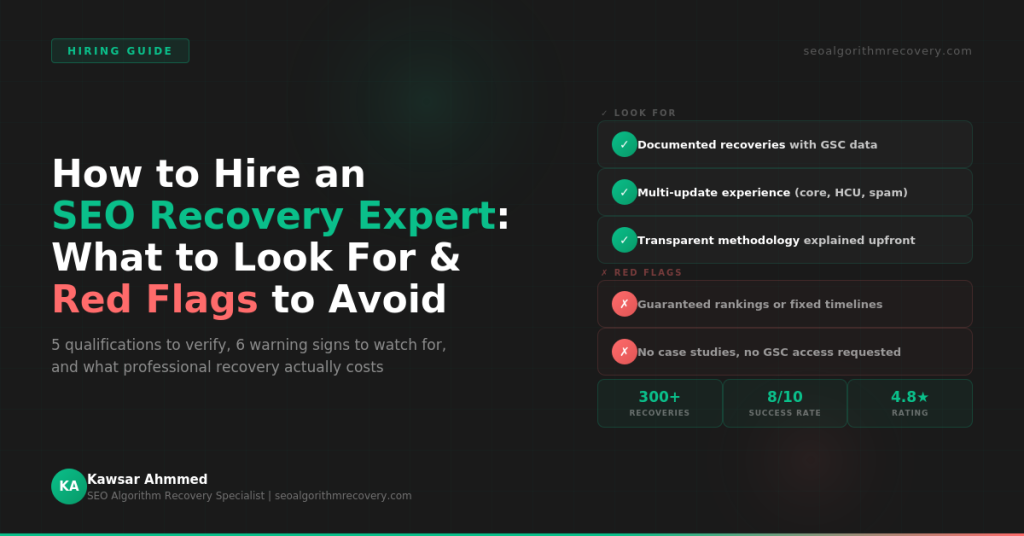
Hiring the right SEO recovery expert requires verifying five core qualifications: documented recovery case studies with before-and-after data, experience across multiple Google update types (core, HCU, spam), proficiency with diagnostic tools like Google Search Console and Semrush, a transparent recovery methodology they can explain before you pay, and clear communication standards with defined reporting cadence. I wrote this guide because I have seen too many site owners waste months and thousands of dollars on unqualified consultants. As someone who has completed 300+ algorithm recoveries with an 8/10 success rate at seoalgorithmrecovery.com, I am sharing the exact criteria I believe every recovery specialist should meet.
5 Qualifications to Verify Before Hiring Anyone
The algorithm recovery space has exploded since the September 2023 HCU devastated thousands of websites. Everyone with an SEO title now claims to offer recovery services. Most cannot deliver. Here are the five non-negotiable qualifications I recommend verifying before signing any contract.
1. Documented recovery case studies
Ask for real before-and-after data showing traffic restoration after a confirmed algorithm hit. Screenshots from Google Search Console showing the drop, the recovery work period, and the traffic returning are the minimum standard. Any consultant who cannot provide this has not actually recovered sites. In my own practice, I maintain documented case data from 300+ recoveries across ecommerce, SaaS, healthcare, fintech, and affiliate site recoveries that I share with prospective clients during consultations.
2. Update-specific recovery experience
Core updates, Helpful Content Updates, spam updates, and manual actions each require different recovery strategies. According to Google Search Central’s documentation on core updates, broad core updates are not penalties but quality reassessments. A qualified specialist must explain this distinction and demonstrate experience recovering sites from each update type. My recovery portfolio spans every major update cycle since 2019.
3. Diagnostic tool proficiency
Recovery starts with data, not guesswork. Your consultant should be fluent in Google Search Console, Semrush, Ahrefs, and Screaming Frog at minimum. I wrote a complete guide on using Search Console for algorithm recovery diagnosis that shows the exact analysis process a qualified specialist should follow.
4. Transparent methodology
A real recovery expert will walk you through their diagnostic framework, implementation phases, and monitoring approach before you commit. In my engagements, I share my complete 4-phase methodology upfront: diagnostic audit, content and E-E-A-T overhaul, authority rebuilding, and ongoing monitoring. If a consultant refuses to explain how they work, that alone disqualifies them.
5. Communication standards
Recovery is stressful. You need a consultant who responds quickly, reports progress consistently, and explains findings in language you understand. I deliver initial assessments within 48 hours, provide weekly progress reports, and maintain a 100% response rate across all client communications.
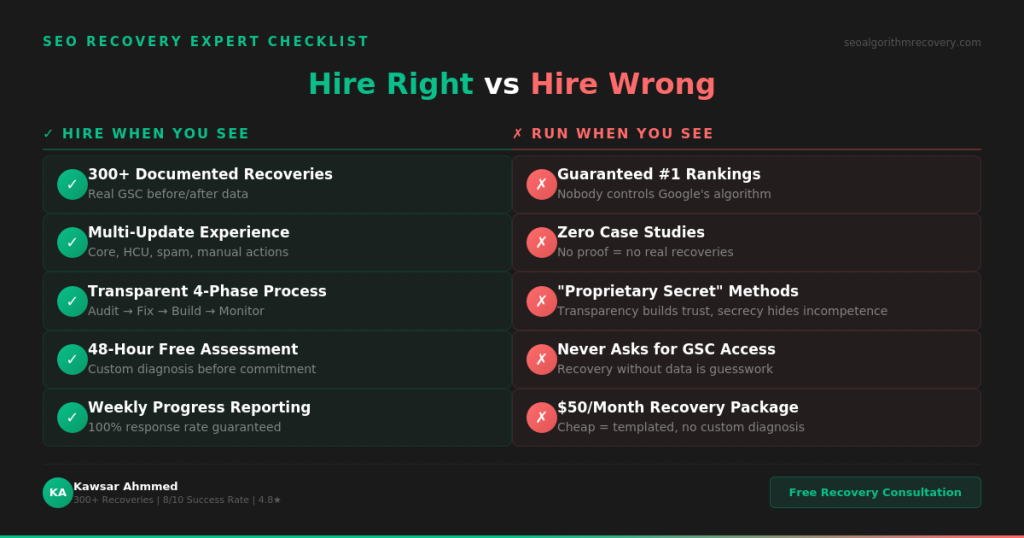
Red Flags That Signal an Unqualified Provider
These warning signs should end your conversation immediately. I share them from experience watching clients come to me after wasting months with the wrong consultant.
- “We guarantee first page rankings within 30 days.”No one controls Google’s algorithm. Recovery timelines depend on competitive factors, update severity, and site history. Promises like this are dishonest
- No case data whatsoever. If they cannot show a single documented recovery with real Search Console data, they have never done this work. Period
- Vague methodology described as “proprietary secrets.”Recovery is not magic. It is structured diagnostic work. Legitimate specialists explain their process because transparency builds trust
- They never ask for Google Search Console access. Recovery without GSC data is impossible. If their first step is not analyzing your actual performance data, they are guessing
- First recommendation is buying backlinks. Core update recovery is a content quality and E-E-A-T problem. Link acquisition is a supporting strategy, not the primary fix. According to Search Engine Journal’s core update recovery analysis, structural content quality improvements drive recovery, not tactical link building
- One-size-fits-all pricing with no audit. Quoting a flat recovery fee before analyzing your site means they apply the same template to everyone. Every site needs a custom diagnosis
Questions to Ask During a Consultation Call
These questions separate qualified specialists from pretenders. I have included what a good answer sounds like for each.
- “Walk me through a specific recovery you completed.”Good answer: specific site type, which update caused the hit, exact changes made, timeline, and measurable outcome. Bad answer: vague generalities about “improving content quality.”
- “How do you distinguish between a core update hit and a helpful content demotion?”Good answer: explains that core updates affect query clusters while HCU applies a site-wide classifier, and describes how Search Console data patterns differ. Bad answer: treats all traffic drops the same
- “What does your diagnostic process look like before recommending changes?”Good answer: describes a structured audit including GSC analysis, content quality scoring, E-E-A-T evaluation, and competitive benchmarking. Bad answer: jumps straight to recommendations without mentioning data analysis
- “Have you recovered sites in my industry before?”Good answer: names specific verticals and explains how the recovery strategy differs. I personally cover e-commerce, SaaS, healthcare, fintech, affiliate, and local businesses across 10+ countries
A consultant who built their practice around broad core update recovery will answer these confidently with specifics. Anyone who deflects or gives textbook answers is not the specialist you need.
What a Professional Recovery Engagement Includes?
| Engagement Phase | What Is Included | My Standard Delivery |
| Initial Assessment | Site review, update identification, recovery viability check | Free 48-hour assessment before any commitment |
| Diagnostic Audit | GSC analysis, content scoring, E-E-A-T evaluation, competitive gaps | Week 1: full custom audit with severity scoring |
| Recovery Roadmap | Prioritized action plan, timeline, resource requirements | Phased roadmap with weekly milestones |
| Implementation | Content fixes, E-E-A-T building, technical corrections | Weeks 2-6: hands-on guidance with weekly check-ins |
| Progress Reporting | Regular updates on rankings, traffic, and recovery metrics | Weekly GSC-based reports, 100% response rate |
| Post-Recovery Monitoring | Ongoing tracking, future update preparation | 90-day post-recovery monitoring with quarterly health checks |
| Measurement | Industry standard: monthly report, vague KPIs, no defined endpoint | My standard: weekly reporting, traffic restoration %, E-E-A-T score improvement, up to 90% traffic recovered |
What Algorithm Recovery Costs and Why Cheap Fails?
Let me be transparent about pricing because this is where most site owners get burned.
- Budget providers ($50-200/month): At this price, you are getting a templated audit and generic recommendations. No custom Search Console analysis, no real diagnostic work. Recovery does not happen at this tier
- Mid-range specialists ($500-1,500/month): This is the range where genuine recovery work becomes viable. Custom diagnostics, hands-on implementation guidance, and regular reporting. My own engagements start at $500/month
- Premium agencies ($3,000-10,000/month): Large agencies with full teams handling enterprise-level recovery. Appropriate for sites with hundreds of thousands of pages, but overkill for most small-to-mid businesses
The calculation is simple: compare the monthly retainer against the revenue you are losing from the organic traffic decline. If your site lost $5,000/month in leads or sales after the algorithm hit, spending $500/month for 3-4 months to restore that traffic is one of the highest-ROI investments you can make.
Part of choosing the right specialist is also understanding what happens after recovery. I help every client build a future-proof strategy against future algorithm updates so they never face the same situation again. Recovery without prevention is incomplete.
Frequently Asked Questions
How do I verify an SEO recovery expert’s claims?
Ask for Search Console screenshots showing documented traffic drops and recoveries with timelines. Check their website for published case studies. Look for client testimonials that specifically mention algorithm recovery, not just general SEO results. My own case data from 300+ recoveries is available during consultations.
Should I hire a recovery specialist or a full-service SEO agency?
For algorithm recovery specifically, a dedicated specialist outperforms generalist agencies. Agencies spread resources across link building, content, and technical SEO. A recovery specialist focuses entirely on diagnosing and reversing your algorithmic demotion. After recovery is complete, you can transition to a generalist agency for ongoing growth.
How long should I give a recovery consultant before expecting results?
Measurable ranking improvements should appear within 4-8 weeks of implementing changes. If a consultant has been working for 3+ months with zero movement in Search Console data, something is wrong with either the diagnosis or the implementation. My average turnaround from diagnosis to visible improvement is 2-4 weeks.
Can I recover without hiring anyone?
Yes, if you have strong technical SEO knowledge and understand E-E-A-T optimization. However, misdiagnosis is the biggest risk with DIY recovery. Spending months fixing the wrong problem wastes time and revenue. A professional diagnosis eliminates guesswork. Explore my algorithm recovery specialist services to see how the process works.
What if the expert says my site cannot be recovered?
An honest assessment is the most valuable thing a consultant can give you. If recovery is not viable, a good specialist will tell you before taking your money and recommend alternatives: pivoting your content model, rebranding, or starting fresh. I provide this honest assessment during my free initial consultation.

Looking for a Recovery Expert Who Checks Every Box on This List?
I do. 300+ recoveries. 7+ years specialized experience. 8/10 success rate. 4.8-star rating. 100% response rate. 48-hour initial assessments. Every engagement starts with a free diagnostic audit. No commitment until I confirm recovery is viable.
About Kawsar Ahmmed
Kawsar Ahmmed is the founder of SEO Algorithm Recovery (seoalgorithmrecovery.com) and a Sr. SEO Strategy & Growth Consultant who has dedicated his career exclusively to Google algorithm penalty recovery. With 7+ years of specialized experience, 300+ successful recoveries, an 8/10 success rate, and a 4.8-star client rating, Kawsar serves clients across ecommerce, SaaS, healthcare, fintech, affiliate, and local business verticals in 10+ countries. Connect on LinkedIn or follow on X (@kawsarahmmedseo).