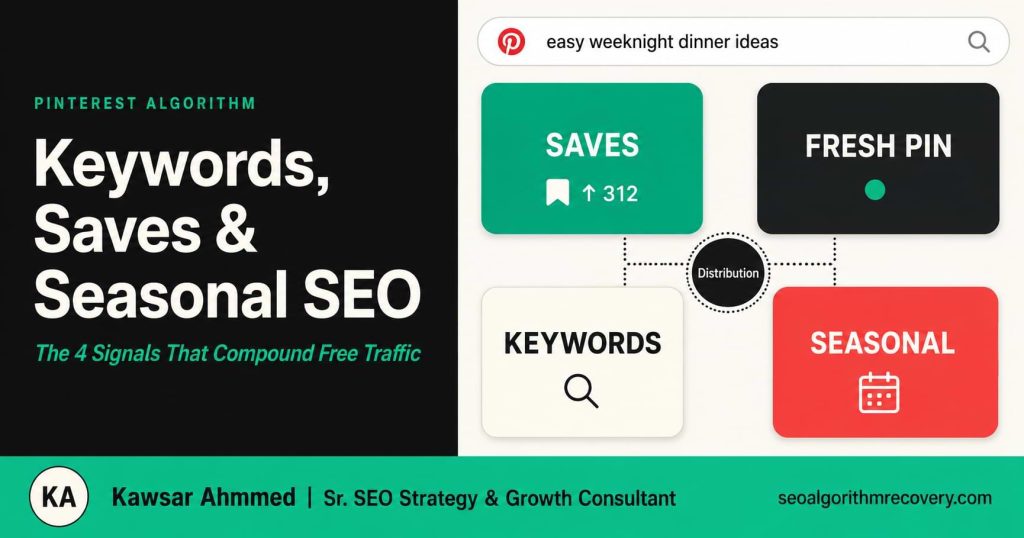
The Pinterest algorithm in 2026 ranks pins using a four-pillar scoring model: keyword relevance, save and click engagement, pin freshness, and seasonal demand alignment. Unlike Instagram or TikTok, Pinterest behaves as a visual search engine, which means SEO compounds for months and years instead of dying within hours. Across my recovery work covered in the SEO algorithm recovery audit reports I publish, I treat Pinterest as the single most underused free-traffic channel for content brands and e-commerce stores in 2026.
How Pinterest’s Algorithm Reads and Ranks Pins?
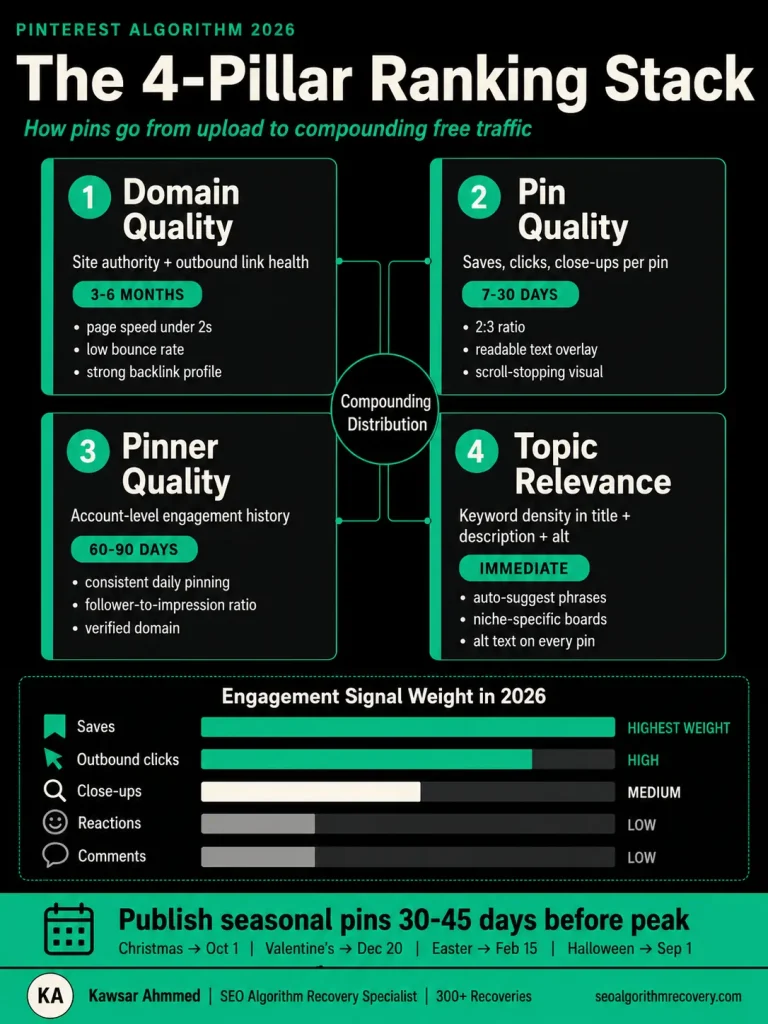
Pinterest does not rank pins by recency alone. It runs a four-pillar scoring system that evaluates every pin the moment it is published and continues re-scoring as engagement accumulates.
The four pillars are domain quality, pin quality, pinner quality, and topic relevance. Each pillar feeds the others, so weakness in any single area caps the rest.
Domain quality reflects the authority of the site the pin links to. Pin quality reflects how the pin itself performs on saves and clicks. Pinner quality reflects the account’s engagement history. Topic relevance reflects how well your pin text matches the keyword cluster it is competing in.
| Signal | What It Reflects | Time to Build | Measurement |
| Domain quality | Site authority + outbound link health | 3 to 6 months | Top boards in Pinterest Analytics |
| Pin quality | Saves, clicks, close-ups per pin | 7 to 30 days | Pin Analytics dashboard |
| Pinner quality | Account-level engagement history | 60 to 90 days | Profile impressions trend |
| Topic relevance | Keyword density in title, description, alt | Immediate | Pin search visibility |
The pillars work together. A high-quality pin from a weak domain still gets capped. A weak pin from a strong domain still underperforms. This is the same compounding-signal logic I cover in detail inside the E-E-A-T SEO checklist for 2026, and Pinterest applies it almost identically to Google.
Keyword Research for Pinterest: Finding High-Volume Pin Titles
Pinterest keyword research works differently than Google. Search Pinterest directly for your seed term and watch the auto-suggest bar. Every suggested phrase is a real query users are typing right now.
Where to pull keyword ideas
- Pinterest search auto-suggest at the top of every search bar
- Pinterest Trends tool, which shows real demand data with seasonal curves
- Guided search tiles, the colored boxes that appear below search results
- Related searches at the bottom of any search result page
- Competitor pin titles ranking in the top six positions for your seed query
Conversational query examples users actually type
- “easy weeknight dinner ideas for picky toddlers”
- “small bedroom storage hacks rental friendly”
- “natural curly hair routine for high porosity hair”
- “Christmas tablescape ideas farmhouse style”
Each of these phrases packs the modifier, the audience, and the style preference into one search. That triple-tagging is exactly how Pinterest’s relevance scoring builds confidence in a pin’s topic match.
Fresh Pin Strategy: What “Fresh” Actually Means
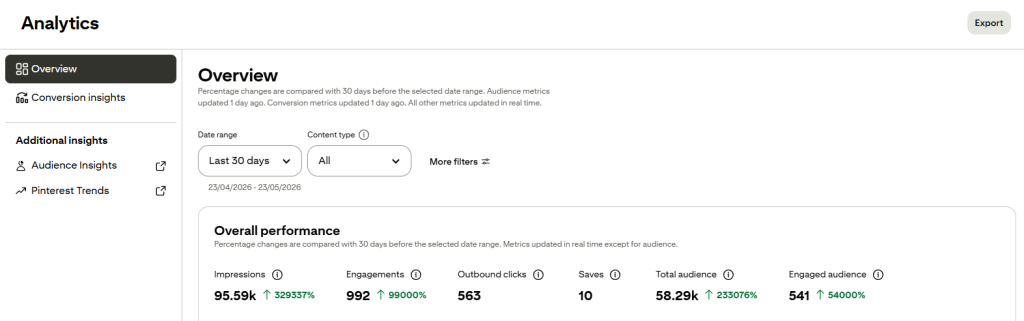
Fresh pin is the most misunderstood term in Pinterest SEO. Pinterest defines a fresh pin as a new image and a new URL combination, not just a new image dropped on a different board.
Reposting the same image to another board is not a fresh pin. Creating five new image variations that point to the same blog post creates five fresh pins.
What counts as fresh in 2026
- New image plus new URL = fully fresh and scored as a brand-new pin
- New image plus existing URL = counts as a new pin variant, partial freshness lift
- Existing image plus new URL = does not count as fresh
- Re-pin of someone else’s pin = does not count as fresh at all
Pinterest rewards consistency over volume. Three fresh pins per day from one account outperforms 20 fresh pins in one burst followed by a week of silence. I have watched this pattern hold across every Pinterest performance review inside my audit workflow.
Saves vs Clicks vs Close-Ups: Which Engagement Moves the Needle
Pinterest tracks five engagement types, and they do not weigh equally in the algorithm.
| Engagement | Algorithm Weight | What It Tells Pinterest | Measurement |
| Saves | Highest | The pin is worth keeping long-term | Saves per pin |
| Outbound clicks | High | The pin delivered on its promise | Click-through rate |
| Close-ups | Medium | Visual stopped the scroll | Close-up rate |
| Reactions | Low | Surface-level emotional response | Reaction count |
| Comments | Low | Engagement but easily inflated | Comment count |
Saves are the most weighted signal in 2026 because saves predict long-term distribution. A pin saved 100 times today will continue receiving impressions for months, while a pin clicked 100 times but never saved peaks in the first 48 hours and dies. The same long-tail compounding logic I apply during a post-update SEO audit checklist review applies almost identically to Pinterest engagement scoring.
Seasonal Content Calendar: 12-Month Publishing Framework
Pinterest demand is seasonal, and Pinterest itself recommends publishing seasonal content 30 to 45 days before the peak. The Pinterest Predicts annual trend report confirms that pins published inside this window earn three to five times more saves than late-published equivalents.
Lead times that consistently work
- Halloween content publishes from early September
- Christmas and holiday décor publishes from October 1
- Valentine’s Day publishes from December 20
- Easter and spring publishes from February 15
- Wedding season publishes from January
- Back-to-school publishes from late June
- Summer recipes and travel publish from mid-April
The pattern is simple. Lead by 45 days for the major holidays, lead by 30 days for everything else. Brands that publish inside the actual season miss the early discovery window completely.
Common Pinterest SEO Mistakes I See in Audits
After auditing channel performance across hundreds of sites, the same mistakes appear repeatedly.
- Stuffing keywords into pin titles instead of writing natural search phrases
- Reusing the same image on multiple URLs and expecting a fresh-pin lift
- Publishing seasonal pins inside the season instead of 30 to 45 days early
- Ignoring board descriptions and topic tags entirely
- Linking to weak landing pages with slow load times and high bounce rates
- Building boards around the brand instead of around user search intent
- Skipping alt text on pin images, which removes one of the strongest relevance signals
These mistakes mirror the same pattern I see in Google traffic drops covered in my YouTube algorithm guide for 2026: signals look thin, intent is misread, and the algorithm has no reason to trust the content. The fix is always topical depth first, distribution second.
Frequently Asked Questions
How long until a new Pinterest account starts driving real traffic?
Most fresh accounts need 60 to 90 days of consistent pinning before pinner quality scores stabilize enough to drive material outbound clicks. Domains with existing authority in Google often see faster Pinterest lift because domain quality transfers across both systems.
Should I use video pins or static image pins in 2026?
Both work, but they serve different roles. Video pins win on close-ups and impressions, while static pins still win on saves. The strongest channels I audit publish roughly 70% static and 30% video, with video reserved for tutorial or product-demo content.
Does Pinterest penalize AI-generated images?
Pinterest has not announced a specific AI penalty, but it does demote low-quality visuals regardless of source. AI-generated images with broken hands, faces, or garbled text get filtered out of distribution quickly because they fail the close-up engagement test.
How many boards should a new account have?
Start with five to eight highly specific boards rather than 20 broad ones. Specificity tells Pinterest exactly which topic cluster the account belongs to, which speeds up topic relevance scoring during the early 60 to 90 day evaluation window.

| Not Getting Traffic From Pinterest? Get a Free 48-Hour Audit Pinterest stagnation and Google traffic drops share the same underlying weakness: thin signals to the ranking algorithm. I diagnose both using the same four-phase recovery methodology that has powered 300+ successful recoveries across 10+ countries. Send me your account or site, and I will return a prioritized fix list within 48 hours. Book your free assessment with Kawsar Ahmmed at SEO Algorithm Recovery today. |