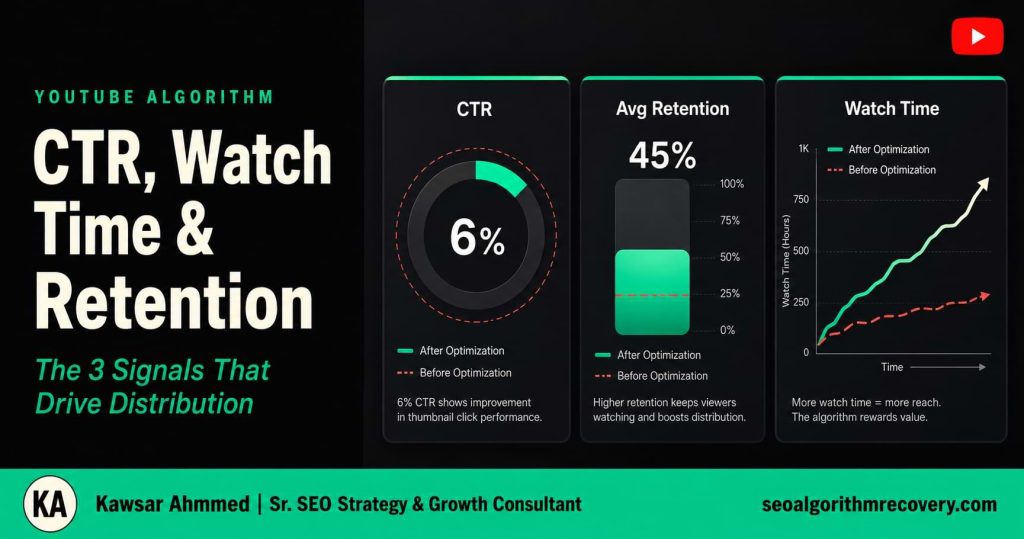
The YouTube algorithm in 2026 ranks videos using a layered scoring system that weighs click-through rate, watch time, average view duration, session duration, and viewer satisfaction signals. CTR alone earns the first chance at impressions. Watch time and absolute retention determine whether those impressions scale into recommended distribution. After auditing content distribution across hundreds of websites and creator channels through my Google Helpful Content Update recovery engagements, I have seen the same pattern hold: channels stuck below 4% CTR or 40% average retention almost never break out, no matter how often they upload.
How YouTube’s Recommendation Engine Works in 2026?
YouTube does not run a single ranking algorithm. It runs three connected systems that score videos differently depending on the surface where the video appears.
The homepage feed prioritizes session duration potential, viewer history, and freshness. Suggested videos, the right rail and post-play autoplay, prioritizes relevance to the current video and watch-time continuation. YouTube search prioritizes title match, description signals, and historical performance for that query.
A creator who optimizes only for one surface leaves the other two starved. That is why some channels rank well in search but never get homepage impressions, while others hit suggested videos hard but rank for nothing.
| Surface | Primary Ranking Signal | Secondary Signal | Measurement |
| Homepage | Personalized CTR + watch history | Freshness + session duration | Impressions in Browse source |
| Suggested | Watch-time continuation + topical similarity | Co-viewing patterns | Suggested videos traffic source |
| Search | Title and description query match | Engagement on that query | YouTube search traffic source |
When I diagnose a stalled channel, the first thing I check is which surface is failing. The fix depends entirely on that diagnosis, and the same content-quality discipline I apply during an AI Overviews traffic recovery engagement translates directly to video.
CTR Optimization: Thumbnails and Titles That Hit 6%+
Click-through rate is the first gate. If your CTR sits below your channel benchmark, YouTube reduces impressions before retention even gets a chance to matter.
Strong CTR comes from thumbnail and title pairs that create curiosity without overpromising. Overpromising kills retention, which kills distribution within hours.
Thumbnail principles I apply during channel audits
- One clear focal subject, readable at 120 pixels wide on mobile feeds
- High contrast between foreground and background
- Facial expression conveying a specific emotion: curiosity, surprise, doubt
- Maximum 3 to 5 words of text, sans-serif, bold
- No element that the video does not actually deliver in the first 30 seconds
Title formulas that consistently outperform
- Specificity formula: How I Got [Specific Result] in [Specific Timeframe]
- Contrast formula: [Common Belief] Is Wrong: [Counter-Evidence]
- Outcome formula: [Action] That Actually [Result]
Brian Dean’s Backlinko analysis of 1.3 million YouTube videos confirmed that videos with 6%+ CTR earn roughly three times more impressions than the 2 to 3% channel average, and that pattern matches what I observe across every channel audit I run.
Watch Time vs Average View Duration vs Absolute Retention
These three metrics get confused constantly, and the confusion costs creators distribution.
Watch time is total minutes watched across all viewers. Average view duration is the per-viewer average watch time on a single video. Absolute retention is the percentage curve showing exactly where viewers drop off.
Of the three, YouTube weighs absolute retention most heavily in 2026 for recommendation decisions, because retention reveals viewer satisfaction in real time. A 15-minute video with 45% retention beats a 20-minute video with 25% retention, even if the longer video has higher raw watch time.
| Video Length | Strong Retention | Average | Weak | Measurement |
| Under 5 min | 60%+ | 45 to 55% | Below 40% | AVD % |
| 5 to 10 min | 50%+ | 40 to 50% | Below 35% | AVD % |
| 10 to 20 min | 45%+ | 35 to 45% | Below 30% | AVD % |
| 20+ min | 40%+ | 30 to 40% | Below 25% | AVD % |
The first 30 seconds drive everything. YouTube’s own Creator Academy training on audience retention shows that channels improving their opening 30-second retention by even 10 percentage points see proportional gains in recommended distribution within two to three weeks.
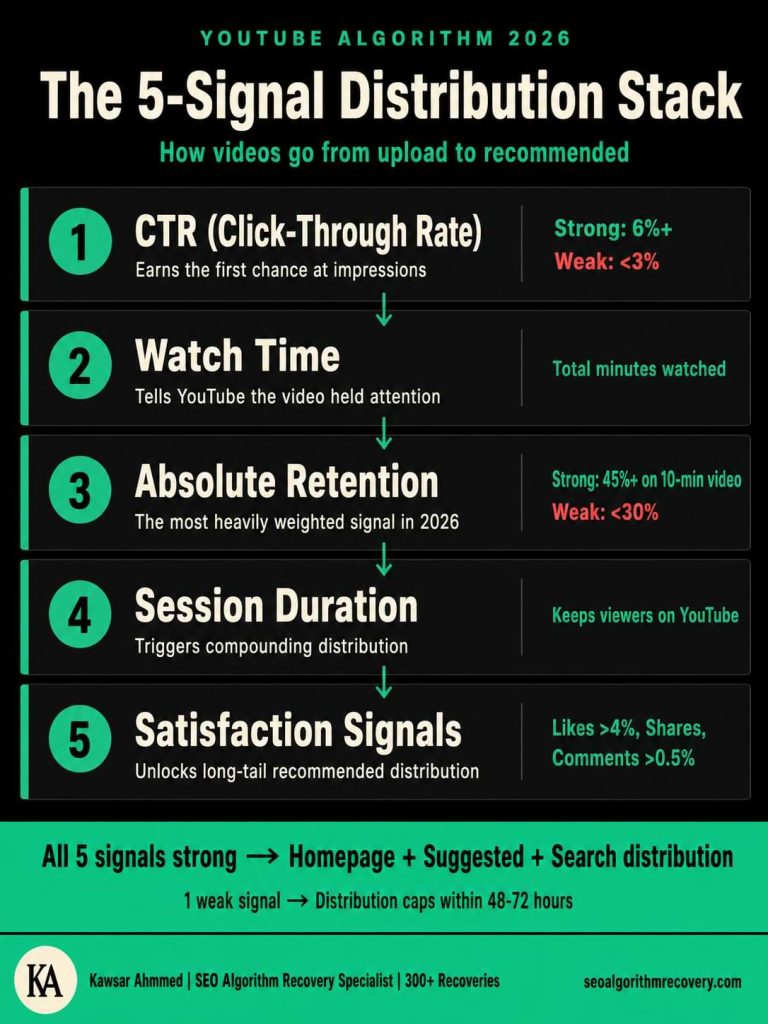
Session Duration: The Hidden Distribution Multiplier
Session duration measures how long a viewer stays on YouTube after watching your video, not just how long they watched yours. This is the metric most creators ignore, and YouTube weighs heavily.
A video that sends viewers off YouTube hurts your future distribution. A video that keeps them on YouTube, even if they go watch someone else, helps your distribution.
What boosts session duration
- End screens linked to evergreen videos with proven high retention
- Pinned comments that reference related videos in your library
- Series-format content that encourages binge watching
- Strong topical clustering with 3+ videos on the same subtopic
This is the YouTube equivalent of internal linking. When I work on E-E-A-T optimization for written content, the same principle applies: keep the visitor engaged inside your ecosystem long enough for the algorithm to read confidence into the signals.
Viewer Satisfaction Signals: Beyond the Click
YouTube uses several signals beyond watch metrics to judge whether viewers actually enjoyed a video.
- Like-to-view ratio, where above 4% is strong
- Comment-to-view ratio, where above 0.5% signals discussion-worthy content
- Share rate, the single strongest satisfaction signal in the model
- End-screen click-through, proving the viewer wanted more from you
- Survey responses, where YouTube periodically asks viewers to rate videos directly
Channels that focus only on clicks and ignore these satisfaction signals plateau. The 2026 algorithm increasingly weights these deep engagement indicators over surface metrics, mirroring exactly the same evolution I track in Google’s helpful content systems for written content.
My YouTube Diagnostic Framework
When I audit a stalling channel, I apply the same four-phase logic from my proprietary SEO recovery methodology:
- Diagnostic audit: pull 90 days of YouTube Studio data, segment by traffic source, identify which surface is failing
- Content and hook overhaul: rebuild the worst-performing recent videos with stronger 30-second openings and better CTR pairs
- Authority and topical clustering: produce 3 to 5 videos in the strongest topical cluster to trigger suggested-video distribution
- Monitoring and iteration: track CTR, retention, and session duration weekly and double down on what compounds
This approach mirrors what works in search traffic recovery, and the discipline of diagnosing before changing is the same discipline I apply across every algorithm recovery engagement at SEO Algorithm Recovery.
Frequently Asked Questions
Does YouTube penalize AI-generated voiceovers in 2026?
YouTube has no specific penalty for AI voice, but it does demote content that performs poorly on retention. Most AI voiceovers underperform on retention because they lack the pacing variation human delivery provides. The retention drop, not the AI itself, is what hurts you.
How long until a new video gets its full distribution?
Most videos receive around 80% of their first-30-day impressions inside the first 48 to 72 hours. If retention and CTR are strong in that window, YouTube continues pushing distribution for weeks. If either signal weakens, distribution drops sharply and rarely recovers without a content change.
Should I delete old underperforming videos?
No. Unlisting low-performance videos is usually better than deletion. Deletion can hurt overall channel signals, while unlisting removes weak content from public discovery without losing the historical engagement data the algorithm uses to score your channel.
How does YouTube Shorts interact with long-form distribution?
Shorts and long-form are scored on separate systems. A strong Shorts channel does not automatically lift long-form performance unless Shorts viewers convert to long-form watch time, which is rare without intentional cross-promotion built into the Short itself.

Channel Stuck? Get a Free 48-Hour Diagnostic
YouTube stagnation and Google traffic drops share the same root cause: weak signals to the algorithm. I diagnose both using the same four-phase recovery methodology that has powered 300+ successful recoveries across 10+ countries. Send me your channel or site, and I will return a prioritized fix list within 48 hours. Book your free assessment with Kawsar Ahmmed at SEO Algorithm Recovery today.