Your traffic just fell off a cliff. Rankings that held steady for months are suddenly gone. You check Google Search Console, scroll through your analytics, and the same question keeps coming back: was this a manual action or an algorithmic penalty?
I have recovered over 300 websites from Google penalties, and this is the single most common point of confusion I see. Site owners waste weeks applying the wrong fix because they misdiagnosed the problem. A manual action requires a completely different recovery approach than an algorithmic hit, and mixing them up costs time, money, and rankings.
If your website traffic dropped after a Google update and you are not sure what caused it, this guide will walk you through exactly how to identify which type of penalty hit your site and what to do about it.
What Is a Google Manual Action?
A manual action is a penalty applied by a human reviewer at Google. Unlike algorithmic changes that happen automatically, a manual action means someone on Google’s Search Quality team looked at your site and determined it violates Google’s spam policies. They then manually suppress your rankings or remove your pages from search results entirely.
Common Reasons for Manual Actions
The most frequent triggers I see in my recovery work include unnatural inbound links (someone built spammy backlinks to your site), thin content with little or no added value, cloaking or sneaky redirects, pure spam violations, and user-generated spam on forums or comment sections.
How to Check for a Manual Action?
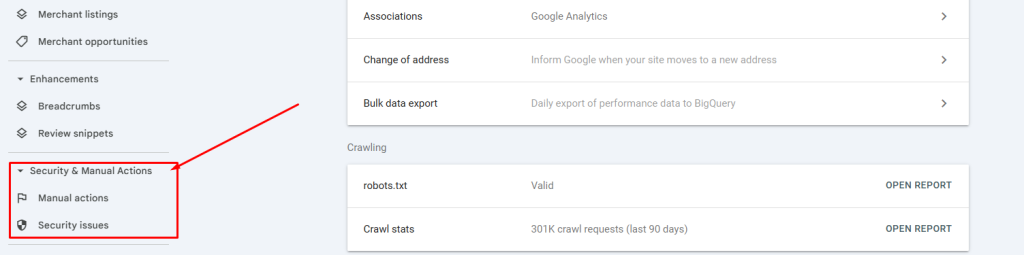
This part is straightforward. Log into Google Search Console, click on Security & Manual Actions in the left sidebar, then click Manual Actions. If you have one, you will see a clear message describing the issue and which pages or sections of your site are affected.
If that page says “No issues detected,” you do not have a manual action. Your problem is algorithmic. Running a complete SEO audit after a Google algorithm update is the right next step in that case.
What Is an Algorithmic Penalty?
Technically, Google does not call these “penalties.” They refer to them as ranking adjustments. But the result is the same: your site loses visibility because a Google algorithm update changed how your pages are evaluated.
Algorithmic demotions happen automatically when Google rolls out updates like the March 2026 core update, the Helpful Content Update, or a spam update. No human looked at your site. The algorithm simply re-scored your pages based on updated criteria, and your site came up short.
How to Diagnose an Algorithmic Hit?
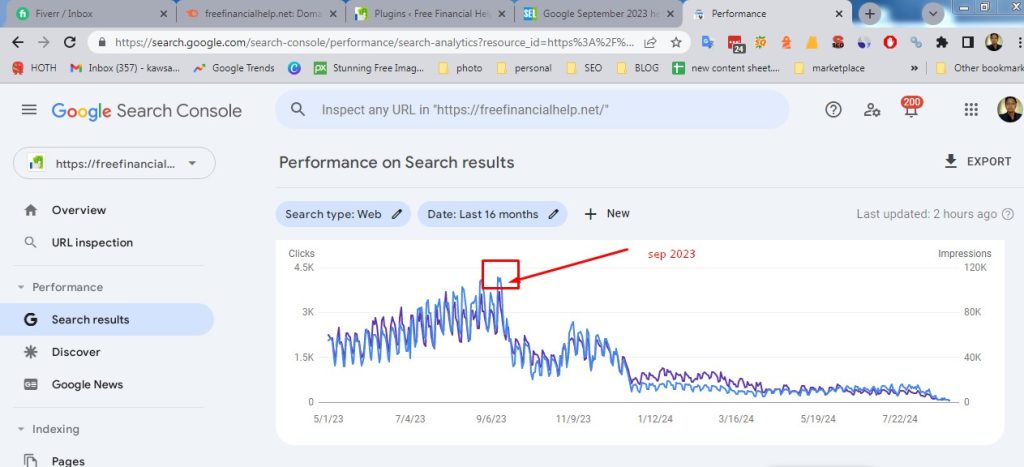
There is no single dashboard that says “you were hit by an algorithm update.” Diagnosis requires correlating your traffic drop with known update rollout dates. Here is how I approach it with every client:
- Check Google Search Console for the exact date traffic started declining.
- Cross-reference that date with Google’s confirmed update timeline on the Google Search Status Dashboard.
- Identify which pages lost the most traffic using the Performance report.
- Analyze whether the drop is site-wide or isolated to specific content clusters.
- Look for patterns: are the affected pages thin, outdated, lacking E-E-A-T signals, or flagged as AI-generated?
Sites that rely heavily on AI-generated content are particularly vulnerable. I have seen this pattern across multiple audits, including cases where AI content triggered quality demotions even without a formal manual action.
Manual Action vs Algorithmic Penalty: Side-by-Side Comparison
| Factor | Manual Action | Algorithmic Penalty |
| Applied by | Human reviewer at Google | Automated algorithm |
| Notification | Yes, in Search Console | No notification |
| Scope | Specific pages or entire site | Usually site-wide or section-wide |
| Timing | Can happen any time | Correlates with update rollout dates |
| Recovery process | Fix issue, submit reconsideration request | Improve content/technical quality, wait for next update |
| Recovery timeline | Days to weeks after approval | Weeks to months (next core update cycle) |
| Common causes | Spammy links, cloaking, thin content | Low E-E-A-T, poor content quality, technical issues |
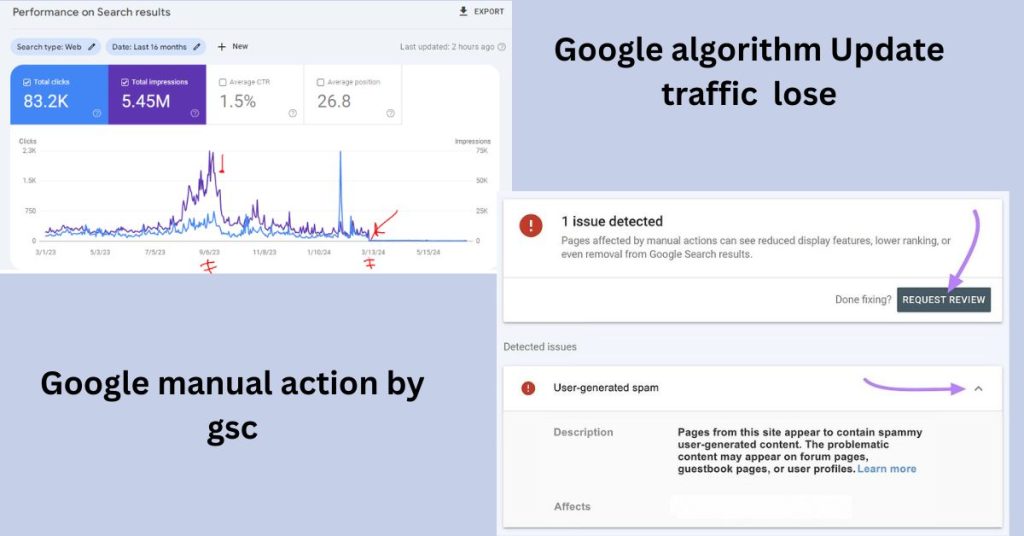
Which Google Updates Cause Which Type of Penalty?
Not every Google update works the same way. Understanding which updates trigger manual actions versus algorithmic adjustments helps you narrow down your diagnosis faster.
Core updates (like the March 2026 core update) are purely algorithmic. They re-evaluate content quality across the entire web. No manual reviewer is involved. If your traffic dropped right when a core update rolled out, you are dealing with an algorithmic issue.
Spam updates can trigger both. Google’s SpamBrain system handles most spam detection algorithmically, but the Search Quality team also issues manual actions for severe violations. If you got hit during a spam update, check Search Console first to see which category you fall into.
The Helpful Content system is algorithmic. It evaluates whether your content was created primarily for people or for search engines. Sites that publish large volumes of low-value or AI-generated content often get caught by this system. Recovery requires a significant content quality overhaul, not a reconsideration request.
Link spam updates are also algorithmic but can overlap with manual actions. If Google’s automated systems detect manipulative link patterns, your rankings drop. If a reviewer spots it, you get a manual action on top of the algorithmic suppression.
When to File a Reconsideration Request vs. When to Focus on Content?
Reconsideration request: Only file one if you have an active manual action in Search Console. Fix every issue flagged in the notice, document what you changed, and submit the request through Search Console. Google typically responds within a few days to a few weeks. If your request is denied, fix the remaining issues and resubmit.
Content and technical fixes: If your traffic drop is algorithmic, a reconsideration request will not help. There is nothing to reconsider because no human made the decision. Instead, focus on improving content quality, strengthening E-E-A-T signals, cleaning up technical issues, and removing or rewriting thin pages. Recovery usually becomes visible after the next relevant algorithm update.
I walk through this entire process in my algorithm recovery audit report, which breaks down exactly what to fix and in what order based on the type of penalty affecting your site.
What If You Have Both?
It happens more often than you would think. A site might receive a manual action for unnatural links while also getting hit by a core update for low content quality. In these cases, you need to address the manual action first (fix and submit reconsideration), then tackle the algorithmic issues separately.
Trying to fix everything at once without a clear sequence usually leads to confusion about what is actually working. Prioritize the manual action, get it lifted, and then move into your content and technical recovery plan.
How to Protect Your Site Going Forward?
Prevention is always cheaper than recovery. After working through more than 300 penalty recoveries, the sites that stay protected long-term share a few habits: they monitor Search Console weekly, they audit their backlink profile quarterly, they keep content updated and genuinely useful, and they never cut corners with mass AI content or link schemes.
The February 2026 Discover core update caught many publishers off guard because they had ignored early warning signs. Staying proactive with regular audits is the single best defense against future penalties. Google’s Search Central documentation on core updates is a solid resource for understanding what each update targets.
Frequently Asked Questions
How do I know if I have a Google manual action?
Log into Google Search Console, go to Security & Manual Actions, and click Manual Actions. If there is a penalty, you will see a detailed description of the issue. If it says “No issues detected,” your problem is algorithmic.
Can an algorithmic penalty turn into a manual action?
Not directly. They are separate systems. However, if Google’s automated spam detection flags your site, a human reviewer might investigate further and issue a manual action. This is relatively rare, but it does happen with severe spam violations.
How long does it take to recover from a manual action?
Once you fix the issues and submit a reconsideration request, Google usually responds within a few days to a few weeks. If approved, rankings typically begin recovering within days.
How long does algorithmic recovery take?
Algorithmic recovery is slower. You need to make improvements and then wait for Google to re-crawl and re-evaluate your site, which often happens during the next major update cycle. This can take anywhere from a few weeks to several months.
Can I recover from both at the same time?
Yes, but tackle the manual action first. Get it lifted, then focus on the algorithmic recovery. Trying to address both simultaneously without a clear order makes it harder to track which changes are driving results.
Not sure what hit your site? I offer a free penalty diagnosis that identifies whether you are dealing with a manual action, an algorithmic penalty, or both. Get your free diagnosis from Kawsar Ahmmed and find out exactly what is holding your site back.
About the Author: Kawsar Ahmmed is the founder of SEO Algorithm Recovery, a consultancy that has helped 300+ websites recover from Google penalties and algorithm updates. With 7+ years of specialized experience in penalty diagnosis and recovery, Kawsar works with e-commerce, SaaS, healthcare, and media sites worldwide. Connect on LinkedIn or visit seoalgorithmrecovery.com.