SaaS SEO recovery after a Google algorithm update requires a targeted approach that addresses comparison page bloat, thin programmatic content, AI-generated help documentation, and weak E-E-A-T signals. Software companies lose organic traffic when Google reclassifies their comparison pages as low-value affiliate content, flags scaled knowledge base articles as unhelpful, or determines that feature pages lack genuine expertise. Recovery involves auditing content quality across your entire SaaS content ecosystem, consolidating duplicate support documentation, rebuilding author authority through product-led content, and aligning every page with Google’s people-first content guidelines.
Why SaaS Sites Get Hit by Google Algorithm Updates?
SaaS websites face a unique set of vulnerabilities that most other business models do not. The content structures that drove organic growth for software companies over the past five years are now the exact patterns Google’s recent core updates are targeting.
I have recovered SaaS clients across B2B and B2C verticals, and the same problems keep appearing. The March 2026 Core Update, which completed rollout on April 8, 2026, hit software companies particularly hard because their content strategies relied heavily on programmatic scaling rather than genuine expertise. Whether you need a Google algorithm recovery expert or want to understand the damage first, the patterns below explain what went wrong.
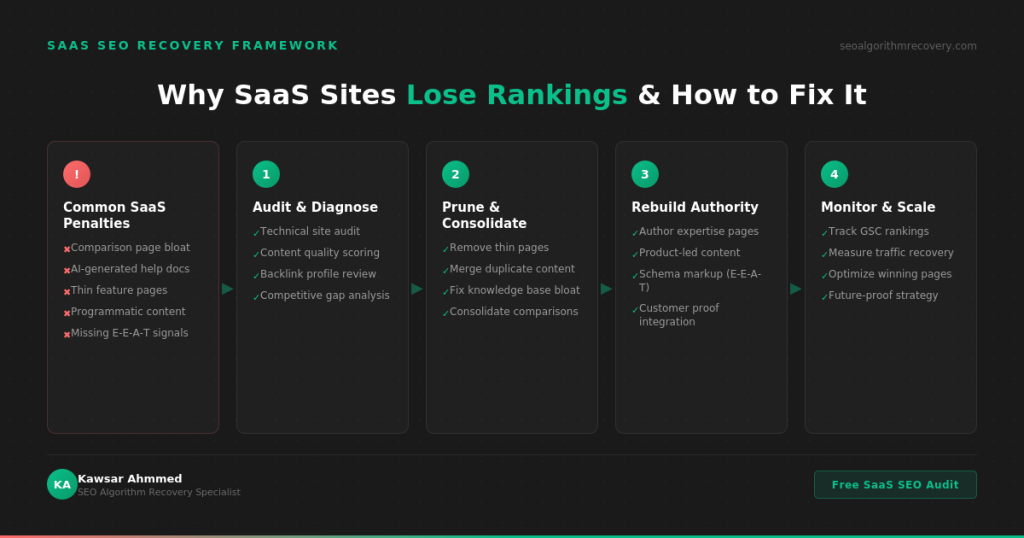
Here are the most common reasons SaaS sites lose rankings after algorithm updates:
- Comparison page bloat: Pages like “Product X vs Product Y” or “Top 10 Alternatives to Product Z” scaled across hundreds of competitor names without adding original analysis, proprietary data, or genuine product testing
- AI-generated help documentation: Knowledge bases and support centers filled with AI-written articles that restate the same instructions in slightly different ways across dozens of pages
- Thin feature pages: Individual pages for every micro-feature with 200-300 words of generic copy and no real user context or implementation guidance
- Aggressive programmatic content: Auto-generated landing pages targeting every industry, use case, or integration without substantive content behind them
- Missing E-E-A-T signals: No author pages, no team expertise sections, no customer proof, and no verifiable credentials connecting the content to real product knowledge
Google’s systems now evaluate whether content provides genuine value beyond what a competitor’s page already offers. For SaaS companies that built their SEO strategy around volume rather than depth, the reckoning has arrived.
Fixing SaaS Comparison and Alternative Pages
Comparison pages were once the highest-converting content type in SaaS SEO. Today, Google increasingly treats them as low-value affiliate content unless they demonstrate first-hand product experience.
The problem is not the format itself. The problem is that most SaaS comparison pages follow the same template: a feature checklist table, generic pros and cons pulled from review sites, and a CTA pushing the reader toward the company’s own product. Google sees thousands of these pages and recognizes the pattern.
How I fix SaaS comparison pages during recovery:
- Add original product testing data. Show actual screenshots, performance benchmarks, or workflow comparisons that could only come from someone who used both tools
- Include named author attribution. Every comparison page needs a byline from someone with verifiable experience using the products being compared
- Remove pages targeting competitors you have never tested. If your team has not genuinely evaluated a competitor, do not publish a comparison page about them
- Consolidate overlapping comparisons. Merge “Product A vs B” and “Product B vs A” into a single authoritative page rather than maintaining duplicate thin pages
- Add decision frameworks. Help readers understand which product fits which use case, team size, or budget instead of just listing features
The goal is to transform comparison content from a keyword-targeting exercise into a genuinely useful decision-making resource. According to Google’s people-first content guidelines, content should provide substantial value compared to other pages in search results. SaaS comparison pages that simply repackage publicly available feature lists fail this test.
Knowledge Base and Help Center Recovery
SaaS knowledge bases are one of the most overlooked sources of algorithmic penalties. Many software companies scaled their help centers to hundreds or thousands of articles without realizing that most of those pages provide near-identical information.
During recovery audits, I consistently find SaaS help centers where 40-60% of articles are either duplicates, near-duplicates, or cover such narrow topics that they provide no standalone value. Google’s Helpful Content system evaluates your entire site, not just individual pages. A bloated knowledge base drags down the quality signals of your entire domain.
Recovery process for SaaS help centers:
- Content inventory audit. Export all knowledge base URLs and categorize them by topic cluster. Identify articles that cover the same subject from slightly different angles
- Consolidation mapping. Merge related thin articles into comprehensive guides. Five separate articles about different aspects of user settings should become one complete settings guide
- Noindex or remove low-value pages. Articles with zero search traffic, no internal links, and minimal content should be noindexed or redirected to relevant parent pages
- Add genuine expertise markers. Include real configuration examples, common error messages with solutions, and workflow screenshots from actual product usage
- Implement proper internal linking. Connect help articles to relevant product pages, blog content, and use case guides to create topical clusters
The most successful SaaS recoveries I have managed reduced knowledge base page counts by 30-50% while improving organic traffic to the remaining pages. Fewer, better pages consistently outperform large volumes of thin documentation. I break down the full content pruning strategy for SEO recovery in my dedicated guide.
SaaS E-E-A-T: Building Authority Through Product-Led Content
E-E-A-T is not optional for SaaS companies anymore. Google’s March 2026 Core Update amplified experience signals as a primary ranking differentiator. Software companies that cannot demonstrate genuine product expertise through their content are losing rankings to competitors who can.
According to Search Engine Journal’s March 2026 Core Update analysis, 72% of top-ranking pages now feature detailed author biographies with verifiable credentials. SaaS companies have a built-in advantage here because their teams genuinely know the product, but most fail to translate that expertise into visible content signals.
SaaS-specific E-E-A-T building blocks:
- Team expertise pages. Create individual author profiles for every team member who contributes content. Include their role, years of experience, specific product areas they own, and links to their LinkedIn profiles
- Product-led blog content. Shift from generic industry topics to content rooted in your actual product experience. Write about real customer problems you solved, not hypothetical scenarios
- Customer proof integration. Embed case studies, testimonials, and usage data directly into your content pages rather than isolating them on a separate testimonials page
- Original data publishing. Use your product’s aggregated and anonymized usage data to publish original research that no competitor can replicate
- Schema markup for expertise. Implement Person, Organization, and SoftwareApplication schema across your site to help Google connect your content to your entity credentials
SaaS companies dealing with traffic losses from Google AI Overviews displacing organic clicks face an additional challenge. Strong E-E-A-T signals increase the likelihood that your content gets cited within AI Overviews rather than replaced by them.
SaaS Recovery: Before vs. After Implementation
This table summarizes the typical changes I implement during a SaaS SEO recovery engagement and what the measurable impact looks like across key metrics.
| Recovery Area | Before Recovery | After Recovery |
| Comparison Pages | 200+ templated pages with no original testing | 40-60 pages with first-hand product analysis |
| Knowledge Base | 500+ thin articles, 40-60% duplicate content | 200-250 comprehensive guides with real examples |
| Feature Pages | Individual page per micro-feature, 200-300 words | Grouped feature hubs with use cases and demos |
| E-E-A-T Signals | No author pages, no team bios, no credentials | Full author profiles, schema markup, customer proof |
| Programmatic Pages | Auto-generated landing pages for 100+ use cases | 10-15 high-quality use case pages with real data |
| Measurement | Organic traffic down 40-70%, ranking for 0 featured snippets | Traffic recovery 60-90% within 2-4 months, 5-10 featured snippets captured |
Recovery Timeline for SaaS Sites
SaaS SEO recovery does not happen overnight, but it follows a predictable timeline when the right actions are taken in the right sequence. Based on my experience recovering software company websites, here is what the typical journey looks like.
Weeks 1-2: Diagnostic and Audit Phase
Complete technical audit, content quality assessment, backlink profile review, and competitive gap analysis. Identify which content categories took the biggest hits and map them to specific algorithm signals. This is where we determine whether the traffic drop came from the core update, a spam update, or both.
Weeks 3-4: Content Pruning and Consolidation
Remove or noindex low-performing pages, merge duplicate content, and begin rewriting priority pages. For SaaS sites, this phase typically focuses on knowledge base cleanup and comparison page consolidation. Implementing a strategic backlink audit and disavow process during this phase also eliminates toxic link signals contributing to quality demotion.
Weeks 5-8: Authority Rebuilding
Launch author pages, implement schema markup, publish product-led content, and integrate customer proof across the site. Local SaaS companies with regional clients should also review their local SEO recovery strategy to ensure location-based pages are not dragging down site quality.
Weeks 9-12: Monitoring and Optimization
Track ranking recovery in Google Search Console, measure organic traffic trends, and refine content based on performance data. Most SaaS clients see measurable recovery within this window, with full restoration typically occurring after the next core update confirms the improvements.
How to Communicate SEO Recovery to SaaS Leadership?
One challenge unique to SaaS companies is the internal communication around SEO recovery. Product teams, engineering leadership, and board members need context that goes beyond “our rankings dropped.”
When reporting to SaaS stakeholders, frame recovery around these metrics:
- Revenue impact. Connect organic traffic loss to pipeline reduction or trial signup decline. Executives respond to revenue numbers, not ranking positions
- Competitive context. Show which competitors gained the rankings you lost and what content strategies they used. This prevents the conversation from becoming about blame
- Recovery probability. Share specific timelines based on the type of update that caused the drop. Core update recoveries typically take one to two update cycles
- Resource requirements. Outline exactly what the recovery needs from engineering, content, and design teams so leadership can allocate resources accordingly
Transparency matters. Recovery is a process, not a quick fix. Setting realistic expectations from the beginning prevents frustration and ensures continued support for the recovery effort.
Common SaaS SEO Recovery Mistakes
I see the same mistakes repeated across SaaS companies attempting recovery without specialized guidance.
- Panic-rewriting everything at once. Changing hundreds of pages simultaneously makes it impossible to measure what worked. Prioritize and implement changes in batches
- Ignoring the knowledge base. Most SaaS teams focus exclusively on blog and marketing pages while the bloated help center continues dragging down site-wide quality signals
- Adding author bios without real credentials. A generic “Content Team” byline does nothing for E-E-A-T. Google evaluates whether the named author has verifiable expertise
- Keeping programmatic pages indexed. Auto-generated pages that served as growth hacks now serve as quality anchors. Remove or substantially improve them
- Waiting for the next update instead of acting. Recovery improvements can be recognized between updates. Waiting wastes months of potential organic revenue
Frequently Asked Questions
How long does SaaS SEO recovery take after a Google core update?
Most SaaS websites begin seeing measurable ranking improvements within 4-8 weeks of implementing recovery changes. Full traffic restoration typically happens after Google’s next core update confirms the quality improvements. In my experience across 300+ recoveries, the average turnaround for SaaS clients is 6-10 weeks with consistent implementation.
Can SaaS comparison pages still rank in 2026?
Yes, but only if they demonstrate genuine first-hand product experience. Templated comparison pages without original testing data, named author expertise, and decision-making frameworks are the ones losing rankings. SaaS companies that invest in real product comparisons with honest analysis continue to rank well.
Should I delete my SaaS knowledge base to improve rankings?
No. Deleting your entire knowledge base removes valuable indexed pages and internal link equity. The correct approach is strategic consolidation: merge thin articles into comprehensive guides, noindex truly low-value pages, and add expertise signals to the remaining content.
Is AI-generated SaaS content causing ranking drops?
Google does not penalize content simply for being AI-generated. However, AI content that lacks original insight, first-hand experience, and editorial oversight triggers quality demotions. SaaS companies using AI to scale content without adding human expertise are seeing significant traffic losses.
What makes SaaS SEO recovery different from ecommerce or local SEO recovery?
SaaS recovery involves unique content types that other verticals do not have: comparison pages, knowledge bases, feature pages, integration pages, and programmatic landing pages. Each requires a different recovery strategy. Additionally, SaaS companies need to align recovery efforts across product, engineering, and marketing teams, which adds organizational complexity. For a different perspective, see how ecommerce SEO recovery after algorithm updates compares.

SaaS Website Lost Organic Traffic After a Google Update?
I recover software company rankings across B2B and B2C verticals. With 7+ years of specialized recovery experience and 300+ successful recoveries, I can diagnose exactly what went wrong and build a custom recovery plan for your SaaS website.
Request your free SaaS SEO audit at seoalgorithmrecovery.com
About the Author
Kawsar Ahmmed is the founder of SEO Algorithm Recovery and a Sr. SEO Strategy & Growth Consultant specializing in Google algorithm penalty recovery. With 7+ years of experience and 300+ successful website recoveries across ecommerce, SaaS, healthcare, fintech, and local business verticals, Kawsar helps businesses restore organic visibility after algorithm updates. Connect on LinkedIn or follow on X (@kawsarahmmedseo).