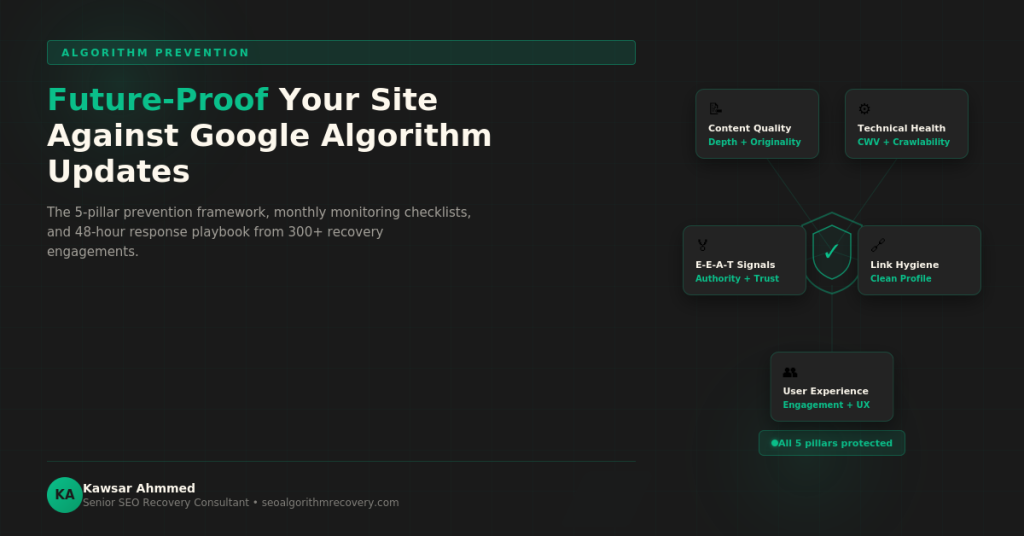
Future-proofing your site against Google algorithm updates requires a proactive system built on five pillars: content quality, technical health, E-E-A-T signals, link hygiene, and user experience. Sites that maintain all five consistently do not just survive algorithm updates. They gain traffic while competitors lose it.
Most site owners only think about Google algorithms after a traffic drop. By that point, the damage is done and recovery takes weeks or months. After working through 300+ algorithm penalty recoveries, I have noticed a clear pattern: sites that get hit once tend to get hit again with the next update because they fix symptoms instead of building systems.
This guide covers the exact prevention framework I set up for clients after every successful recovery. If your business website recently recovered from an algorithm hit, this is how you make sure it never happens again.
The 5 Pillars of Algorithm-Proof SEO
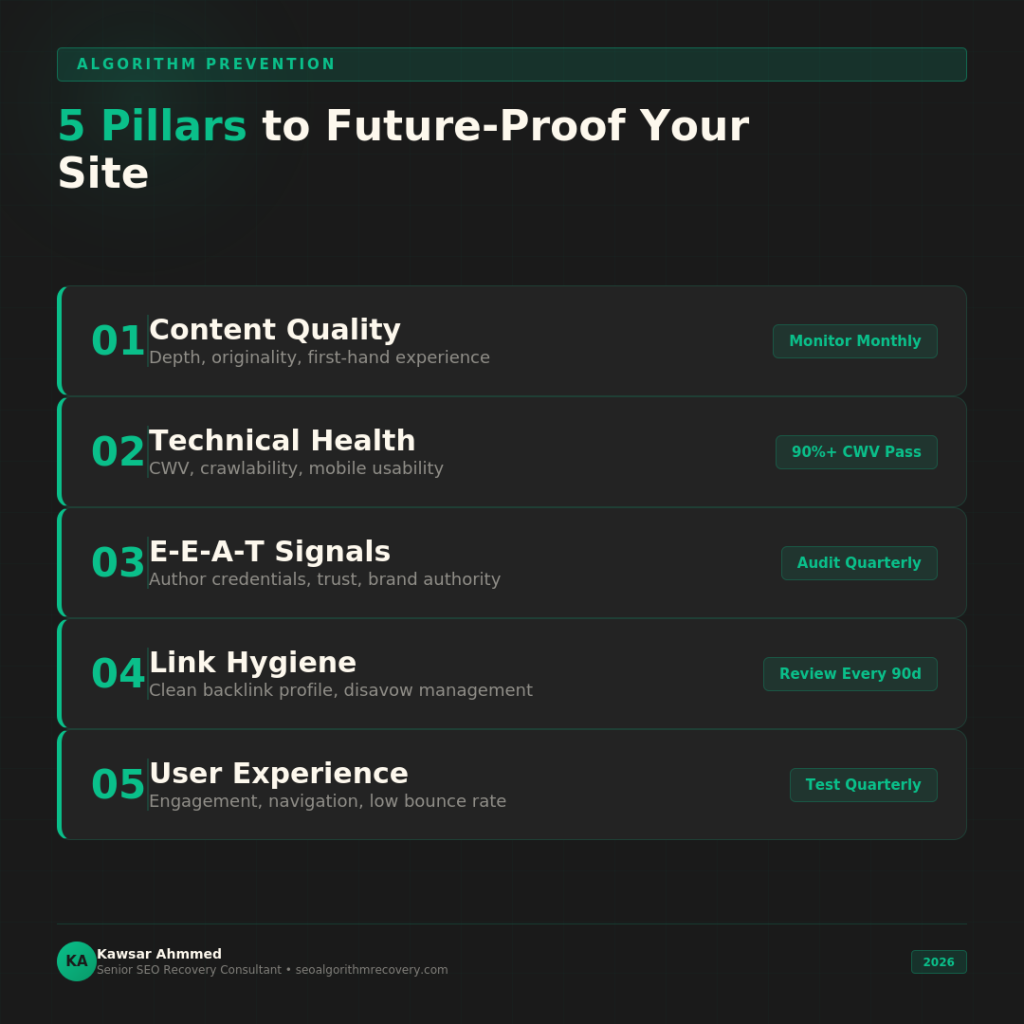
Google’s ranking systems evaluate hundreds of signals, but they all funnel into five core areas. Weakness in any single pillar creates vulnerability. Here is how each one connects to algorithm resilience.
| Pillar | What Google Evaluates | Weak Signal | Strong Signal | Measurement |
| Content Quality | Depth, originality, first-hand experience, helpfulness | Thin pages, duplicate content, AI-generated filler | Expert-written, unique data, solves user intent fully | Track indexed page count, monitor ‘Crawled not indexed’ in GSC monthly |
| Technical Health | Crawlability, indexing, Core Web Vitals, mobile usability | Slow load times, crawl errors, broken internal links | Sub-2s load time, clean crawl, 90%+ CWV pass rate | Run Screaming Frog crawl monthly, review CWV in GSC weekly |
| E-E-A-T Signals | Author credentials, brand reputation, trustworthiness | No author bios, anonymous content, no brand mentions | Named experts, published credentials, cited by others | Audit author pages quarterly, track branded search volume in GSC |
| Link Hygiene | Backlink quality, anchor diversity, toxic link ratio | Spammy PBN links, unnatural anchor text patterns | Editorial links, diverse anchors, clean disavow file | Backlink audit in Ahrefs/Semrush quarterly, disavow review every 90 days |
| User Experience | Engagement, bounce behavior, navigation clarity | Intrusive ads, confusing layout, high pogo-sticking | Clean design, clear navigation, low bounce rate | Review GA4 engagement rate monthly, test mobile UX quarterly |
Google’s own helpful content guidelines emphasize that content should demonstrate first-hand expertise and provide substantial value beyond what other results offer. Sites that treat these five pillars as an ongoing system rather than a one-time checklist consistently survive updates that penalize their competitors.
Monthly Monitoring Checklist: What to Review Every 30 Days?
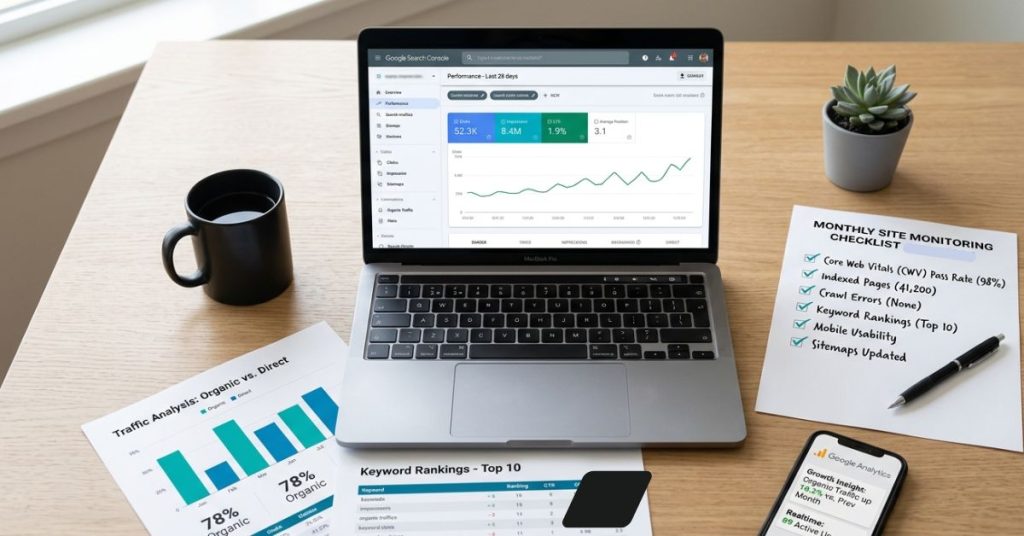
Prevention works only if you are looking at the right data at the right intervals. Here is the monthly checklist I set up for every retainer client.
- GSC Performance comparison (this month vs. last month): Track total clicks, impressions, and average position. A 10%+ drop in any metric before an announced update signals a creeping quality issue. I walk through the full comparison setup in my Google Search Console algorithm recovery guide
- Indexed page count in GSC Pages report: If your indexed count drops without you removing pages, Google is quietly deindexing content it no longer considers valuable
- Core Web Vitals pass rate: Aim for 90%+ on mobile. According to research from BrightEdge, sites with passing CWV scores recover 35% faster after core updates than sites with failing scores
- New and lost backlinks in Ahrefs or Semrush: Watch for sudden spikes in low-quality links pointing to your site. Negative SEO attacks and scraped content syndication often precede spam update penalties
- GA4 engagement rate by page group: Sort your content into categories (blog, product, service pages) and track engagement rate for each. A declining engagement rate in one category warns you before Google’s systems catch up
Quarterly Content Audits: Prune, Refresh, and Expand Before Google Forces You To
Every 90 days, run a content audit that sorts every indexed page into one of four buckets: keep, update, consolidate, or remove. This proactive cycle is the single biggest differentiator between sites that get hit by helpful content updates and sites that gain traffic from them.
Keep: Pages with steady or growing traffic, strong engagement metrics, and unique content that serves clear user intent. Leave these alone.
Update: Pages that rank on page 2 or 3, have outdated statistics or answer questions that have evolved. Refresh with current data, add first-hand insights, and improve internal linking.
Consolidate: Multiple pages targeting similar topics that split authority. Merge them into one comprehensive resource with proper 301 redirects. Google’s documentation on URL consolidation confirms this as a recommended practice for duplicate content issues.
Remove: Pages with zero traffic for 6+ months, thin content under 300 words with no unique value, and auto-generated or AI-produced pages that add nothing the rest of your site does not already cover. Use 410 status codes for permanent removal.
Building a Google Update Response Playbook: The First 48 Hours
When Google announces a new algorithm update, most site owners panic and start making random changes. That is the worst possible response. Here is the 48-hour playbook I give every client.
Hour 0 to 6: Do nothing to your site. Monitor the Google Search Status Dashboard and confirm the update type. Check industry forums and SEO news for early reports on which site categories are affected.
Hour 6 to 24: Run baseline snapshots. Export your GSC Performance data for the last 28 days. Screenshot your current indexed page count. Run a fresh backlink report. These baselines are essential for measuring actual impact versus panic.
Hour 24 to 48: Assess real impact. Compare yesterday’s GSC data against the baseline. Updates typically take 1 to 2 weeks to fully roll out, so do not overreact to day-one fluctuations. If you see drops exceeding 20% in clicks on your top pages, prioritize a deeper diagnosis. An experienced SEO consultant specializing in core update recovery can cut this diagnosis time from weeks to days.
Why Most Sites Get Hit Repeatedly and How to Break the Cycle?
In my 300+ recovery engagements, roughly 45% of clients came to me after their second or third algorithm penalty. The pattern is almost always the same: they fixed the immediate problem after the first hit but never built prevention systems.
Here are the most common mistakes that lead to repeat penalties:
- Fixing only the pages that dropped instead of auditing the entire site for the same issues. If 10 pages got hit for thin content, chances are 50 more pages have the same problem but have not been caught yet
- Treating recovery as a project with an end date instead of an ongoing maintenance commitment. Algorithm updates now roll out 10 to 12 times per year. Your prevention work needs to match that cadence
- Ignoring E-E-A-T after the immediate crisis passes. Author bios get set up during recovery and then never updated. Credential pages go stale. Expert content production stops once traffic returns
- Skipping quarterly backlink audits after cleaning up toxic links during recovery. New spammy links accumulate constantly, especially on sites that gained visibility after recovery
- Not monitoring competitors. When your competitors get hit by an update, and you did not, that is valuable data. Study what they did wrong and verify you are not doing the same things. When they recover, study what they fixed
Breaking this cycle requires a shift from reactive SEO to proactive monitoring. That is exactly what my monthly monitoring retainer is built around: catching the signals before Google’s next update turns them into penalties. According to Search Engine Land’s algorithm update tracking, Google confirmed 13 major updates in 2025 alone, and the pace is only increasing.
Frequently Asked Questions
How often does Google release algorithm updates?
Google rolls out major confirmed updates approximately 10 to 13 times per year, including core updates, spam updates, helpful content updates, and review updates. Smaller unconfirmed updates happen almost daily. A proactive monitoring system catches the impact of both confirmed and unconfirmed changes.
Can I completely prevent my site from being affected by algorithm updates?
No site is 100% immune to algorithm fluctuations. However, sites that consistently maintain all five pillars (content quality, technical health, E-E-A-T, link hygiene, and user experience) experience minor fluctuations of 5 to 10% rather than catastrophic 50%+ drops. The goal is resilience, not immunity.
Is monthly SEO monitoring worth the investment if my site has not been penalized?
Prevention is significantly cheaper than recovery. A typical algorithm penalty recovery takes 60 to 120 days and costs thousands in lost revenue and consultant fees. Monthly monitoring costs a fraction of that and catches problems weeks before they escalate. In my client data, sites on ongoing monitoring plans have a 90% lower rate of major algorithm impact compared to sites without active monitoring.