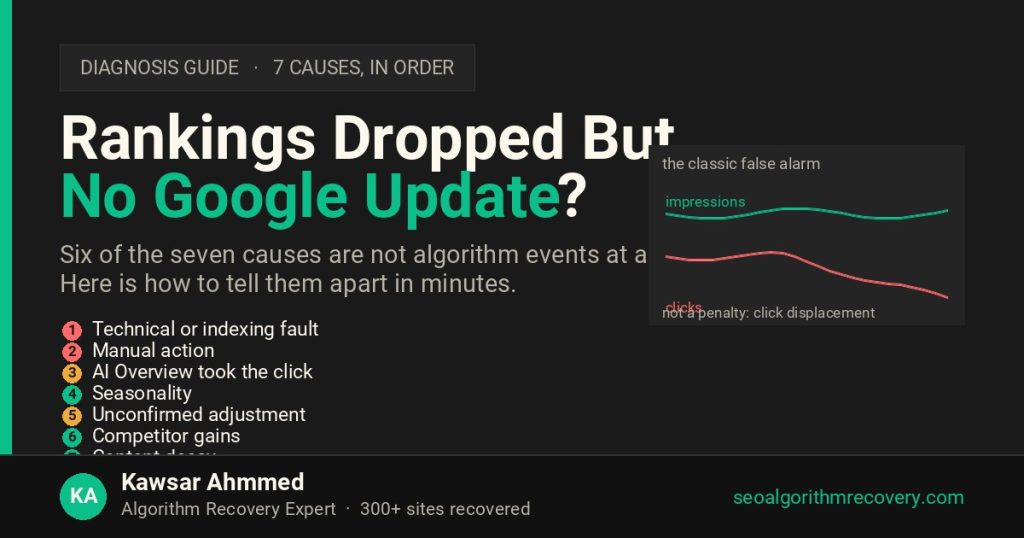
If your rankings dropped and no Google update was confirmed, the cause is usually one of seven things: an unconfirmed adjustment, an AI Overview taking the click, a technical or indexing fault, a manual action, seasonality, a competitor gain, or slow content decay. Only the first is an algorithm event. The other six are diagnosed and fixed differently, and treating all of them as a quality problem is why most self-managed recoveries stall. Work through them in the order below, because the cheapest checks rule out the most cases.
First, confirm there really was no update
Google confirms only the largest changes. Since 2024 it has named fewer updates each year while volatility has stayed high, so a drop with no matching announcement is now the normal case rather than the exception.
Check two sources before you accept that no update was involved. Open the live update tracker and look for a confirmed rollout window containing your drop date, remembering that rollouts run 12 to 24 days and the effect can land on any day inside that window, not just the first. Then open the volatility sensor for the same date. High volatility with no confirmation means an unconfirmed adjustment, which is cause one below.
If both come back quiet, the cause is almost certainly on your side of the fence, and that is good news. Site-side causes are faster to fix and do not wait for a core update to reassess.
The seven causes, in diagnostic order
Run these in sequence. Each check takes minutes, and the early ones eliminate the largest share of cases. The Measurement column is the exact signal that confirms or rules out each cause.
| Order | Cause | Measurement (how to confirm) | Typical time to fix |
|---|---|---|---|
| 1 | Technical or indexing fault | Indexed page count fell in the Pages report during the same week | Days to 2 weeks |
| 2 | Manual action | Manual Actions report is not empty | Weeks, after reconsideration |
| 3 | AI Overview click displacement | Impressions and average position flat while clicks and CTR fall | 2 to 6 weeks |
| 4 | Seasonality | Same dip appears in the same weeks last year | No fix needed |
| 5 | Unconfirmed algorithm adjustment | Sensor volatility high on the drop date, no confirmed update | Weeks to a core update cycle |
| 6 | Competitor gains | Your position fell while impressions held; new sites now rank above you | Ongoing competitive work |
| 7 | Content decay or lost links | Gradual decline over months, no single break date | 4 to 12 weeks |
1. Technical or indexing fault
This is first because it is the most common cause of a sharp drop with no update, the fastest to confirm, and the only one where acting immediately is correct.
- Open Indexing, then Pages, and compare indexed counts across the drop week. Why: A fall in indexed pages alongside a fall in clicks is a technical problem, not a ranking problem. The reason will be named in the excluded reasons list.
- Check for an accidental noindex or a robots.txt change. Why: Staging settings pushed to production are the classic version of this. It can remove a whole section from search within days.
- Check canonical tags on the affected template. Why: A plugin update or theme change that points every page at the homepage will collapse rankings across a template while leaving the site apparently intact.
- Check server uptime and response times for the drop week. Why: Sustained 5xx errors during a crawl cause genuine ranking loss. It usually recovers on its own once stability returns, but you need to know that is what you are watching.
- Check whether a migration, redesign or CMS update landed within three days of the drop. Why: Correlation with a deploy is stronger evidence than any algorithm theory. The Search Console recovery guide covers each report in detail.
2. Manual action
A manual action is a human reviewer deciding your site violates a policy. It is not an algorithm update and it never appears on the update tracker, which is exactly why it fits this article.
Open Security and Manual Actions in Search Console. If the report is empty, rule this out and move on. If it is not empty, stop working through this list, because the fix path is a reconsideration request and nothing else will restore the rankings. The manual action versus algorithmic penalty guide explains why the two are never treated the same way.
3. AI Overview click displacement
This is the most misdiagnosed cause on the list and it has grown into the most common one for informational sites. Your rankings did not move. An AI answer appeared above the results and absorbed the click.
- Compare clicks against impressions and average position on the same chart. Why: The signature is unmistakable. Impressions flat or rising, average position flat or improving, clicks falling. A ranking drop moves all three together.
- Filter to the queries that lost the most clicks and search each one in an incognito window. Why: If an AI Overview sits above your result, you have your answer in thirty seconds.
- Check whether the losses cluster on question-shaped queries. Why: Definitional and how-to queries attract AI answers far more than transactional ones. If your commercial pages held and your guides fell, that is the pattern.
Rewriting content for quality will not fix this and often makes it worse by removing the specifics that earn a citation. The response is a format and query targeting change, covered in recovering traffic lost to AI Overviews.
4. Seasonality
Two minutes of work rules out a surprising share of panicked drops. Set the Search Console date range to compare with the same period last year rather than the previous period.
If the same dip appears in the same weeks a year earlier, your traffic is behaving normally. Travel, retail, education, tax and recruitment queries all have predictable annual shapes. Year-over-year comparison is the only honest view for these sectors, and comparing against the previous 28 days will mislead you every time.
5. Unconfirmed algorithm adjustment
If the first four are ruled out and volatility was elevated on your drop date, you are looking at a real ranking change that Google chose not to name. These are narrower than core updates and often target a specific pattern rather than site quality generally.
- Group your pages by template and find which group carried the loss. Why: Unconfirmed adjustments usually hit one page type. Thin location variants, tag archives, and near-duplicate service pages are the usual casualties.
- Wait two weeks before acting. Why: Unnamed changes are frequently refined or partly reversed within days. Changing your site in response to something Google then rolls back leaves you worse off.
- If it holds after two weeks, treat it as a quality signal on that template. Why: Consolidating near-duplicates into fewer, deeper pages is the fix that works most often, and it is covered in the content pruning strategy.
6. Competitors gained, you did not fall
Rankings are relative. A page can lose position without getting worse, because something better arrived. This looks identical to a demotion in a rank tracker and completely different in the SERP.
Take the ten queries with the largest click loss and look at who now occupies your old positions. If the same two or three domains appear repeatedly and their pages are newer, more detailed, or better structured than yours, this is a competitive problem. No amount of technical fixing or waiting for a core update will recover a position that a genuinely better page now holds. The work is content improvement against a specific benchmark, not recovery.
7. Content decay and lost links
This one has no drop date at all, which is how you recognise it. The daily click line slopes down over months with no sharp break anywhere.
- Check the age of your top-performing pages. Why: Content covering versions, prices, years or best-of lists loses relevance on a schedule. Google prefers fresher results for those queries regardless of your site quality.
- Check referring domains over the last twelve months. Why: Links disappear when sites are redesigned, sold or shut down. A steady loss of referring domains produces exactly this gradual slope.
- Check whether your own internal links still point at your priority pages. Why: Site redesigns often quietly remove navigation links and internal link equity moves with them.
The decision tree in one paragraph
Indexed pages fell, fix the technical fault now. Manual Actions report not empty, file a reconsideration request and stop here. Impressions flat and clicks down, it is click displacement, not a penalty. Same dip last year, it is seasonality. High volatility on the drop date, it is an unconfirmed adjustment, wait two weeks then work on the affected template. New domains in your old positions, it is competitive, not recovery. No sharp date at all, it is decay, refresh content and rebuild links.
If two or more of these are true at once, you have overlapping causes and each needs its own fix and its own reassessment cycle. That is when a drop takes six months instead of two, as covered in how long recovery takes.
Frequently asked questions
When was the last Google algorithm update?
The live tracker on this site syncs with the Google Search Status Dashboard twice a day and shows the most recent confirmed update, its start and end dates, and whether anything is rolling out right now.
Why did my rankings drop with no Google update?
Most commonly a technical or indexing fault, an AI Overview taking clicks while your position held, seasonality, or an unconfirmed ranking adjustment that Google did not announce. Manual actions, competitor gains and slow content decay account for the rest.
Does Google update its algorithm without announcing it?
Yes, thousands of times a year. Google confirms only broad core updates, larger spam updates and occasional product updates. Everything else ships silently, which is why unconfirmed volatility is now more common than confirmed updates.
How can I tell an algorithm drop from a technical problem?
Check the Pages report in Search Console. If indexed page counts fell in the same week as the clicks, it is technical. If indexing is stable and only rankings moved, it is algorithmic or competitive.
Should I wait or act when there is no confirmed update?
Act immediately on technical faults and manual actions. Wait two weeks on everything else, because unconfirmed adjustments are often refined or reversed and site changes made in the meantime destroy your ability to measure what worked.
My traffic dropped but my rankings are the same. Is that a penalty?
No. Stable positions with falling clicks means something above your result took the click, usually an AI Overview or an expanded SERP feature. It is a visibility problem rather than a ranking penalty and needs a different fix.
Worked through the list and still cannot place it?
Send your Search Console access or export. Within 48 hours I tell you which of the seven causes applies, whether more than one is in play, and what the fix sequence should be. Free, no obligation.
Get free recovery auditSources: Google Search Central documentation on core updates, manual actions and Search Console reports; confirmed rollout dates from the Google Search Status Dashboard as recorded on this site’s live tracker; diagnostic sequence and cause frequency from client engagements between 2017 and 2026.