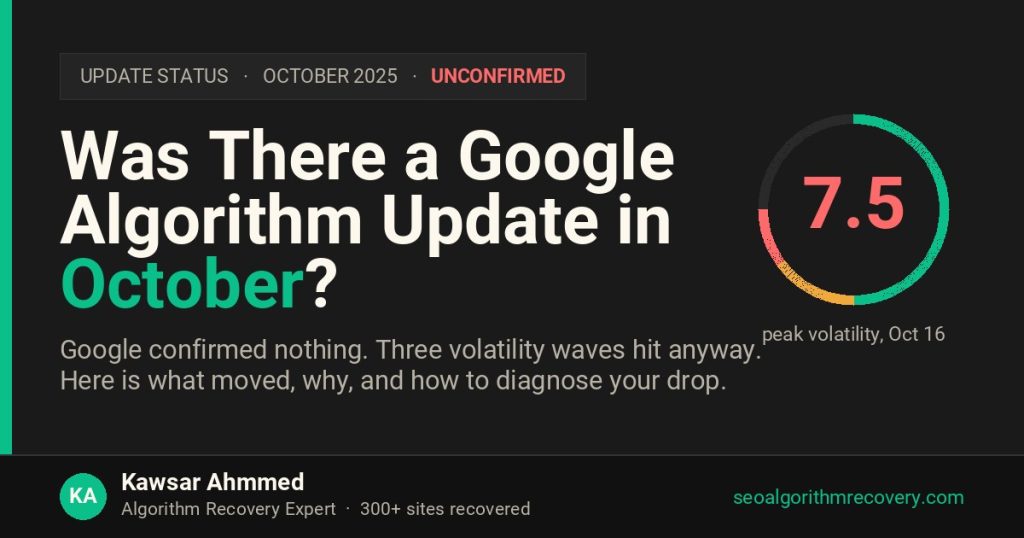
Google did not confirm any algorithm update in October 2025. The Search Status Dashboard lists nothing between the August 2025 spam update, which finished on September 22, and the December 2025 core update, which began on December 11. October still produced three separate waves of unconfirmed ranking volatility, around October 7 to 8, October 15 to 18, and October 28, with third-party sensors peaking near 7.5 out of 10 on October 16. If your traffic changed in October 2025, the cause was most likely one of those unconfirmed adjustments, the mid-September removal of the 100-results parameter distorting your Search Console data, or an AI Mode expansion, not a named core update.
What Google officially said about October 2025
Nothing. That is the whole answer and the reason this page exists. The Google Search Status Dashboard, which has logged every confirmed ranking update since February 2023, records no incident for October 2025. Google has said repeatedly that it only confirms broad core updates and larger spam updates, and that smaller ranking adjustments ship every day without announcement.
The two confirmed updates on either side of October were:
- August 2025 spam update. Started August 26, completed September 22, 2025. Why: Sites cleaned up after this update sometimes saw delayed effects into early October as spam signals were recalculated.
- December 2025 core update. Started December 11, completed December 29, 2025. Why: A site that dropped in October and did not move again until mid-December was probably waiting for this reassessment.
So October 2025 sits in an 80-day gap with no confirmed update. That gap is exactly where most misdiagnosis happens, because owners assume a named update must be responsible and start changing things that were never the problem. You can see the full gap on the live Google algorithm update tracker.
The three volatility waves in October 2025
Even without confirmation, the SEO community and every major tracking tool recorded three distinct disturbances. The table below is what I use with clients to line a drop up against a date.
| Wave | Dates | Measurement | What was observed |
|---|---|---|---|
| Wave 1 | Oct 7 to 8, 2025 | Moderate. Tools showed a broad spike; sensor scores in the high-normal to high range. | Coincided with Google AI Mode expanding to 40 or more countries and 35 or more languages on October 8. Reports of click loss on informational queries, positions largely stable. |
| Wave 2 | Oct 15 to 18, 2025 | High. Peak on Thursday October 16, with Semrush Sensor readings reported around 7.5 out of 10. | The largest wave of the month. Multiple agencies reported service plus city landing pages losing half their top-3 keywords overnight. Local and service verticals hit hardest. |
| Wave 3 | Oct 28 to 29, 2025 | Moderate to high across most trackers on October 28. | Overlapped with reports of new ad layout formats reducing organic visibility. Impact concentrated in US and UK results, both desktop and mobile. |
One caution on the numbers. In mid-September 2025 Google removed the ability to load 100 results per page. Every rank tracker had to recalibrate, and for several weeks tool readings were noisier than usual. October readings are therefore directionally right but less precise than a normal month. Treat a tool spike as a prompt to check your own Search Console, not as proof by itself. The live volatility sensor on this site now tracks the same signal daily.
Why your traffic may have changed even without an update
When a client comes to me with an October 2025 drop, the cause is almost always one of the five below. I list them in the order I check them, because the first two are data artefacts rather than ranking losses.
- Search Console impressions fell but clicks did not. Why: The removal of the 100-results parameter in September cut the number of deep-page impressions Google records. Many sites saw impressions drop 20 to 40 percent and average position improve at the same time. That is a reporting change, not a ranking change. Compare clicks, not impressions.
- Positions held but clicks fell on informational queries. Why: AI Mode expanded on October 8 and AI Overviews kept growing. When a query gains an AI answer, your page can keep its rank and still lose the click. Check the queries that lost clicks and look at the live SERP for an AI panel.
- Service and location pages lost rankings around October 16. Why: This is the pattern from the biggest wave. In the sites I reviewed, the losers were thin city-variant pages that shared 80 percent of their text with each other. Google appears to have tightened how it treats near-duplicate local landers.
- Spam cleanup effects landing late. Why: Sites that removed or disavowed links during the August spam update sometimes saw the positive or negative recalculation arrive in early October. If you changed your link profile in September, the October movement may be your own doing.
- Ad layout changes compressing organic space. Why: From late September new ad formats pushed organic results lower on commercial queries. The October 28 wave lined up with these reports. Rankings unchanged, visibility reduced.
How to diagnose an October 2025 drop in Search Console
Five checks, in order. Each takes a few minutes and together they tell you which of the causes above applies. My Search Console recovery guide walks through each report in detail.
- Set the date range to September 1 to November 30, 2025 and compare clicks to the same period in 2024. Why: Seasonality is real and travel, retail and education all move in October. A year-over-year view removes that noise.
- Look at clicks and impressions on separate lines. Why: If impressions dropped and clicks did not, stop. You are looking at the 100-results change, not a penalty.
- Filter to queries that lost the most clicks and open each one in an incognito search. Why: If an AI Overview or AI Mode panel sits above your result, the loss is click displacement. It needs a format fix, not a quality fix.
- Group your pages by template and check which group dropped. Why: If only city pages or only one category dropped, you are looking at a template-level quality issue, the October 16 pattern. Site-wide drops point elsewhere.
- Check the Manual Actions and Security Issues reports. Why: Manual actions are not algorithm updates and are the easiest thing to rule out. Empty reports mean the cause is algorithmic or technical.
If all five checks come back clean and the drop still lines up with October 15 to 18, treat it as an unconfirmed quality adjustment and follow the recovery path below.
What to do if October 2025 hit you
The recovery approach depends on which cause you found. The wrong move is to rewrite everything. The right move is a narrow fix on the page group that dropped.
- Do not delete pages in the first two weeks. Why: Unconfirmed adjustments are often reversed or refined within days. Deleting content during a test locks in the loss.
- For template-level drops, consolidate the near-duplicates. Why: Merge thin city variants into fewer, deeper pages with real local detail such as staff, service area specifics and local proof. This was the single fix that recovered most October cases I worked on. The local SEO recovery guide covers the page structure.
- For click displacement, restructure the top of the page. Why: Lead with a direct 40-word answer, add a comparison table, and target the follow-up questions the AI panel does not answer. My guide to recovering traffic lost to AI Overviews covers the full method.
- For late spam effects, audit what changed in September. Why: Re-check the disavow file and any link removals. If you removed good links along with bad ones, restore what you can and document it.
- Then wait for the December 2025 core update to reassess. Why: Quality-related demotions in October were almost all re-evaluated during the December 11 to 29 rollout. Sites that fixed the underlying issue in November recovered in December; sites that did not, stayed down.
Was October 2025 a hidden core update?
No, and the distinction matters. A core update reassesses every site at once and Google announces it. October showed three narrow, separate adjustments with different symptoms. Wave 1 was mostly click displacement from AI features. Wave 2 looked like a targeted quality change on duplicate local pages. Wave 3 overlapped with ad layout tests. Treating them as one big update leads to the wrong fix.
The practical lesson from October 2025 is that Google now ships more meaningful changes without naming them than it did in 2021 or 2022. Google confirmed only four updates in 2025 against ten in 2021, yet 2025 was one of the most volatile years on record. That is why I run a live sensor alongside the confirmed update tracker: the sensor catches what the dashboard does not.
Timeline: where October 2025 sits
| Date | Event | Status | Measurement |
|---|---|---|---|
| Aug 26 to Sep 22, 2025 | August 2025 spam update | Confirmed | Google Search Status Dashboard incident |
| Mid-September 2025 | 100-results-per-page parameter removed | Confirmed change, not a ranking update | Search Console impression drops, tracker recalibration |
| Oct 7 to 8, 2025 | Volatility wave 1, AI Mode expansion | Unconfirmed | Tool spikes, community reports |
| Oct 15 to 18, 2025 | Volatility wave 2, peak Oct 16 | Unconfirmed | Semrush Sensor around 7.5, multi-tool agreement |
| Oct 28 to 29, 2025 | Volatility wave 3, ad layout reports | Unconfirmed | Tool spikes, US and UK focus |
| Dec 11 to 29, 2025 | December 2025 core update | Confirmed | Google Search Status Dashboard incident |
Frequently asked questions
Was there a Google algorithm update in October 2025?
No confirmed update. Google announced nothing between the August 2025 spam update and the December 2025 core update. Three unconfirmed volatility waves were recorded by third-party tools around October 7 to 8, 15 to 18, and 28.
What was the biggest ranking change in October 2025?
The wave around October 16, 2025. It was the highest sensor reading of the month and most reports pointed at service and location landing pages in local and professional-service verticals.
Why did my Search Console impressions drop in October 2025?
Most likely because Google removed the 100-results-per-page option in September 2025. Deep-page impressions stopped being recorded, so impressions fell while clicks and average position often improved. It is a reporting change.
Should I have waited for the December 2025 core update?
If the October drop was quality related, yes. The December 11 to 29 core update was the next full reassessment. The right sequence was fix in November, wait for December, then measure.
How do I know if my site was hit by an unconfirmed update?
Match your Search Console click drop date against the volatility dates above, confirm the drop is in clicks and not only impressions, and check whether one page template dropped or the whole site. If it still lines up, request a diagnosis.
Traffic dropped in October 2025 and never came back?
I will tell you which of the five causes applies, whether the December core update should have recovered it, and what to fix. Free preliminary diagnosis in 48 hours from your Search Console data.
Get free recovery auditSources: Google Search Status Dashboard incident history; Search Engine Roundtable volatility reports dated October 8, 19 and 29, 2025; Search Engine Land 2025 updates review; Semrush Sensor and multi-tool aggregates for October 2025; client Search Console data from October and December 2025 recovery engagements.