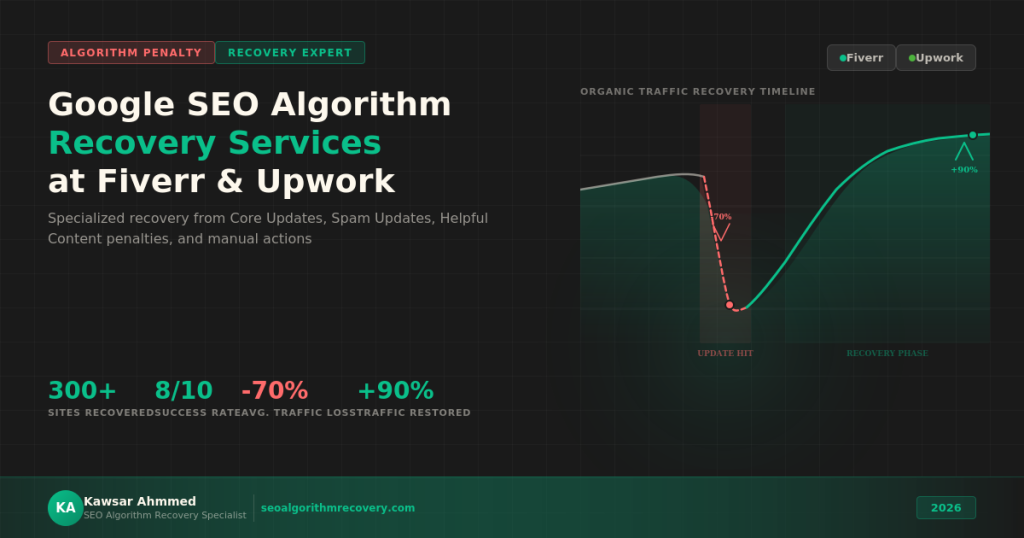
Google SEO algorithm recovery is a specialized service that diagnoses and reverses traffic losses caused by Google algorithm updates, manual actions, and penalty-related ranking drops. Freelance platforms like Fiverr and Upwork connect website owners with recovery specialists who analyze Search Console data, audit content quality, fix technical SEO issues, and rebuild E-E-A-T signals to restore organic visibility.
Every time Google rolls out a core update, spam update, or helpful content update, thousands of websites lose rankings overnight. The March 2026 Core Update, which began rolling out on March 27, 2026, is just the latest example. Paired with the March 2026 Spam Update and the February 2026 Discover Core Update, site owners across e-commerce, healthcare, SaaS, and publishing verticals have been dealing with significant organic traffic losses.
I am kawsar ahmmed, I have spent over 8 years focused exclusively on recovering websites from these exact situations. Through my consultancy, SEO Algorithm Recovery (seoalgorithmrecovery.com), I have completed 300+ successful recoveries with an 8 out of 10 success rate. My services are available directly through my website and on freelance platforms including Fiverr and Upwork.
What Is Google Algorithm Recovery?
Google algorithm recovery is the process of identifying why a website lost rankings or traffic after a Google update and then implementing the technical, content, and authority improvements needed to regain visibility. It is not a one-size-fits-all fix. Each recovery requires a detailed diagnosis because different updates target different quality signals.
A core update re-evaluates how pages compare against competing content for the same queries. A spam update enforces policies against manipulative tactics like cloaking, link schemes, or expired domain abuse. The Helpful Content system assesses whether a site prioritizes user value over search engine manipulation. Each type demands a different recovery approach, which is exactly why hiring a specialist matters. For a deeper look at how manual penalties differ from algorithmic penalties, refer to my guide on Google manual action vs algorithm penalty.
Types of Google Algorithm Updates That Require Recovery
| Update Type | What It Targets | Recovery Focus |
| Core Update | Overall content quality and relevance compared to competitors | Content depth, E-E-A-T signals, topical authority improvement |
| Spam Update | Manipulative SEO tactics including link spam, cloaking, and thin doorway pages | Toxic backlink cleanup, disavow file creation, spam policy compliance |
| Helpful Content Update | Sites with content created primarily for search engines rather than users | Content pruning, human-first rewrites, removing AI-generated filler |
| Manual Action | Specific policy violations flagged by Google reviewers in Search Console | Violation fix, documentation, reconsideration request submission |
| Discover Update | Content quality and engagement signals specific to Google Discover feed | Clickbait removal, demonstrated expertise, original value signals |
The March 2026 Core Update rolled out alongside the March 2026 Spam Update, creating overlapping ranking volatility that made diagnosis especially challenging. My detailed recovery walkthrough for sites affected by these updates is available in my article on Google spam update recovery.
Why Hire an Algorithm Recovery Specialist on Fiverr and Upwork?
Most general SEO freelancers on these platforms offer keyword research, backlink building, and on-page optimization. Algorithm recovery is a different discipline entirely. It requires the ability to read Search Console performance reports, correlate traffic drops with specific update rollout dates, identify content quality patterns across hundreds of pages, and execute recovery strategies that align with what Google is actually rewarding in 2026.
When evaluating recovery specialists on Fiverr or Upwork, look for these qualifications:
- Documented track record of recovering sites from specific Google updates (not just general SEO results)
- Proficiency with Google Search Console, Semrush, Ahrefs, and Screaming Frog for penalty diagnosis
- Experience across multiple verticals including e-commerce, healthcare, SaaS, and local business
- A structured recovery framework with clear timelines and deliverables rather than vague promises
- Understanding of E-E-A-T (Experience, Expertise, Authoritativeness, Trustworthiness) implementation for post-update content rebuilding
My 5-Step Algorithm Recovery Process
Whether you hire me through Fiverr, Upwork, or directly at seoalgorithmrecovery.com, every engagement follows the same proven recovery framework that I have refined across 300+ client projects.
- Penalty Diagnosis (48 Hours): I analyze your Google Search Console data, cross-reference traffic drops with confirmed update rollout dates, and identify which update type caused the decline. This step alone separates guesswork from actionable recovery.
- Technical SEO Audit: I run a full crawl using Screaming Frog and audit indexing issues, Core Web Vitals, crawl errors, duplicate content, broken schema markup, and site architecture problems. My complete SEO audit checklist after Google algorithm update covers every element I review.
- Content Recovery: I identify thin pages, AI-generated filler content, and pages lacking demonstrable first-hand experience. Content is either pruned, consolidated, or rewritten to meet Google’s current helpful content standards. Read my full guide on Helpful Content Update recovery for the detailed methodology.
- Authority and Backlink Rebuilding: I audit your backlink profile using Ahrefs and Semrush, remove or disavow toxic links, and develop a clean link-building strategy that strengthens E-E-A-T signals without triggering SpamBrain.
- Post-Recovery Monitoring (90 Days): Recovery does not end at implementation. I provide 90 days of monitoring with weekly progress reports, quarterly health checks, and proactive adjustments to protect against future updates.
Fiverr vs Upwork: Choosing the Right Platform for SEO Recovery
| Factor | Fiverr | Upwork |
| Hiring Model | Browse pre-packaged service gigs with fixed pricing tiers | Post a project and review proposals from freelancers |
| Best For | Quick SEO audits, one-time penalty diagnosis, and fixed-scope recovery tasks | Ongoing recovery retainers, long-term SEO management, and complex multi-phase projects |
| Pricing | Fixed packages starting from $50 to $500+ depending on scope | Hourly or milestone-based; retainers typically $500/month and up |
| Communication | Direct messaging with seller before and during order | Proposal-based interaction with contract negotiation |
| Vetting Quality | Check seller ratings, reviews, portfolio, and response rate | Review proposal details, job success score, and work history |

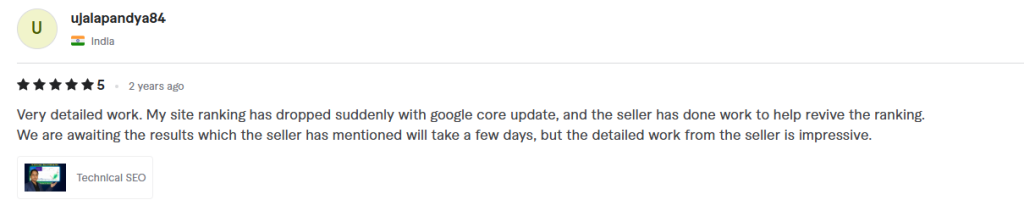




Both platforms work well depending on your situation. If your site was just hit by the March 2026 Core Update and you need a fast diagnosis, a Fiverr gig with a fixed deliverable can get you answers within 48 hours. If you need ongoing recovery management with weekly reporting and continuous optimization, an Upwork retainer gives you more flexibility. I offer both options, and you can view my detailed recovery packages and past case studies at my audit report page.
The 2026 Algorithm Landscape and Why Recovery Demand Is Growing
Google has released three major updates in early 2026 alone: the February 2026 Discover Core Update, the March 2026 Spam Update (completed in under 24 hours), and the March 2026 Core Update starting March 27. This pace of overlapping updates means more sites are experiencing compounded ranking losses that are harder to self-diagnose.
AI Overviews are also reshaping organic click-through rates, with many informational queries now answered directly in Google’s search results. Sites losing traffic to AI Overviews need a different optimization strategy than sites losing traffic to a core update. I cover this in detail in my guide on how to recover traffic lost to Google AI Overviews.
The growing complexity of Google’s ranking systems in 2026 is exactly why algorithm recovery has become a specialized skill. General SEO knowledge is no longer enough to reverse a traffic collapse. You need someone who understands how SpamBrain identifies manipulative link patterns, how the Helpful Content classifier evaluates site-wide content quality, and how core updates compare your pages against competing results on a query-by-query basis.
How to Get Started with Algorithm Recovery?
If your website has experienced a sudden traffic drop that aligns with a confirmed Google update, the first step is getting a professional diagnosis. You do not need to commit to a full recovery engagement upfront. Start with a diagnostic audit to understand exactly what happened, and then decide on next steps.
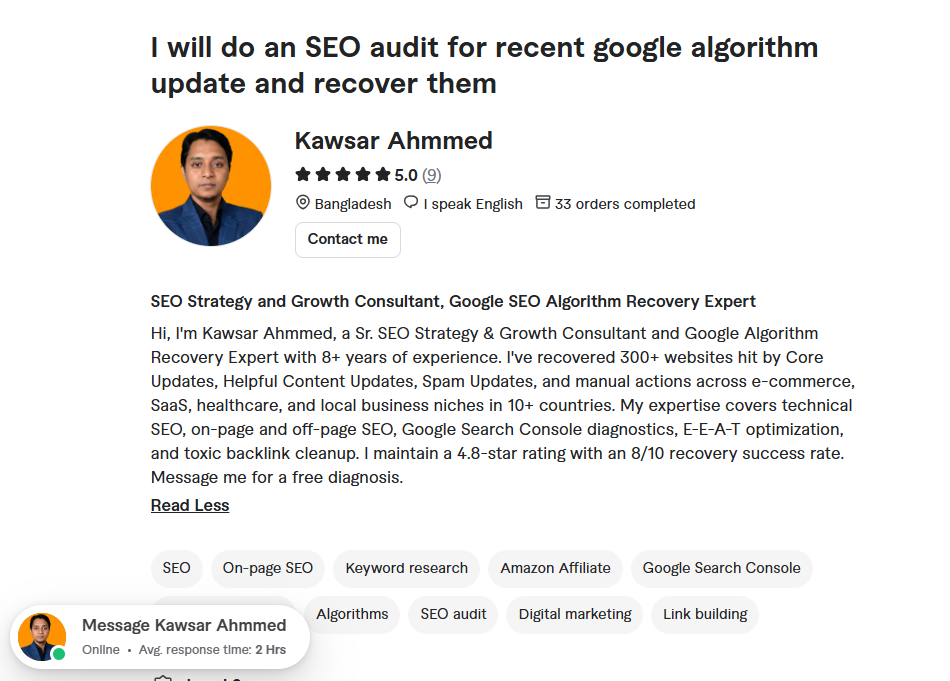
You can reach me through any of these channels:
- Fiverr: fiverr.com/s/vv0bpaA
- Upwork: My Upwork service page
- Website: seoalgorithmrecovery.com
- LinkedIn: linkedin.com/in/kawsarahmmed
- X (Twitter): @kawsarahmmedseo
Was your site hit by a Google algorithm update in 2026? Get a free recovery audit. Contact Kawsar Ahmmed at seoalgorithmrecovery.com to start your diagnosis today.
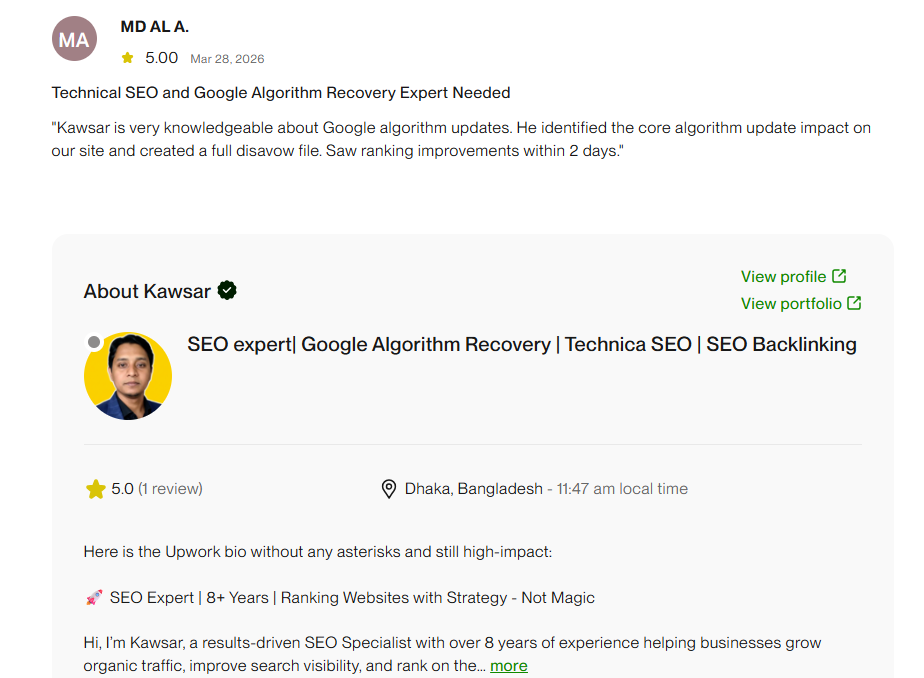
Frequently Asked Questions
How long does algorithm recovery take?
Most recoveries show measurable improvement within 2 to 4 weeks after implementation. Full recovery timelines depend on the severity of the penalty, the number of affected pages, and the next Google update cycle. Some sites recover within one update cycle, while others require sustained optimization across two or three cycles.
Can I recover from a Google core update without hiring a specialist?
It is possible if the issues are straightforward, such as a few thin pages that need expanding. However, when traffic drops exceed 40% or involve multiple update types overlapping, professional diagnosis significantly increases recovery speed and accuracy. My guide on traffic drops after Google updates in 2026 explains the common patterns I see across client sites.
What is the difference between a Fiverr gig and an Upwork retainer for SEO recovery?
A Fiverr gig is ideal for a fixed-scope deliverable such as a penalty diagnosis report or a one-time technical audit. An Upwork retainer suits ongoing recovery work where weekly progress tracking, continuous content optimization, and monthly reporting are required over 30 to 90 days.
Is algorithm recovery the same as regular SEO?
No. Regular SEO focuses on growing rankings for new keywords. Algorithm recovery focuses on diagnosing why existing rankings dropped after a specific Google update and implementing targeted fixes. The skill set, tools, and diagnostic process are different. Recovery requires understanding Google’s ranking systems at a deeper technical level than standard optimization.