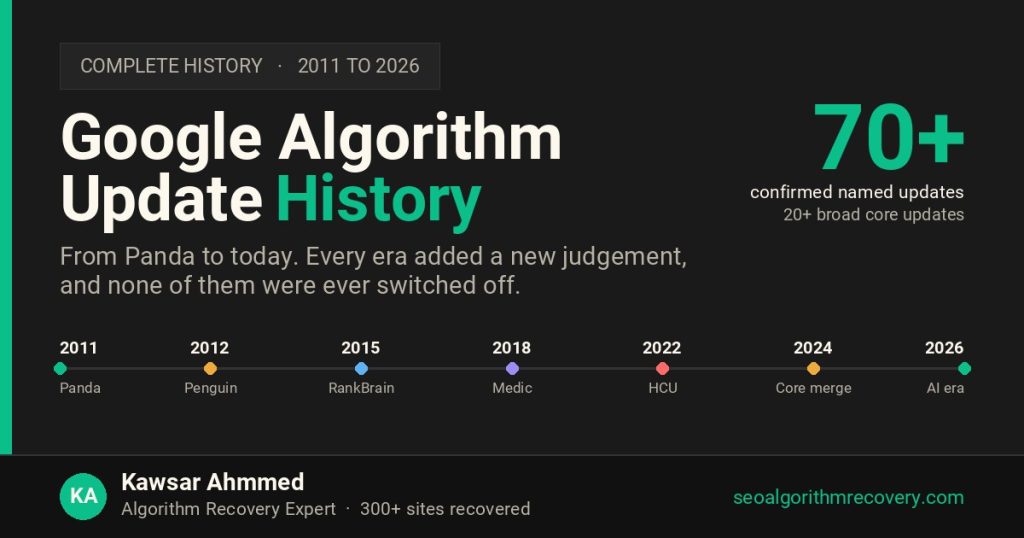
Google has confirmed more than 70 named algorithm updates since Panda launched in February 2011. The pattern across fifteen years is consistent: each generation added a new judgement to the ranking stack rather than replacing what came before. Panda added content quality, Penguin added link trust, Hummingbird and BERT added meaning, the helpful content system added site-level intent, and the 2024 to 2026 updates added scaled content enforcement and AI-era click displacement. Every one of those judgements is still active today, which is why recovery depends on identifying which system moved rather than applying generic quality advice.
Live: every confirmed update since 2020
The chart below is generated from the Google Search Status Dashboard and refreshes twice a day. Each bar is one confirmed update drawn from start to completion, so bar length shows rollout duration. Click any bar for that update’s dates, official rollout log and recovery path. The written history that follows covers 2011 to 2019, which predates the dashboard.
Live rollout chart · synced with Google
Confirmed Google algorithm updates, 2020 to today
Each bar is one confirmed update, drawn from its start date to its completion date. Hover or tap a bar for details, click to open the update page. Source: Google Search Status Dashboard, synced twice daily. Open the full tracker →
2011 to 2013: Google learns to judge content and links
Before 2011, ranking was won largely through keywords and link volume. Three updates in three years ended that, and they established the two questions Google still asks of every page: is this content worth ranking, and did the links pointing at it come honestly.
| Update | Date | What it judged | Measurement (what site owners saw) |
|---|---|---|---|
| Panda | February 2011, then 28 refreshes to 2015 | Content quality, thin and duplicate pages | Site-wide demotion for content farms and scraper sites |
| Penguin | April 2012, then periodic refreshes | Manipulative link building and over-optimised anchors | Sharp drops for sites with paid or directory link profiles |
| Hummingbird | August 2013 | Query meaning rather than keyword matching | Conversational and long-tail queries began returning better results |
What this era taught us about recovery. Panda introduced the concept that still causes the most confusion today: a site-level judgement. Individual pages were not being penalised. The site as a whole was scored, and weak pages dragged strong ones down. That is why pruning works, and it is the direct ancestor of the helpful content system thirteen years later. Penguin taught the opposite lesson about links: recovery required removing or disavowing the manipulation, and it was slow. Both lessons still hold, and both are covered in the content pruning strategy and the backlink audit and disavow guide.
2014 to 2016: local, mobile and machine learning
Search fragmented in this period. Results stopped being one list for everyone and started depending on device, location and inferred intent.
| Update | Date | What it judged | Measurement (what site owners saw) |
|---|---|---|---|
| Pigeon | July 2014 | Local results tied more closely to web ranking signals | Local pack composition changed sharply in many cities |
| Mobile-friendly update | April 2015 | Mobile usability as a ranking signal | Non-responsive sites lost mobile rankings first |
| RankBrain | October 2015 | Machine learning applied to unfamiliar queries | Rankings appeared for concepts never explicitly targeted |
| Penguin 4.0 | September 2016 | Link evaluation moved into the core, in real time | Link recovery stopped waiting for periodic refreshes |
What this era taught us about recovery. Penguin 4.0 is the important one. Before it, a site with a link penalty waited months or years for the next Penguin refresh even after cleaning up. Afterwards, link evaluation ran continuously. That is the reason link and spam recoveries are still faster than core update recoveries today, a distinction explained in how long recovery takes. RankBrain taught something subtler: rankings became less predictable at the individual keyword level, so diagnosing a drop by watching one keyword stopped being reliable.
2017 to 2019: expertise, core updates and language understanding
This is when the modern pattern took shape. Google began naming broad core updates, publishing guidance on them, and applying a visibly higher standard to pages that could affect health, finances or safety.
| Update | Date | What it judged | Measurement (what site owners saw) |
|---|---|---|---|
| Fred (unconfirmed name) | March 2017 | Ad-heavy, thin, revenue-first content | Affiliate and display-ad sites lost heavily |
| Medic core update | August 2018 | Expertise and trust on health, finance and legal pages | YMYL sites without credentials dropped sharply |
| Core updates named and announced | March, June, September 2019 | Broad relevance and quality reassessment | Google began pre-announcing updates on Twitter |
| BERT | October 2019 | Meaning of words in context, including prepositions | Long-tail and question queries returned more precise results |
What this era taught us about recovery. The August 2018 core update is the origin of every E-E-A-T conversation that followed. It demonstrated that for some topics, being accurate is not enough if the reader cannot see who is accountable for the content. Health and finance sites that added credentialed authors, citations and transparent ownership recovered at later core updates. Those that only rewrote the text did not. That distinction is the core of the YMYL recovery guide.
2020 to 2021: page experience, reviews and a crowded calendar
2021 was the busiest confirmed year on record, with eleven updates. Google was adding new specialised systems rather than only tuning the core, and each one judged a narrow slice of the index.
| Update | Date | What it judged | Measurement (what site owners saw) |
|---|---|---|---|
| Three core updates | January, May, December 2020 | Broad quality reassessment | Site-wide movement in each rollout window |
| Passage ranking | February 2021 | Individual passages inside long pages | Deep pages started ranking for specific questions |
| Product reviews system | April 2021 onward | First-hand evidence in review content | Thin affiliate roundups lost, hands-on reviews gained |
| Page experience | June to September 2021 | Core Web Vitals, HTTPS, mobile usability | Small, broad effect acting as a tie-breaker |
| Vicinity local update | November 2021 | Proximity weighting in local results | Map pack positions reshuffled by distance |
What this era taught us about recovery. Specialised systems meant scope became the primary diagnostic signal. If only your review pages dropped, the reviews system moved and rewriting your service pages would waste months. Grouping pages by template before doing anything is the single highest-value diagnostic habit from this period, and it is step three of the first 48 hours checklist.
2022 to 2023: the helpful content era
The August 2022 helpful content update introduced something new: a site-wide classifier that could hold an entire domain down regardless of how good any individual page was. The September 2023 release of the same system produced the most severe and longest-lasting demotions of the decade.
| Update | Date | What it judged | Measurement (what site owners saw) |
|---|---|---|---|
| Helpful content update | August 2022 | Whether a site is built for people or for search engines | First site-wide classifier demotion |
| December 2022 link spam update | December 2022 to January 2023 | SpamBrain applied to link neutralisation | Manipulative links devalued rather than penalised |
| September 2023 helpful content update | September 2023 | Site-level helpfulness, applied harder | Severe, persistent site-wide drops for many publishers |
| Reviews system goes continuous | From late 2023 | Review content, updated without announcements | Google stopped naming individual reviews updates |
What this era taught us about recovery. September 2023 is the update I still see most often in audits, three years later. The lesson was brutal and clear: site-level demotions do not lift because you improved a few pages. They lift when the overall proportion of genuinely useful content changes, which usually means removing or consolidating a lot of it. Sites that pruned aggressively and added first-hand experience recovered at later core updates. Sites that added more content on top of the existing pile did not. The current path is set out in the helpful content recovery guide.
2024: the merge and the spam policy reset
The March 2024 core update ran 45 days, the longest core rollout on record, and it changed the structure of the ranking system rather than just its weights.
- The helpful content system was folded into the core ranking systems. Why: There would be no more standalone helpful content updates. Sites demoted in September 2023 could now only be reassessed during core updates, which redefined every recovery timeline that followed.
- Three new spam policies were published: scaled content abuse, site reputation abuse and expired domain abuse. Why: These replaced the older automatically generated content rules and remain the enforcement standard in 2026. See scaled content abuse recovery.
- AI Overviews launched in the United States in May 2024. Why: This was not an algorithm update, but it began the separation of ranking from traffic that now defines search. A page can hold position one and lose most of its clicks.
- Three further core updates followed in August, November and December 2024. Why: The November and December updates ran only seven days apart, an unusual cadence that made attribution difficult for anyone measuring across both.
2025 to 2026: fewer announcements, more movement
The most important trend of the current era is a divergence. Google confirmed only four updates in 2025, down from eleven in 2021, while measured ranking volatility stayed high. Most changes now ship without a name, which is why a live volatility reading has become as useful as the official announcement list.
| Year | Confirmed updates | Measurement (what changed) | What it meant for site owners |
|---|---|---|---|
| 2021 | Eleven | Peak announcement volume | Most drops could be matched to a named update |
| 2024 | Six | Structural change: helpful content merged into core | Recovery timelines lengthened to core update cycles |
| 2025 | Four | Long gaps, including 147 days between core updates | Unconfirmed volatility became the common experience |
| 2026 | Six so far | First Discover-only update, three spam updates, faster rollouts | Clustered updates made attribution the hardest problem |
Two 2026 developments deserve their own note. The February 2026 Discover core update was the first time Google adjusted Discover recommendations independently of search ranking, which means Discover traffic now has to be diagnosed as its own channel. And in May 2026, Google extended its spam policies to cover attempts to manipulate generative AI responses, putting AI-facing tactics inside the same enforcement perimeter as traditional spam.
Four patterns across fifteen years
Reading the whole history rather than the last update is what makes it useful. Four patterns repeat.
- Systems get absorbed, not retired. Why: Panda became part of core in 2016, Penguin in 2016, helpful content in 2024. Each time, the judgement stayed and only the announcement stopped. Nothing on this page has been switched off.
- Continuous systems recover faster than scheduled ones. Why: Once a system runs in real time, as links did after Penguin 4.0 and spam does today, fixing the cause can show results in weeks. Anything reassessed only during core updates waits months.
- The bar for evidence keeps rising. Why: 2011 rewarded not being thin. 2018 required visible expertise. 2024 required not producing at scale. 2026 rewards genuine first-hand information gain. The direction has never reversed.
- Announcements are shrinking while impact is not. Why: Fewer named updates with steady volatility means date matching alone no longer explains most drops. That is what the seven causes of a drop with no update exists to solve.
How to use this history when your site drops
Find the date your Search Console clicks fell, then check it against the chart above using the date checker tool. If it matches a confirmed update, the update type tells you which system moved and therefore which fix applies. If it does not match, check the volatility sensor for that day, because unconfirmed adjustments are now more common than confirmed ones. For the underlying explanation of how these systems interact, see what the Google algorithm actually is.
Frequently asked questions
How many Google algorithm updates have there been?
Google has confirmed more than 70 named updates since Panda in February 2011, including over 20 broad core updates. It also makes thousands of unannounced changes each year, so the confirmed list is a small fraction of the total.
What was the first Google algorithm update?
Google has adjusted ranking since launch, but Panda in February 2011 was the first update widely named, publicly discussed and confirmed by Google. It targeted thin and low-value content and applied a site-level quality judgement for the first time.
Which Google update had the biggest impact?
By lasting effect, the September 2023 helpful content update and the March 2024 core update. The first produced the most severe site-wide demotions of the decade and the second changed how recovery works by merging the helpful content system into the core ranking systems.
Are Panda and Penguin still running?
Not as separate named systems. Both were absorbed into the core ranking systems in 2016. The judgements they introduced, content quality and link trust, still operate continuously inside core.
How often does Google release a core update?
Historically three or four times a year, though the gaps vary widely. Between March 2024 and May 2026 the interval between core updates ranged from 7 days to 147 days, with an average of about 82 days.
Where can I see the full list of Google algorithm updates?
The live tracker on this site lists every confirmed ranking update since 2020 with start and end dates, synced twice a day with the Google Search Status Dashboard. The dashboard itself is the primary source and covers February 2023 onward.
Still carrying a drop from an update on this page?
Some sites have been down since September 2023 because the original cause was never resolved. Send your Search Console access and within 48 hours I will tell you which system is still holding you down and what it takes to change that. Free, no obligation.
Get free recovery auditSources: Google Search Central announcements and ranking systems documentation; Google Search Status Dashboard incident history from February 2023 onward, synced live on this site; Google Search Central blog posts for the March 2024 core update and spam policy changes; contemporaneous industry reporting for updates predating the dashboard; recovery outcomes from client engagements between 2017 and 2026.